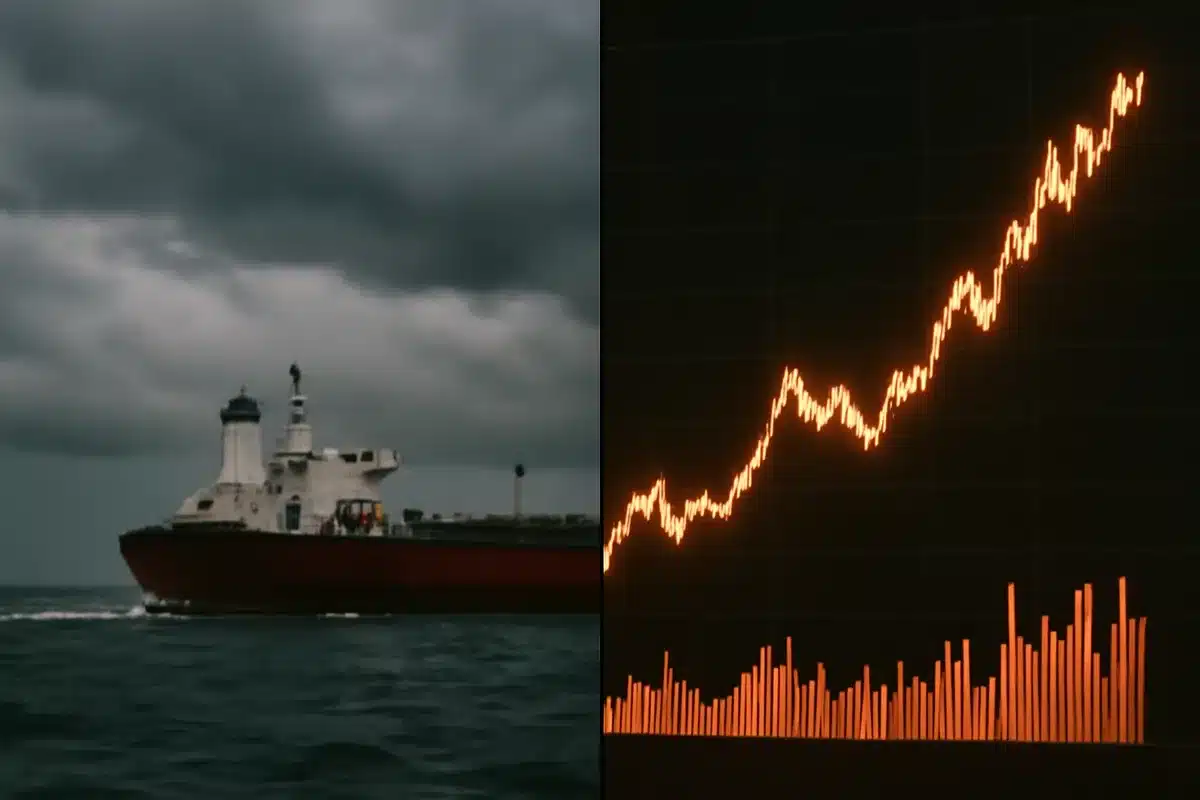
Oil prices have broken through $100 a barrel as U.S.-Iran military tensions escalate in the Middle East, with Brent crude reaching $100.83 on September 9, 2026, driven by fears of further supply disruptions in one of the world’s most critical energy chokepoints.
The surge marks the latest peak in a volatile cycle that began when the U.S. struck three Iranian oil tankers in the Strait of Hormuz on September 7, prompting Iranian retaliation and reigniting concerns about a region that handles roughly 20% of global seaborne oil trade.

Goldman Sachs warned on September 8 that heightened attacks on shipping in the Persian Gulf and Red Sea could push oil prices above $120 a barrel if disruptions intensify, according to Reuters and CBS News.
The Strait of Hormuz has been the focal point of supply concerns throughout 2026, with shipping traffic severely constrained since March when the Iran war began. Recent strikes on tankers have reignited fears that the waterway could face even tighter restrictions, threatening global energy security.
Oil prices have already begun rippling through broader markets. Stock indices fell on the news: the S&P 500 dipped as oil prices surged, while the VIX volatility index jumped 5% on August 31 amid Iran tensions. Gas prices have held near $4.15 a gallon, according to reports from September 9, straining U.S. consumer budgets.
Bond yields also rose sharply, with the 10-year Treasury yield nearing two-decade highs as investors reassessed inflation risks from energy costs. Refinance rates climbed to 7%, adding pressure on borrowers already facing higher mortgage costs.
How the Strait of Hormuz Disruption Drives Oil Markets
The Strait of Hormuz is not merely a shipping lane—it is a critical artery for global energy. Roughly 20% of the world’s oil supply and major liquefied natural gas (LNG) shipments pass through this narrow passage between Iran and Oman.
When the Iran war escalated in late February 2026, military strikes effectively closed the strait to most commercial traffic. According to reporting from March 2026, international oil prices surpassed $100 per barrel for the first time since 2022, driven by fears of production shutdowns and shipping disruptions in the region.
The current escalation—with the U.S. Central Command striking Iranian tankers on September 7 and Iran retaliating with attacks on commercial vessels—has revived those supply-shock fears. A sustained disruption of the Strait of Hormuz would create oil market conditions for which there is no historical precedent, according to a Congressional Research Service report from August 2026.
Analysts have compared the current situation to past energy crises. When Russia invaded Ukraine in February 2022, oil prices spiked sharply, but the disruption was far smaller in scale than a prolonged Hormuz closure. The 1973 Arab oil embargo and the 1979 Iranian Revolution both caused major price shocks, yet neither affected as large a percentage of global supply as a full blockade of the Strait would today.
Market Forecasts and Investor Concerns
Goldman Sachs is not alone in warning of further price escalation. Analysts at the Council on Foreign Relations and Brookings Institution have noted that the conflict has created a supply shortfall larger than those in the 1973 and 1979 oil crises, according to April 2026 reporting.
J.P. Morgan Global Research, however, has offered a more measured forecast: the firm projects Brent crude to average $86 per barrel in the third quarter of 2026, $80 in the fourth quarter, and $78 at year-end. This suggests that if current tensions ease, prices could retreat from current levels.
The divergence in forecasts reflects genuine uncertainty. Energy markets are now pricing in a “war premium”—extra cost to compensate for geopolitical risk. Goldman Sachs estimated in March 2026 that traders demand about $14 more per barrel than they did before the Iran conflict to account for heightened supply disruption risk.
For consumers and businesses, the stakes are direct. Higher oil prices feed into gasoline costs, heating expenses, and production costs across industries. A sustained move to $120 or higher would likely trigger more aggressive Federal Reserve tightening, potentially slowing economic growth and increasing unemployment.
Gas prices have already strained global oil supply, while stock market weakness reflects broader investor anxiety about energy costs and inflation. The Strait of Hormuz tensions continue to escalate, leaving traders and policymakers watching each day for signs of further military action or diplomatic breakthrough.
Sources
- Reuters — confirmed Brent crude prices, Goldman Sachs $120 forecast, tanker strikes, and oil price movements tied to U.S.-Iran tensions
- CBS News — reported Goldman Sachs warning on oil prices and Persian Gulf shipping risks
- MarketWatch — provided current Brent and WTI crude prices as of September 9, 2026
- Bloomberg — supplied live oil price data and market commentary
- Congressional Research Service — detailed analysis of Strait of Hormuz security and unprecedented disruption scenarios
- Brookings Institution — assessed Iran conflict supply disruptions relative to historical oil crises
- Council on Foreign Relations — provided expert analysis on energy security and geopolitical risk
- J.P. Morgan Global Research — issued Brent crude price forecasts for 2026
- LA Times — confirmed oil prices surpassing $100 in March 2026 as baseline for current spike