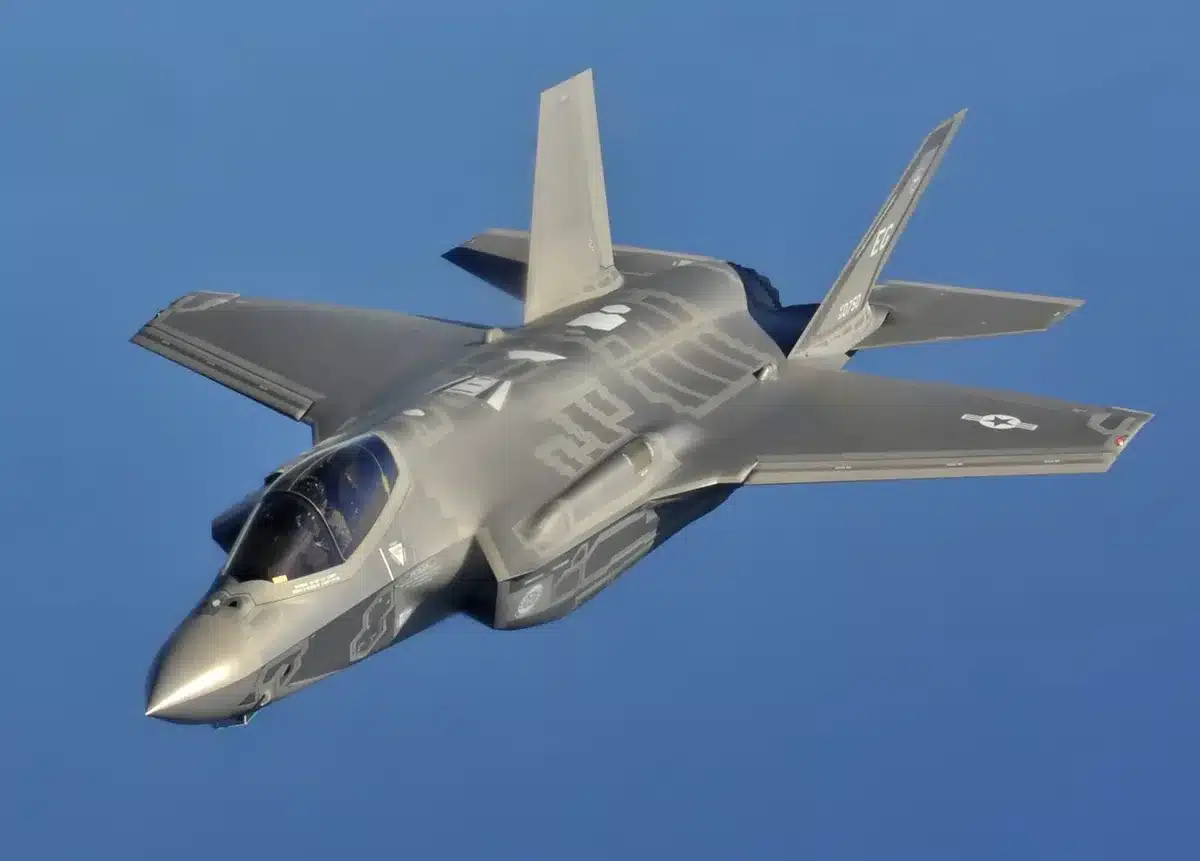
The F-35B Lightning II’s unit cost jumped to $121.4 million for production Lots 18 and 19, representing an 11.4 percent increase from the $109 million price tag of earlier production runs, according to the F-35 Joint Program Office. The short-takeoff and vertical landing variant flown by the Marine Corps is now the most expensive of the three F-35 models, driven by inflation, soaring raw material costs, and persistent supply chain pressures that have battered the program.
The F-35A conventional variant climbed 11.5 percent to $92 million from $82.5 million, while the carrier-based F-35C rose 8.5 percent to $110.8 million from $102.1 million. These are the highest unit costs in the program’s history, with flyaway costs reflecting all basic production expenses including government-furnished equipment such as the F135 engine built by Pratt & Whitney and radar systems supplied by Northrop Grumman.

The Pentagon has blamed inflation, rising prices of raw materials, and supply chain disruptions for the cost spike across Lots 18 and 19, which will deliver 296 aircraft over the next two years under a $24.3 billion contract finalized in September 2025. Lockheed Martin, the program’s prime contractor, acknowledged the pressures in prior statements, with executives warning that keeping the F-35’s price below the rate of inflation would be challenging for these production runs.
The cost increases reflect broader challenges facing the F-35 program beyond unit pricing. The Pentagon’s modernized selected acquisition report, released in August 2026, showed the total estimated acquisition cost for all three variants rising more than 10 percent to $536.2 billion since 2023. Projected buying costs are climbing by over $50 billion across the program’s lifespan due to upgrades, shifts in procurement volumes, and a surge in spare parts aimed at boosting the fleet’s operational readiness.
The F-35B’s higher cost reflects its technical complexity: the variant features a unique swiveling engine nozzle and hovering capabilities that the F-35A, optimized for the Air Force, does not require. The F-35C, used by the Navy and Marine Corps, carries bigger wings for carrier operations and folding wingtips for storage in tight ship spaces, placing it between the A and B variants in production difficulty.
Lockheed Martin and the F-35 Joint Program Office have stated that the increase in price per jet remains below the rate of inflation when adjusted for economic conditions, and that the airframe cost itself is consistent with prior years. However, the gap between inflation-adjusted costs in 2012 dollars and current-year dollars—shown in the Pentagon’s acquisition report—reveals the full weight of price pressures on suppliers. Labor wage inflation, material costs, and supply constraints have created significant financial strain on defense contractors and their subcontractors feeding the F-35 supply chain.
The cost trajectory echoes prior warnings from defense officials. In July 2024, Greg Ulmer, then-president of Lockheed Martin Aeronautics, told Defense One that keeping the F-35’s price stable would be difficult, citing rising raw material and labor costs. The program has also faced setbacks tied to modernization efforts: Block 4 upgrades—intended to add new computing power, weapons, and sensor fusion capabilities—are years behind schedule and over budget, while delays in delivering upgraded radars have forced the Pentagon to accept new aircraft without the nose-mounted sensor in some cases.
A total of 20 customers globally, including the United States, are on contract for the F-35. International buyers, who largely procure the F-35A variant, face the same cost pressures as U.S. services, and rising prices have sparked disputes with some partners; Switzerland trimmed its F-35 order by six aircraft in March 2026 in response to cost increases and delays. The program’s total lifecycle cost—encompassing acquisition and sustainment through 2088—is now projected to remain beneath $2 trillion after briefly exceeding that threshold in 2024, though sustainment costs have climbed 44 percent since 2018, from $1.1 trillion to $1.58 trillion.
Sources
- Breaking Defense — confirmed F-35B cost increase to $121.4 million, cited inflation and supply chain issues as drivers
- Air & Space Forces Magazine — reported cost figures for all three F-35 variants in Lots 18 and 19, included expert commentary from Lockheed Martin and JPO
- F-35 Joint Program Office — provided official unit cost figures and flyaway cost definitions
- Pentagon Modernized Selected Acquisition Report (August 2026) — detailed total acquisition cost growth and program-wide cost drivers