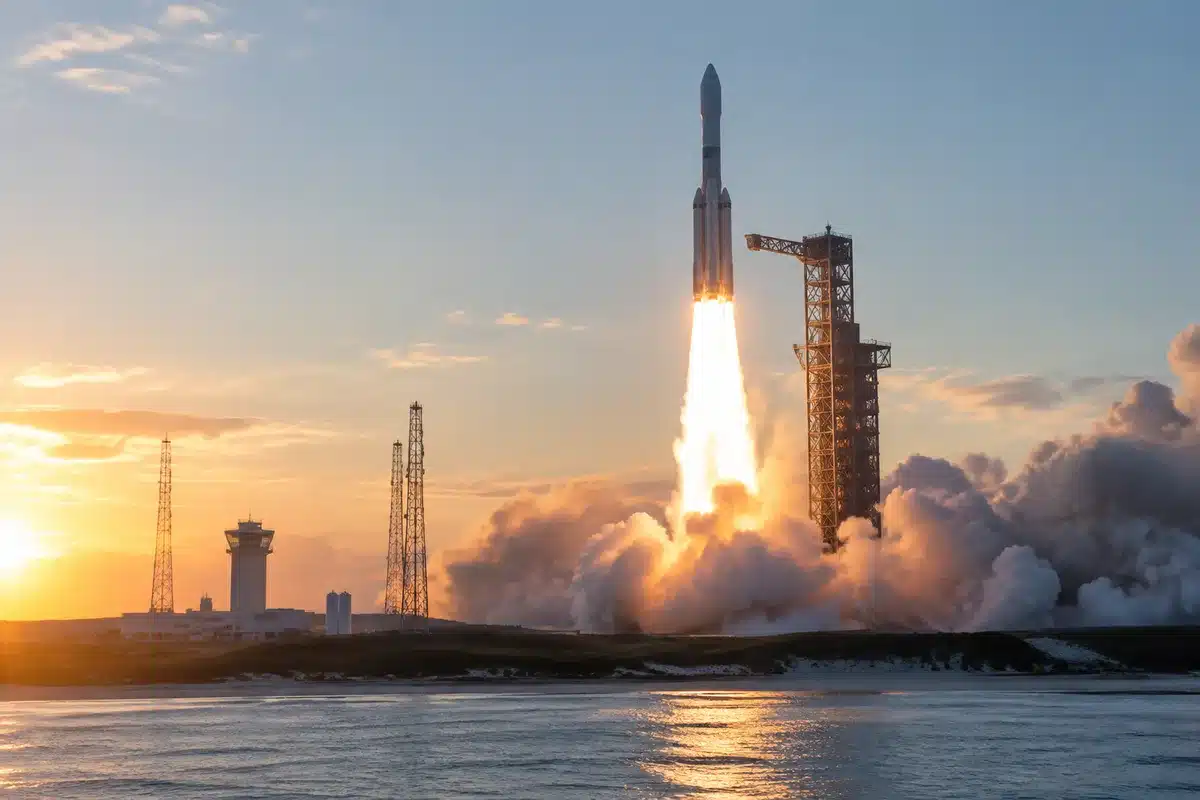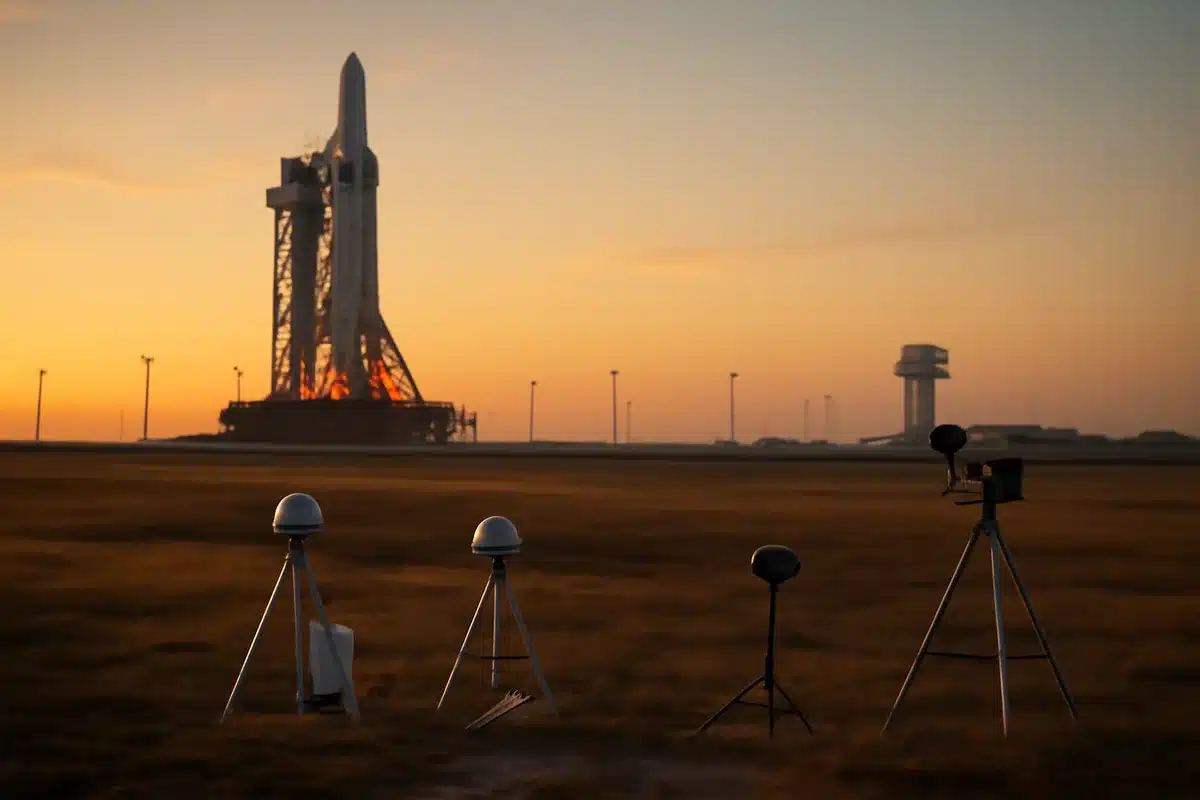
Researchers at Sandia National Laboratories have used infrasound data to demonstrate how Blue Origin’s Cape Canaveral test blast propagated sound waves across 1,700 kilometers—roughly 1,000 miles—revealing new capabilities for monitoring rocket launch anomalies. When the New Glenn rocket exploded during a static fire test on May 28, 2026, the explosion generated low-frequency sound waves below the range of human hearing that traveled far beyond the launch site at Cape Canaveral Space Force Station.
Scientists Elizabeth Silber and Logan Scamfer analyzed infrasound signals from 36 broadband microbarometers positioned at regional stations around Cape Canaveral, some up to 1,700 kilometers away, to independently confirm the time and location of the explosion. They published their findings in The Seismic Record, a peer-reviewed journal of the Seismological Society of America.

The team calculated the explosion’s yield at 0.131 kilotons TNT-equivalent. According to Silber, the amount of fuel aboard the New Glenn at the time was not publicly known, but researchers compared their yield estimate to plausible scenarios of the rocket’s chemical-energy reserves, finding that between 3 and 6 percent of available chemical energy was expressed in the rapid pressure-producing blast.
Infrasound—sound below 20 Hz—has long been used to detect large explosions and energetic atmospheric events. The Comprehensive Nuclear-Test-Ban Treaty Organization employs infrasound as a primary monitoring technique to detect nuclear test explosions. Silber emphasized the rarity of studying a full launch vehicle-scale event involving liquid methane rocket fuel. “Full launch vehicle-scale observations involving cryogenic fuels, specifically liquid oxygen and liquid methane, are still very, very limited,” she said in a statement published by the Seismological Society of America. “Most existing information comes from much smaller experiments or historical tests involving different propellant systems.”
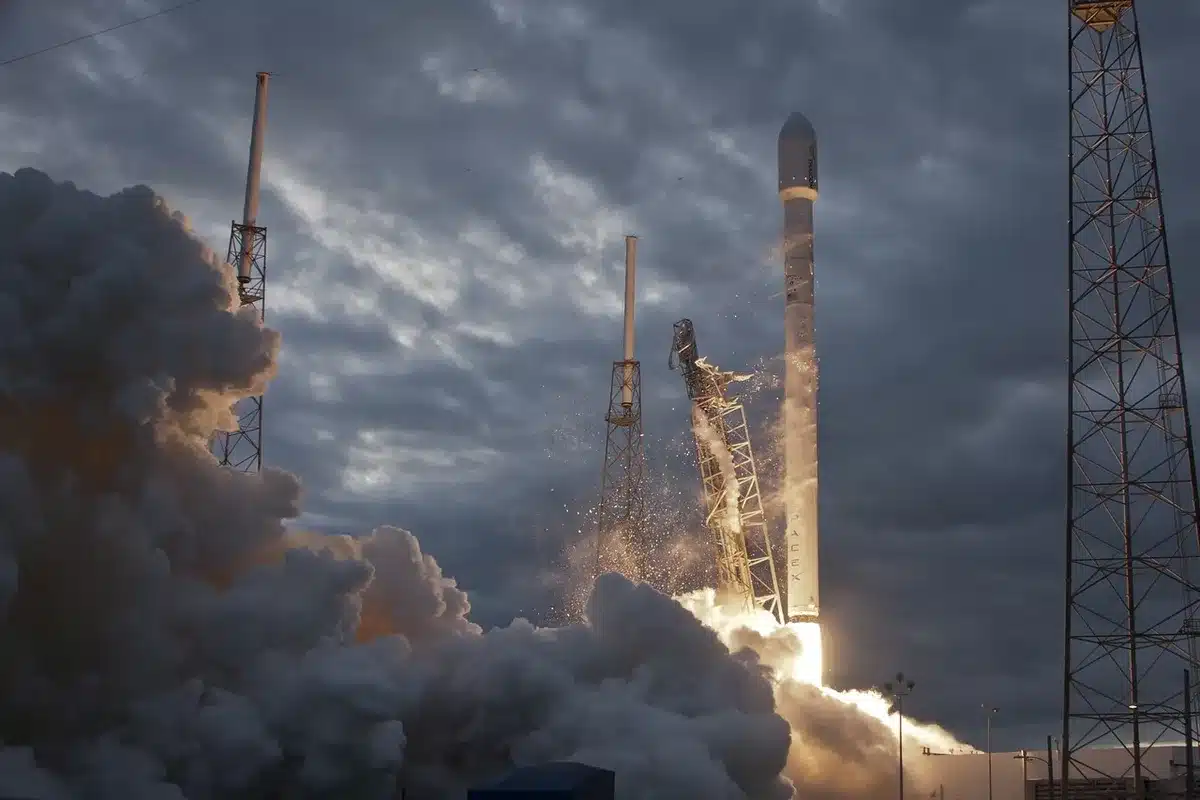
The infrasound method proved effective because the explosion created a rapid pressure pulse that propagated through the atmosphere as low-frequency waves. Silber noted that in large propellant accidents, fuel and oxidizer do not necessarily mix and react all at once—some material contributes to the initial blast while other material burns more gradually in the fireball and plume. “So what we found is kind of consistent with previous liquid propellant experiments,” she said.
The study demonstrates practical applications for infrasound analysis beyond academic interest. Silber and colleagues have previously used infrasound to track the reentry of the sample return capsule from NASA’s OSIRIS-Rex robotic space mission and to detect successful Blue Origin rocket launches from a stratospheric solar hot air balloon in 2021. The technique can detect various “impulsive events,” including meteoroids, ocean waves, industrial accidents, and mining explosions.
Blue Origin’s investigation into the explosion’s cause concluded in early August that a faulty main oxygen valve on one of the rocket’s BE-4 engines triggered the accident. The company’s CEO Dave Limp identified the anomaly as originating at the main oxygen valve on one of the seven BE-4 engines powering the New Glenn. The New Glenn had completed three successful missions before the May 28 test.
Sources
- Seismological Society of America — Announcement of Silber and Scamfer’s infrasound study on the New Glenn explosion, published September 1, 2026, with direct quotes from Elizabeth Silber on the rarity of liquid methane observations and propellant behavior.
- The Seismic Record — Peer-reviewed study by Elizabeth A. Silber and Logan T. Scamfer analyzing regional infrasound from 36 microbarometer stations, confirming explosion time and location, and estimating yield at 0.131 kilotons TNT-equivalent.
- Space.com — August 6, 2026 report on Blue Origin CEO Dave Limp’s identification of the faulty main oxygen valve on a BE-4 engine as the cause of the New Glenn explosion.
- SpaceNews — August 5, 2026 report confirming the explosion was traced to a valve in the rocket’s BE-4 engine during the static-fire test in May.
- CNN, NPR, CNBC, BBC, PBS NewsHour — Multiple outlets reporting on the May 28, 2026 New Glenn explosion during the static fire test at Cape Canaveral, with no injuries reported.