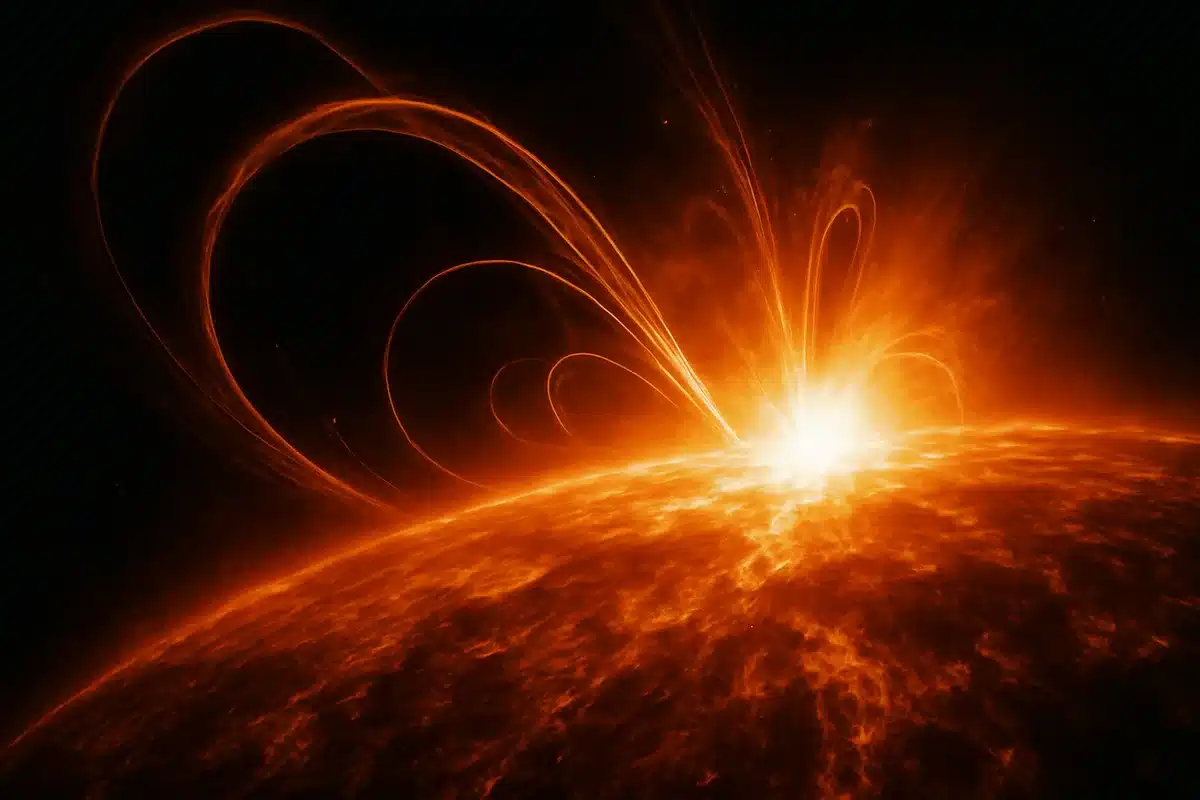
Solar activity has surged to moderate levels as a returning sunspot region fires M-class solar flares in early September 2026, continuing a pattern of intense eruptions even as Solar Cycle 25 enters its declining phase.
Sunspot AR4513, which was particularly active in late August, unleashed multiple M-class flares including an M6.9-class eruption on August 25 that triggered a coronal mass ejection (CME) headed toward Earth. The region has rotated back into view, and new M-class flares are being detected as solar activity remains elevated.
M-class flares rank as the second-strongest category of solar eruptions, below only the most powerful X-class events. These flares ionize the upper atmosphere and can cause brief disruptions to shortwave radio communications on Earth’s sunlit side. More severe eruptions can also affect satellite operations and navigation systems that depend on precise signals.
Solar Cycle 25, which began in 2019, reached its maximum in 2024 and 2025 with more intense activity than scientists initially predicted. The cycle has now entered a declining phase, according to space weather forecasters, though significant flare activity can still occur during this period. The current surge in M-class flares demonstrates that even as the overall cycle weakens, individual sunspot regions remain capable of producing substantial eruptions.
The most intense geomagnetic storm on record was the Carrington Event of September 1–2, 1859, which disrupted telegraph systems globally and produced auroras visible as far south as the tropics. According to NOAA, storms of that magnitude occur roughly once every 500 years, while storms about half as intense happen approximately every 50 years.

Current solar activity poses no immediate widespread threat to modern infrastructure, but space weather agencies continue monitoring sunspot regions for potential impacts on communications, power distribution, and satellite-dependent services. The M-class flare activity from AR4513 earlier in August demonstrated how returning active regions can produce renewed bursts of energy as they rotate back into Earth-facing positions.
Sources
- EarthSky — September 2026 solar activity reports showing M-class flare eruptions from active regions
- Space.com — August 26, 2026 report on M6.9 solar flare from AR4513 and CME forecast
- NASA — Information on solar flare impacts to radio communications, satellites, and navigation systems
- NOAA — Carrington Event precedent and frequency of extreme geomagnetic storms
- USA Today — August 26, 2026 reporting on M-class flare classification and solar activity