A new analysis by the Committee for a Responsible Federal Budget shows that repealing taxes on Social Security benefits would accelerate the program’s insolvency from 2032 to 2031, and push Medicare’s hospital fund into insolvency four years earlier than projected. The finding underscores a central tension in the ongoing Social Security policy debate: while some politicians have called for eliminating benefit taxation to provide relief to retirees, such a move would worsen the very solvency crisis the program faces.
The Congressional Budget Office released its analysis last week, examining how the current system of taxing Social Security benefits works. CRFB’s accompanying paper, published in July, analyzed the implications of repealing that taxation and explored alternatives.

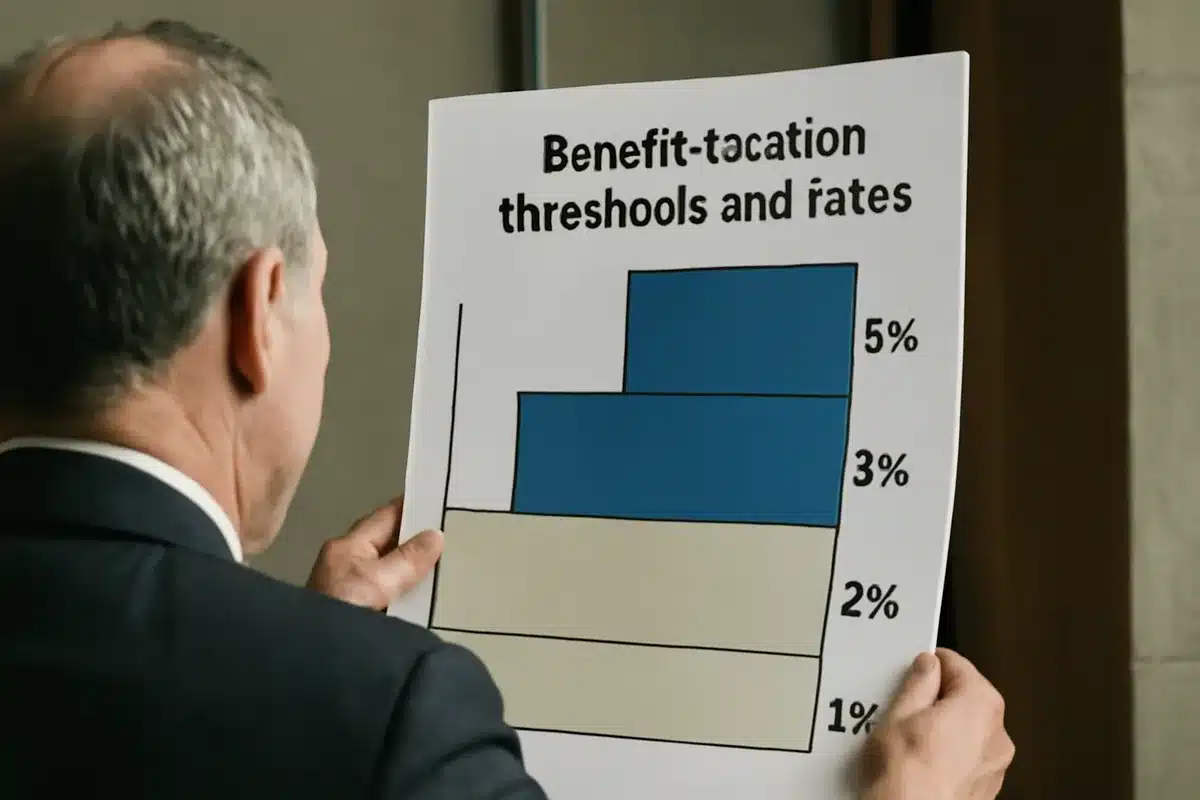
Currently, Social Security benefits are partially subject to income tax based on a three-tier system. Depending on a retiree’s household income, anywhere from 0% to 85% of benefits can be counted as taxable income. Revenue from taxation of the first 50% of benefits goes to the Social Security trust fund, while revenue from the next 35% is credited to Medicare’s Hospital Insurance fund. In 2025, this taxation generated $99 billion—representing 5% of the dedicated revenue that funds both programs, according to CRFB’s analysis.
The solvency implications of full repeal are substantial. If benefit taxation were eliminated entirely, Social Security’s 75-year solvency gap would widen from 4.4% to 5.3% of payroll—a one-fifth increase in the shortfall. Medicare’s Hospital Insurance fund would fare worse: its long-term gap would double from 0.6% to 1.2% of payroll, according to CRFB.
The analysis comes as Social Security already faces a critical deadline. The program’s retirement trust fund is projected to be depleted in 2032, at which point all beneficiaries would face an automatic benefit cut unless Congress acts. The current system of benefit taxation, established in 1984 and expanded in 1993, was designed to improve “tax neutrality” by treating Social Security income more like other retirement income while also serving as a form of means-testing for higher-income beneficiaries.
However, CRFB’s analysis identifies significant flaws in the current approach. The three-tier taxation structure creates very high effective marginal tax rates during the phase-in—in some cases exceeding 50%—which research shows discourages work among older workers. The system is also complex and confusing, with multiple income thresholds ($25,000, $32,000, $34,000, and $44,000) that can surprise seniors with unexpected tax bills.

Alternative Approaches to Reform
Rather than repealing benefit taxation entirely, CRFB’s paper proposes 18 different reform options that could address the system’s flaws while improving solvency. One approach would simplify the current system by establishing a single income threshold—such as $50,000 for single filers and $100,000 for couples—above which 85% of benefits would be taxed. Another option would rationalize the formula by counting 85% of all benefits as income while establishing a deduction to address concerns about lower-income retirees.
More aggressive options include taxing 90% or even 93% of all benefits, which CRFB argues would maximize tax neutrality on average while maintaining progressivity through the existing income tax schedule. The paper also explores automatic withholding of taxes from benefit payments, which could reduce the surprise tax bills that currently confuse many seniors and may lead to unpaid taxes.
CRFB emphasizes that expanding or reforming benefit taxation could actually improve both efficiency and fairness while raising new revenue. By removing the income-based phase-in that creates high marginal rates, policymakers could encourage work among older Americans—a goal that repealing taxation entirely would undermine.
The debate over benefit taxation sits within a broader Social Security policy discussion as the program approaches its solvency crisis. Recent legislation, including the One Big Beautiful Bill Act, reduced—but did not eliminate—taxation of benefits for many seniors through a temporary $6,000 bonus deduction for those age 65 and older. That deduction is set to expire in 2029.
Sources
- Committee for a Responsible Federal Budget — analysis of Social Security benefit taxation, implications of repeal, and 18 policy reform options
- Congressional Budget Office — report on the current system of taxing Social Security benefits and effects of repeal
- Social Security Administration — historical context on benefit taxation system established in 1984 and expanded in 1993