The James Webb Space Telescope has completed one of the largest planet-formation studies to date, observing 72 young sun-like stars and revealing that planets face a critical race against time to form before the gas that builds them vanishes. The research, led by Naman Bajaj of the University of Arizona’s Lunar and Planetary Laboratory and published in The Astronomical Journal, shows how different mechanisms expel gas from planet-forming disks at different stages of a system’s early life.
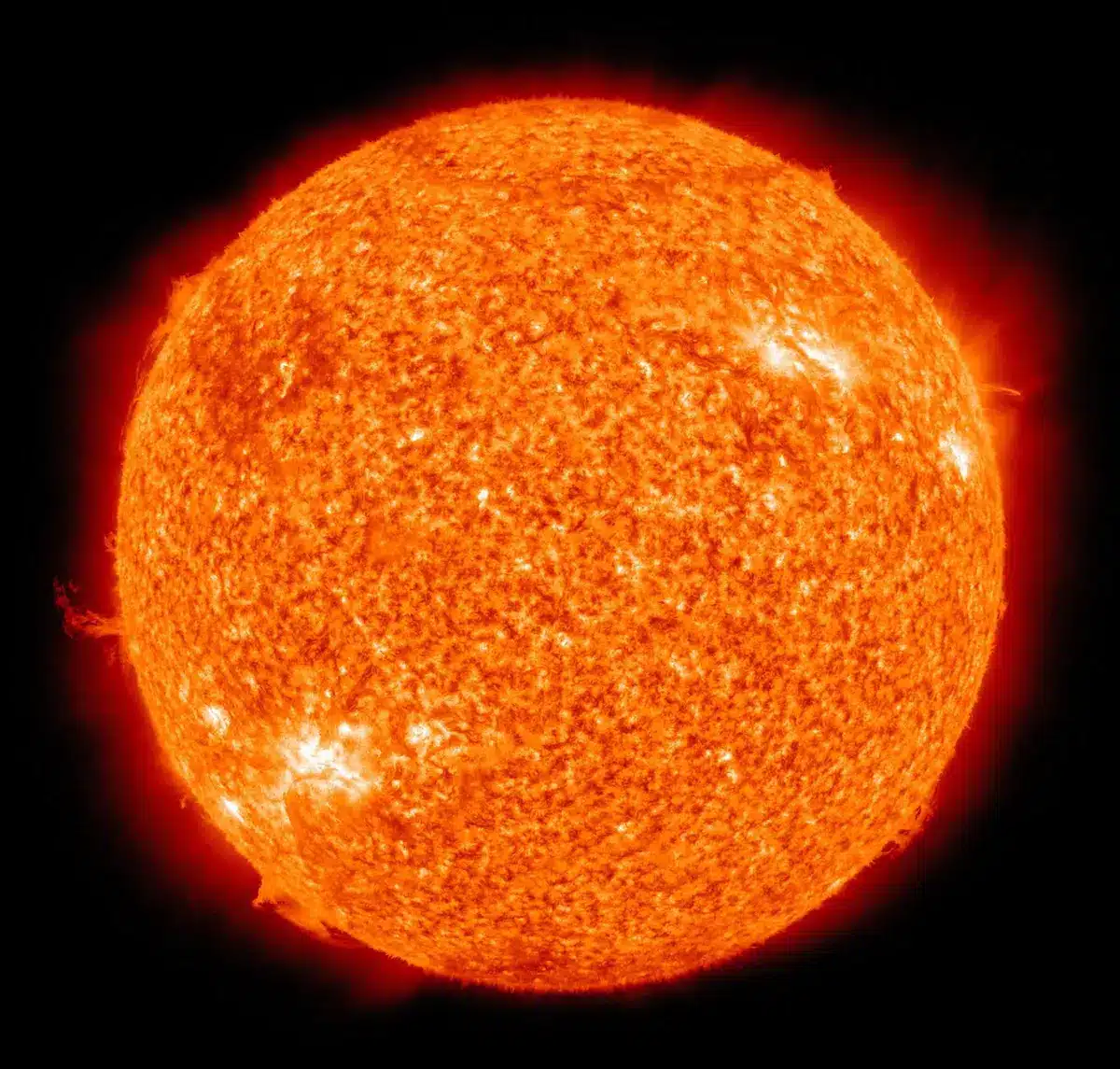
Planets form within rotating disks of gas and dust surrounding young stars, but this raw material does not persist forever. In our own solar system’s first few million years, the sun was surrounded by a protoplanetary disk containing about 100 times more gas than dust—most of which eventually vanished. Understanding how and when this dispersal occurs is crucial because giant planets like Jupiter require substantial gas to build their massive atmospheres.
Using archival data from NASA’s James Webb Space Telescope’s Mid-Infrared Instrument, Bajaj’s team examined 72 systems at different evolutionary stages, effectively creating a timeline of gas loss. The researchers traced two key gases: molecular hydrogen, the most abundant molecule in protoplanetary disks, and ionized neon. The findings revealed extended emissions from these gases in 66 of the 72 disks, with conical molecular hydrogen winds visible in 46 systems and fast-moving neon jets in 40.
Two Stages of Gas Loss
The study confirms that planetary systems undergo a dramatic shift in how they lose gas. Early in a system’s life, strong jets and broad winds driven by magnetic fields dominate, carrying material away at 10 to 100 miles per second. These magnetically driven outflows are so powerful they block high-energy X-ray photons from reaching the disk, preventing certain chemical processes.
After a few million years, these magnetic winds weaken. At that point, photoevaporative winds—driven by high-energy radiation from the star itself—become the dominant force. Unlike the vigorous early phase, photoevaporation quietly erodes what remains of the disk as ultraviolet and X-ray radiation heats the gas until it escapes. “After a few million years, the jets disappear and the molecular winds fade, leaving behind only gentler atomic winds that quietly erode what remains,” Bajaj said in a statement.
This transition directly shapes planetary formation outcomes. As Bajaj explained, “Gas giants like Jupiter must assemble their massive atmospheres while the disk is still substantial enough to supply them, before winds and jets carry that raw material away into space.” The window for building these massive worlds is finite—typically just the first 10 million years of a system’s existence.
The research builds on theoretical predictions made in 2020 by co-author Ilaria Pascucci, a professor at the University of Arizona’s Lunar and Planetary Laboratory, who predicted the existence of molecular winds strong enough to block X-rays. This new study confirms those predictions by directly observing molecular hydrogen for the first time across dozens of young systems. The findings show that no single process controls disk dispersal; instead, planetary systems progress through distinct phases, each removing material through different physical mechanisms.
The team plans next to measure exactly how much gas mass is lost over time and determine the precise distances from the star where gas launches from the disk. These measurements could reveal where different types of planets—from rocky worlds to gas giants—can successfully form before their window of opportunity closes.
Sources
- Phys.org — the core study findings, quotes from Uma Gorti (SETI Institute) and Naman Bajaj on the race against time, details on molecular hydrogen and neon observations
- University of Arizona News — additional quotes from Bajaj, details on the two mechanisms and their timescales, the 2020 Pascucci prediction, and the visual description of the images
- The Astronomical Journal — publication details and DOI for the peer-reviewed paper