Update (Aug 24): Scientists have discovered evidence of water inside green glass beads collected by Apollo 15 astronauts in 1971, a finding made more than 35 years after the mission that reveals new insights into the lunar interior.
Apollo 15 marked its 55th anniversary on July 26, 2026, commemorating one of NASA’s most groundbreaking lunar missions and the first of the ambitious “J” missions that dramatically expanded scientific exploration on the Moon.
At 9:34 a.m. EDT on July 26, 1971, astronauts David Scott, Alfred Worden, and James Irwin lifted off from Kennedy Space Center aboard a Saturn V rocket, beginning a mission that redefined what was possible during human exploration of the lunar surface.
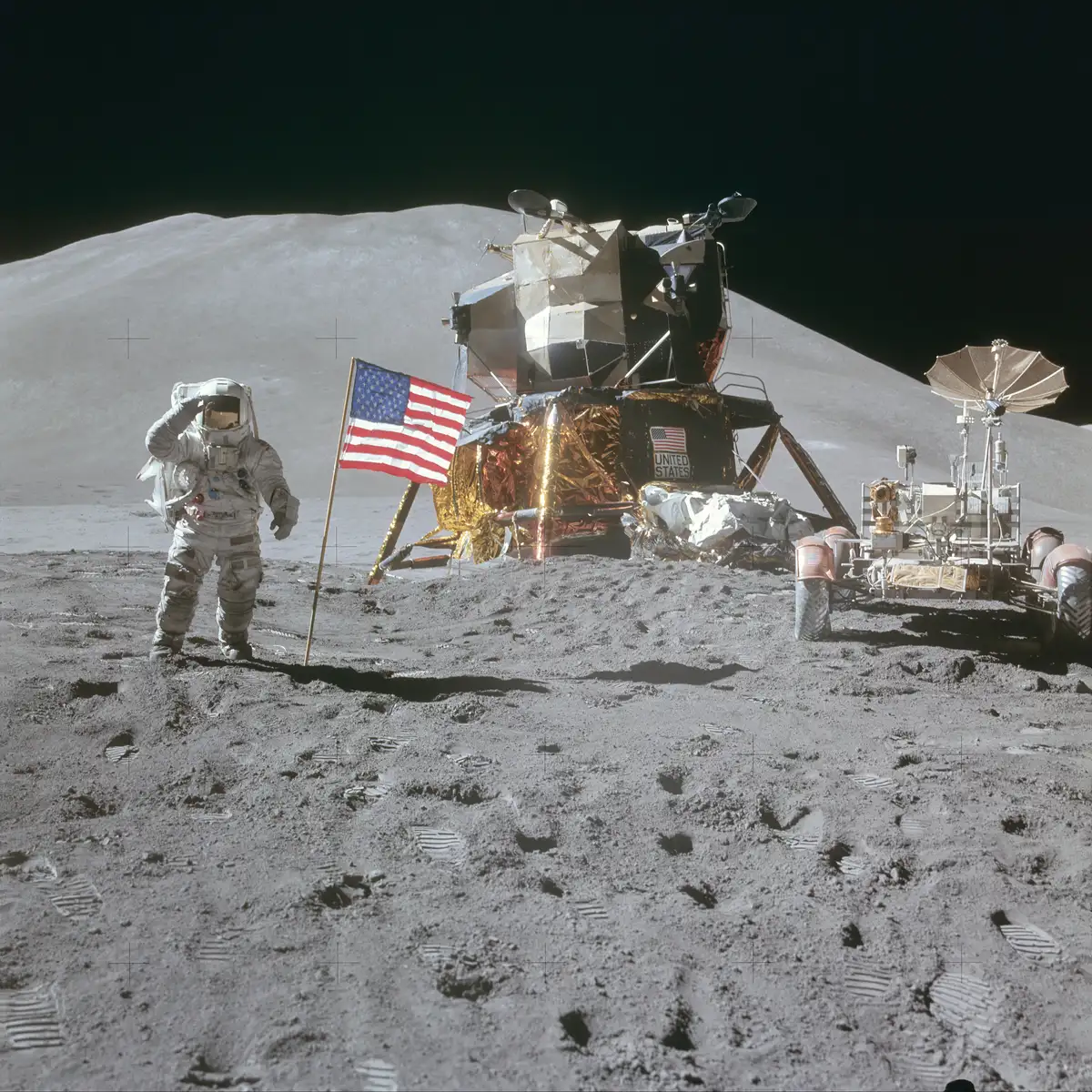
Apollo 15 introduced several major firsts for the Apollo program. Most notably, it carried the Lunar Roving Vehicle (LRV)—the first electric rover used on the Moon. The battery-powered four-wheeled vehicle allowed astronauts to travel much farther from their landing site than any previous crew, significantly increasing the amount of scientific research and lunar samples collected.
The mission marked the first time astronauts remained on the lunar surface for three full days, giving them more time to conduct experiments, deploy scientific instruments, and explore the Moon’s rugged Hadley-Apennine region. Scott and Irwin spent a total of 67 hours on the Moon and performed three extra-vehicular activities (EVAs, or “moonwalks”), totaling 18 hours and 35 minutes.
While Scott and Irwin explored the Moon, Command Module Pilot Worden remained in lunar orbit, conducting observations and experiments before reuniting with the crew for the journey home. The extended stay and greater mobility ushered in a new chapter of lunar exploration, focusing heavily on geology and scientific discovery.
More than five decades later, Apollo 15’s legacy continues to influence NASA’s plans for returning humans to the Moon. Under the Artemis program, astronauts are preparing for even longer stays on the lunar surface. Artemis IV, currently targeted for 2028, is expected to send astronauts to the Moon’s south polar region, where they will spend about one week conducting science, testing new technologies, and preparing for future human missions to Mars. Apollo 15 demonstrated that astronauts could live and work on the Moon for extended periods while exploring vast stretches of the lunar landscape, laying the foundation for the next generation of lunar exploration.
Sources
- Space Coast Daily — Apollo 15 launch date, crew names, mission duration on lunar surface, Hadley-Apennine landing site, LRV introduction, EVA duration, and Artemis IV plans
- NASA — Apollo 15 as first “J” mission with longer stay time and greater surface mobility
- Lunar and Planetary Institute — EVA duration (18 hours 35 minutes) and total lunar surface time (67 hours)