The U.S. Navy has developed a submarine torpedo tube drone system that launches and recovers unmanned underwater vehicles through existing submarine tubes without requiring divers or surfacing, significantly extending the stealth and operational range of attack submarines.
Huntington Ingalls Industries (HII) integrated Woods Hole Oceanographic Institution’s Yellow Moray docking technology into its REMUS 620 medium unmanned undersea vehicle (UUV), achieving the first successful recovery of the drone into a Virginia-class submarine torpedo tube test fixture in October 2025 at Seneca Lake, New York. The feat occurred less than seven months after the two organizations began collaboration.
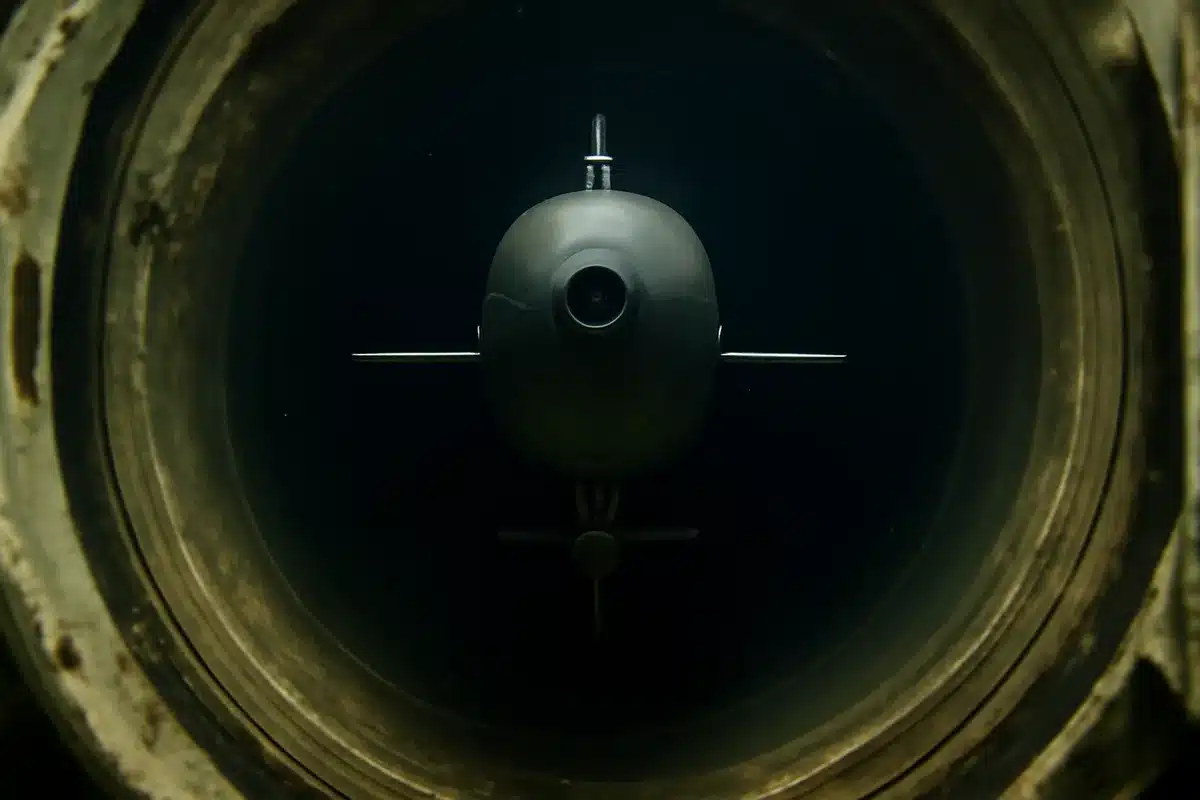
The REMUS 620 measures 12.75 inches in diameter and must fit precisely into a 21-inch torpedo tube designed to hold Mark 48 torpedoes, leaving only about four inches of water on each side. The drone autonomously navigates into a shock and fire enclosure capsule (SAFECAP) positioned inside the tube, then backs out through a reverse swimout maneuver without turning around—a sequence performed entirely underwater in darkness without human control.
In April 2026, the Defense Innovation Unit awarded HII a contract to deliver the Torpedo Tube Launch and Recovery (TTLR) system for operational deployment on U.S. Navy submarines. The system enables submarines to deploy and recover autonomous drones while remaining submerged and covert, eliminating the need for surface operations or diver assistance that would compromise stealth.
The REMUS 620 offers endurance up to 110 hours and a range of 275 nautical miles in its maximum battery configuration, though that extended range comes at a cost: the three-battery version stretches to 169 inches long and weighs 719 pounds, compared to 105 inches and 414 pounds for the single-battery variant. The vehicle operates at depths to 600 meters, exceeding the Virginia-class submarine’s published test depth of greater than 800 feet, allowing it to work in waters deeper than its host platform.
Navigation relies on an iXblue inertial navigation system paired with GPS, long-baseline positioning, and Doppler-aided dead reckoning—a redundant approach necessary because the inertial system alone accumulates roughly 250 meters of drift over a full mission, too much error to reliably find a 21-inch hole in the dark. A WHOI acoustic modem enables communication with the submarine during the recovery approach.
The capability extends the U.S. Navy’s reach in intelligence, surveillance, and reconnaissance (ISR), mine warfare, and seabed operations while preserving the submarine’s acoustic signature and tactical position. According to HII, the system “keeps stealth intact” by enabling drones to be launched and recovered without the submarine surfacing or maneuvering to deploy divers.
The REMUS 620 can also serve as a host platform, launching and recovering smaller autonomous vehicles or payloads from underwater—a capability that gives submarines the ability to deploy multiple drone systems in a single mission. The vehicle can be deployed from surface ships, amphibious vessels, and helicopters as well, making it part of a broader Navy effort to integrate crewed and unmanned platforms into a coordinated, distributed network.
Prior to the REMUS 620 breakthrough, the Navy’s Yellow Moray UUV, a variant of HII’s REMUS 600, completed the first forward-deployed launch and recovery from the USS Delaware (SSN 791) off Norway in May 2025. That at-sea success with an earlier generation vehicle validated the concept before the 620 was tested at Seneca Lake against a stationary fixture rather than an operational submarine.
HII’s unmanned systems division reported the REMUS program as its fastest-growing business unit in the second quarter of 2026, though absolute revenue remains modest within the company’s broader portfolio. The firm announced plans to invest in unmanned production capacity in the second half of the year, signaling confidence in future demand for submarine-launched drone systems.
Sources
- HII — REMUS 620 first torpedo tube recovery in October 2025, Yellow Moray integration, and April 2026 DIU contract award
- Autonocion — Technical specifications of the REMUS 620, torpedo tube dimensions, battery configurations, and navigation systems
- Workboat — Joint team achievement and Yellow Moray torpedo tube launch and recovery technology
- Naval News — REMUS 620 validation for torpedo tube deployment and SAFECAP compatibility testing
- The Defense Post — HII contract for submarine torpedo tube drone launch and recovery system