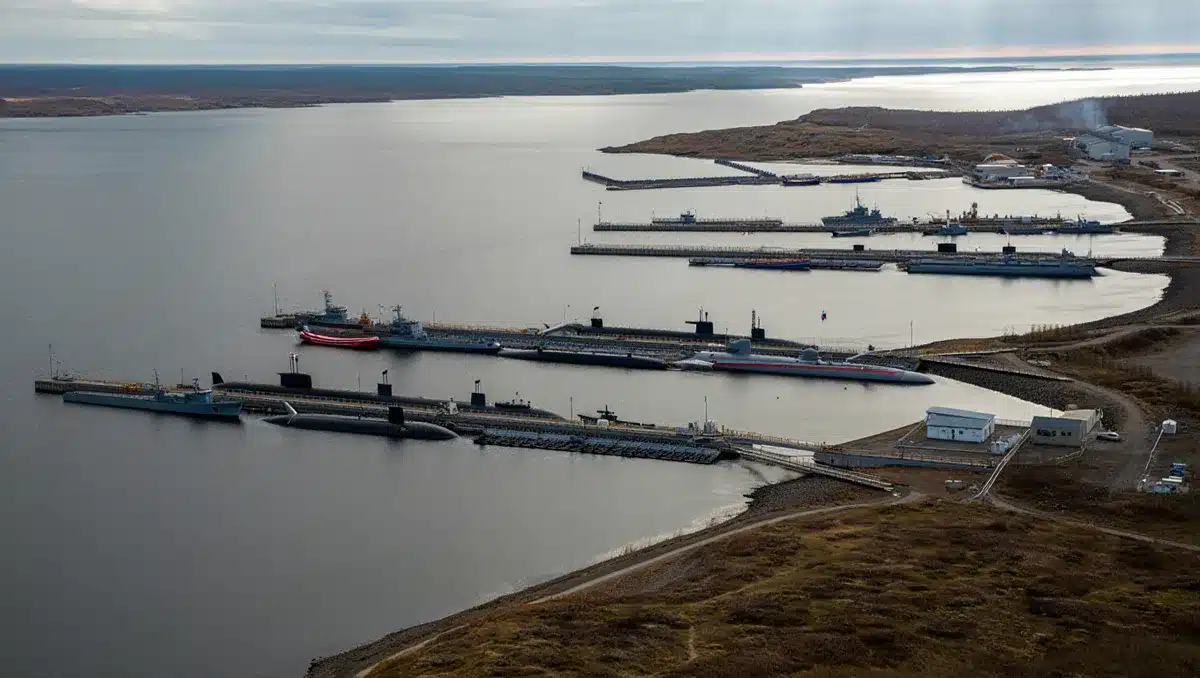
Russia has expanded its use of anti-drone netting at a major naval hub on the Pacific Ocean, with satellite imagery showing more than half a dozen submarines covered by protective nets at the Rybachiy nuclear submarine base on Kamchatka Peninsula, located more than 4,500 miles east of Ukraine. The expansion, captured by US spatial intelligence firm Vantor on August 6, 2026, marks a striking increase from May, when only two submarines were protected by the netting.
The base serves as the central hub for Russia’s Pacific Fleet and hosts Borei-class nuclear-powered ballistic missile submarines, which are among the most heavily armed warships in the world. Each carries 16 RSM-56 Bulava submarine-launched intercontinental ballistic missiles equipped with multiple independently targetable nuclear warheads. The fact that Russia is fortifying these vessels at port—thousands of miles from active fighting—signals deep concern about the expanding reach of Ukrainian drone capabilities.
Submarines are designed primarily to survive by remaining undetected at sea, not by absorbing attacks while sitting in port. Once moored at a pier, their enormous size and predictable location make them substantially more vulnerable to unmanned systems. Britain’s defense ministry said in an intelligence update on August 6 that the counter-drone cages and netting Russia has deployed were “applied as a preventive measure in response to Ukraine’s increased ability to strike targets further from the front line.”
Ukraine has repeatedly demonstrated the reach of its drone arsenal. In Operation Spiderweb on June 1, 2025, Ukrainian forces launched 117 drones from deep inside Russia itself, targeting strategic bombers at airbases thousands of kilometers behind the front lines in the Arctic and Siberia. In December 2025, Ukraine’s Security Service deployed underwater drones to attack the Novorossiysk naval base, disabling a Kilo-class submarine in what officials described as the first underwater drone strike against a naval vessel in history.

Russia has extended similar defenses elsewhere. Satellite imagery from June 2026 shows that Russia equipped at least three submarines with counter-drone cages—which shield conning towers—at the Novorossiysk naval base in the Black Sea. That facility has been repeatedly targeted by Ukrainian drone attacks, and Russia has attempted to defend it by placing large barriers in the water and now covering critical assets with protective netting.
The expansion of these defenses reflects a broader Russian shift toward fortifying high-value military infrastructure against drone strikes. Across Russia, footage shows continued operations to protect targets, including the deployment of air defense systems on Moscow rooftops. The growing reach of drone attacks has increasingly threatened targets deeper into central Russia, including industrial facilities in the Urals region. According to a Financial Times report in late July 2026, the United States and France were playing a central role in facilitating Ukraine’s long-range drone strikes by providing intelligence to identify targets and avoid Russian air defenses.
The appearance of anti-drone nets at Rybachiy, so far from the conflict zone, underscores how the character of modern naval warfare has shifted. Russia’s most strategically important submarines—vessels that carry the bulk of its nuclear deterrent—now require the same kind of improvised protective measures that have become common across the battlefield, from artillery positions to supply lines to energy facilities.
Sources
- Business Insider — satellite imagery from Vantor showing expanded anti-drone netting at Rybachiy naval base in August 2026, comparison to May 2026, distance from Ukraine, Borei-class submarine details, Operation Spiderweb description, Britain’s defense ministry statement, Black Sea Fleet defenses, and context on Ukraine’s long-range drone capability
- Military Watch Magazine — additional details on Rybachiy base significance, Borei-class ballistic missile submarine specifications, Operation Spiderweb details, and analysis of submarine vulnerability in port
- Naval News — May 2026 reporting on initial anti-drone netting deployment at Rybachiy on Borei-class submarines