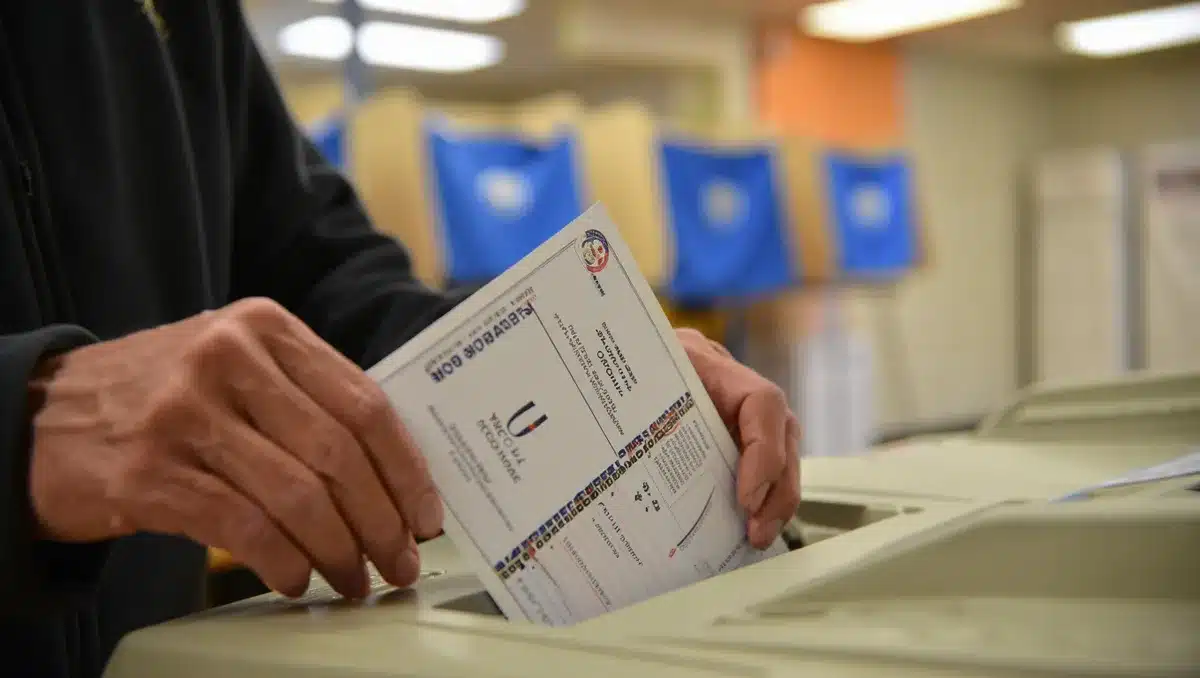
Missouri voters overwhelmingly rejected Amendment 5 on Tuesday, with 83% voting “no” in a decisive defeat for a proposal that would have phased out the state income tax and expanded sales taxes to replace the lost revenue.
The amendment, championed by Gov. Mike Kehoe and Republican lawmakers, represented one of the most ambitious tax overhauls in state history. It would have required the legislature to gradually reduce the income tax rate based on revenue growth, with the goal of eliminating it entirely by 2032. To make up for the roughly $8.5 billion in annual income tax revenue, lawmakers would have gained authority to expand and raise sales and use taxes within a five-year window.
The result is a major setback for Kehoe, who prioritized income tax elimination in his State of the State address this year. Without voter approval, lawmakers cannot expand sales and use taxes to fund the income tax phase-out. The failure also prevents lawmakers from gaining broader authority to change which goods and services are subject to sales taxes—a power that opponents warned could have given the legislature unchecked ability to raise taxes on everyday purchases.

The nonpartisan Missouri Budget Project warned that the amendment would have shifted the tax burden away from higher earners and onto working families. The organization found that 80% of Missourians would have seen a net tax increase, with the average household paying over $500 more annually if the income tax was eliminated and sales taxes were expanded to replace the revenue. Middle-class households earning between $50,000 and $80,000 would have faced increases of around $535 per year, according to the Institute on Taxation and Economic Policy.
Opponents of Amendment 5 raised particular concerns about the impact on school funding and public services. The Missouri Budget Project noted that the state income tax provides more than half of the general revenue the state receives each year. Parent groups and school districts across the state, including the Independence School District, formally opposed the amendment, citing uncertainty about how education would be funded if the income tax was eliminated. Educators warned that the shift to sales taxes could leave schools vulnerable to funding cuts during economic downturns, when consumer spending typically drops.
Supporters of the amendment, including Rep. Bishop Davidson, R-Republic, who sponsored it, argued that eliminating the income tax would spur economic growth and draw new residents to Missouri. They pointed to states without income taxes, such as Florida and Tennessee, as examples of economic success. However, the amendment included no specific exemptions or plan for which services would be taxed, leaving those decisions entirely to lawmakers. Gov. Kehoe had stated he would never support extending sales taxes to agriculture, health care, or real estate, but these exemptions were not written into the amendment itself.

The Missouri rejection occurred the same day that Kansas voters also rejected a similar income tax elimination amendment by approximately 68%, suggesting a broader voter skepticism toward tax-restructuring plans that shift the burden from income to consumption. Both states had pursued aggressive tax-cutting agendas in recent years—Missouri had already eliminated its capital gains tax in 2025, reducing state revenue by an estimated $510 million annually—but voters in both states declined to go further.
With Amendment 5’s defeat, the state’s income tax structure remains unchanged, and future efforts to eliminate it would require another constitutional amendment and another statewide vote. Lawmakers retain the ability to cut income tax rates through legislation, as they have done in prior sessions, but cannot expand sales taxes without voter approval.
Sources
- St. Louis Public Radio — detailed reporting on Amendment 5’s 83% rejection, revenue impact, and school funding concerns
- Missouri Budget Project — analysis showing 80% of Missourians would face net tax increases averaging over $500 annually
- Institute on Taxation and Economic Policy — middle-class household tax impact figures
- Kansas Reflector — Kansas voters rejected similar amendment by 68% on August 4, 2026
- Fox2Now — final vote tally confirming 82.4% “no” vote with 95% of precincts reporting
- News-Leader — confirmation of approximately 83% voting “no” as of final count