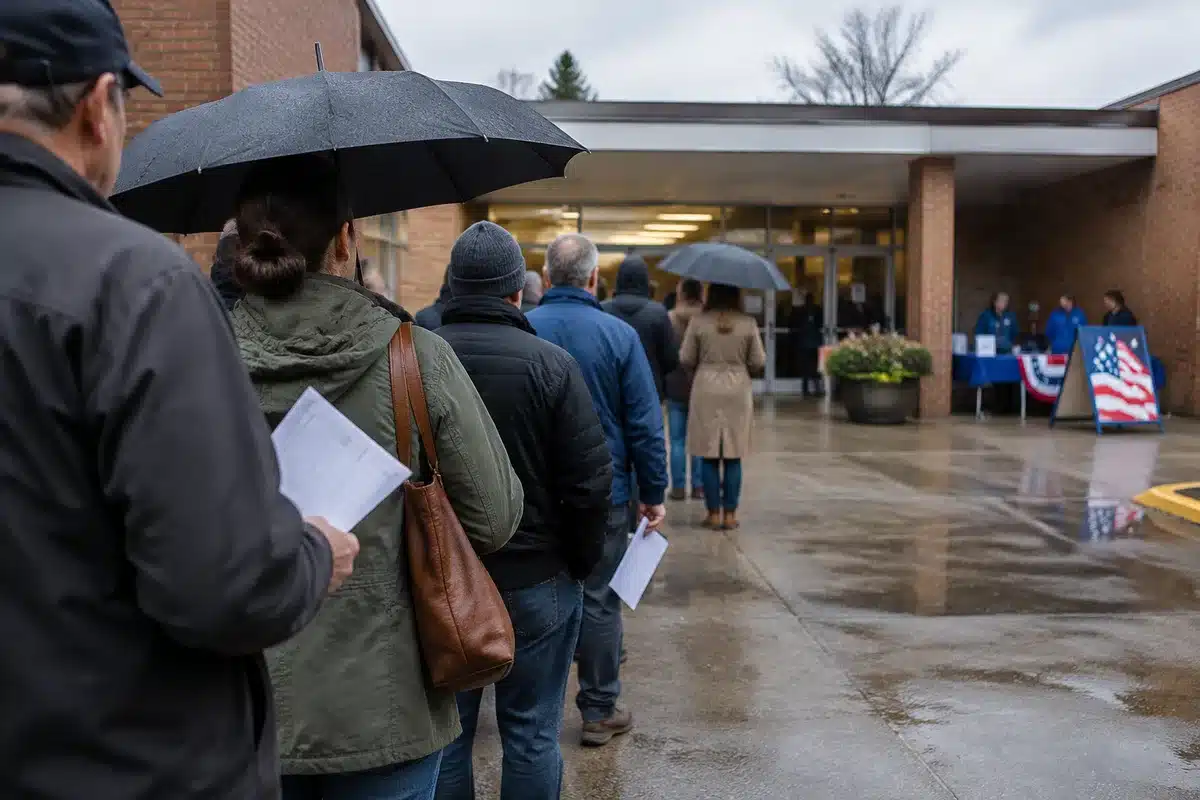
Michigan Democrats are voting today in a high-stakes Senate primary between progressive Abdul El-Sayed, a 41-year-old former public health official, and moderate U.S. Representative Haley Stevens, 43, to choose a nominee for the seat being vacated by retiring Senator Gary Peters. El-Sayed has led in recent polls, with one survey showing him ahead 54 percent to 39 percent, according to Emerson College Polling released July 30.
The race represents a fundamental test of the Democratic Party’s direction as it seeks to regain control of the Senate following Donald Trump’s 2024 victory. El-Sayed, who served as director of Wayne County’s Department of Health, Human and Veteran Services, has run an anti-establishment, progressive campaign centered on Medicare for All and ending unconditional U.S. military aid to Israel. Stevens, who has represented Michigan’s 11th congressional district since 2018, emphasizes her moderate record and her role in helping rescue the Big Three automakers during the Obama administration.
The ideological divide extends across multiple policy areas. On healthcare, El-Sayed backs Medicare for All while Stevens supports expanding Medicare access. On immigration, El-Sayed calls for abolishing ICE while Stevens proposes reforming the agency. On Israel, El-Sayed is more critical and pro-Palestinian, calling for ending unconditional military aid; Stevens has voted to provide additional military aid to Israel and received significant support from AIPAC, the pro-Israel lobbying group.
Stevens received backing from Senate Democratic leadership, including Senate Minority Leader Chuck Schumer, and endorsements from retiring Senator Peters, former Governor Jennifer Granholm, and Governor Gretchen Whitmer. The establishment support has translated into a massive fundraising advantage: approximately $50 million has been spent on Stevens’ behalf compared with less than $2.3 million for El-Sayed as of July, according to Wikipedia’s election coverage. AIPAC alone has spent nearly $30 million supporting Stevens, surpassing all of their prior investments for a single candidate in a particular race.
The race has become one of the most expensive and contentious Democratic primary fights in recent memory, with over $40 million in outside spending flooding in. Campaign finance emerged as a contrast point: El-Sayed and state Senator Mallory McMorrow, who withdrew from the race in July as her polling declined, called for an end to corporate political spending and rejected corporate donations. Stevens said she was not taking new corporate pledges, describing herself as the “only non-millionaire” in the race.
The winner of today’s primary will face Mike Rogers, the presumptive Republican nominee and a former congressman, in November’s general election. This open Democratic Senate seat is critical for the party’s hopes of reclaiming the chamber, where Republicans currently hold 53 of the 100 seats. Michigan is one of only two Democratic-held Senate seats in a state won by Trump in 2024, making it a key battleground. Republicans have not won a U.S. Senate race in Michigan since 1994.
The primary also reflects broader tensions within the Democratic Party over its future strategy. Progressive figures, including Senator Bernie Sanders, have backed El-Sayed and other progressive challengers in Michigan congressional races, arguing that his policy positions would energize voters in both the primary and general election. The outcome in Michigan could signal the party’s direction heading into the general election cycle.
Sources
- The Guardian — El-Sayed leading in polls, outside spending breakdown, policy differences on Israel
- Wikipedia (2026 United States Senate election in Michigan) — campaign finance figures, candidate backgrounds, endorsements, policy positions
- Emerson College Polling — polling data showing El-Sayed ahead 54–39 percent
- NBC News — race description and Democratic primary battle framing
- New York Times — live election updates and race context
- Washington Post — Peters endorsement and race significance
- Ballotpedia — candidate information and primary date confirmation
- CNBC — candidate descriptions and race framing
- PBS NewsHour — fact-checking article on candidate claims