Dell stock has retreated sharply from its record high as a broader cooling in AI investor sentiment and concerns about stretched valuations weigh on the sector. The company’s shares tumbled roughly 14% on July 15 after hitting a 52-week high of $465.96 in May, pulling back from a year-to-date surge of over 230%.
The sell-off reflects a reversal in the AI momentum trade that had propelled Dell and other chip suppliers higher throughout the first half of 2026. Investors have begun questioning whether the massive capital expenditure commitments by hyperscalers can justify the valuations of companies supplying the infrastructure, according to analysts monitoring the market.

The trigger for the recent decline came partly from a Wall Street Journal report that Nvidia is in talks to guarantee roughly $250 billion in financing for OpenAI’s data center buildout in Ohio. While the deal would theoretically benefit Nvidia by securing future chip orders, analysts flagged it as a sign of circular financing dynamics reminiscent of the dot-com era—a pattern where vendors finance their own customers’ purchases rather than genuine independent demand.
Broader concerns about AI capital spending have mounted across the sector. The consensus estimate among Wall Street analysts for AI hyperscaler capital expenditure in 2026 now stands at $527 billion, up from $465 billion earlier in the year. Investors have grown skeptical about whether returns on these investments will materialize quickly enough to justify the spending surge and the elevated stock valuations that have accompanied it.
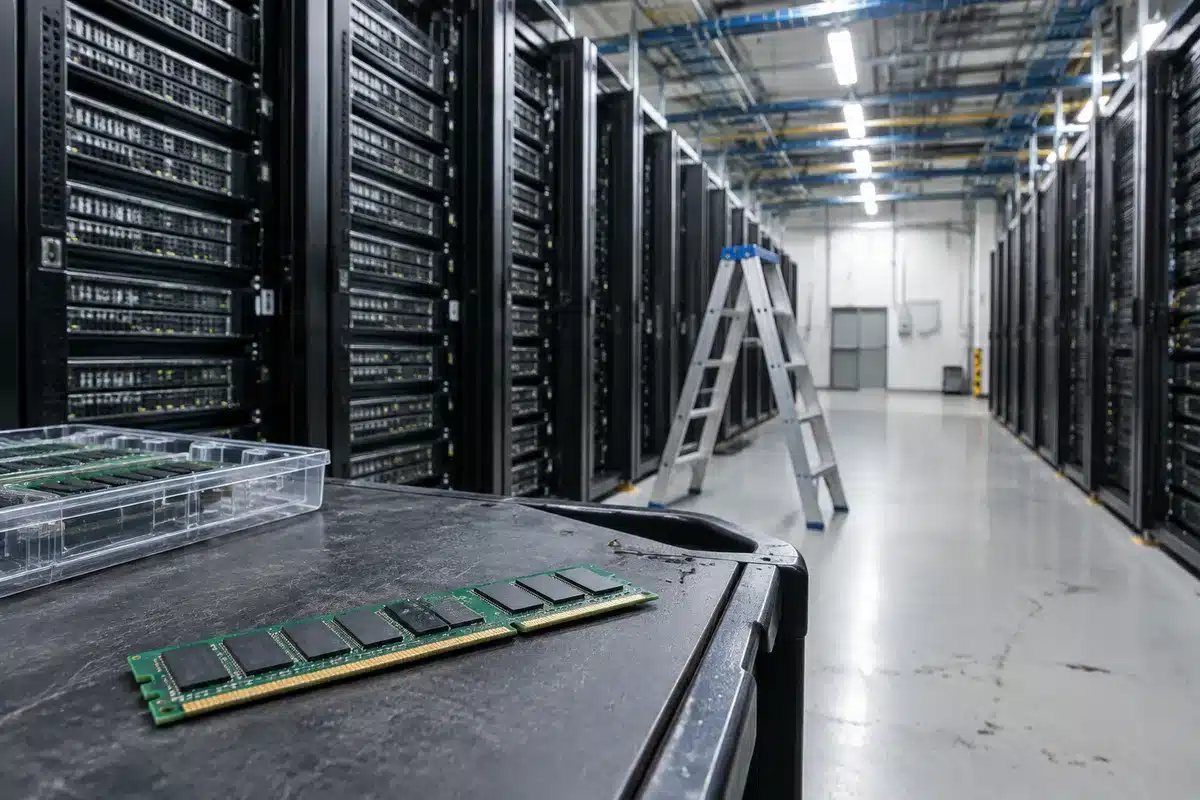
Despite the stock pullback, Dell’s underlying business metrics remain robust. The company reported AI-optimized server revenue of $16.13 billion in its latest quarter, up 757% year-over-year, and delivered $24.7 billion in AI server revenue across fiscal 2026. The company also booked $24.4 billion in fresh AI orders during that same period, underscoring sustained demand from major cloud providers and AI companies building out their infrastructure.
The pullback in Dell and other AI infrastructure suppliers aligns with a broader market reassessment. The Philadelphia Semiconductor Index dropped 4.8% in mid-July as investors rotated away from the most expensive AI-related names. Chip stocks including Intel, AMD, and Broadcom all declined in the same period, with analysts citing valuation compression as a key driver alongside questions about the pace and profitability of AI adoption.
Dell’s recovery to $442.74 on July 22 suggests the stock may be stabilizing after the initial shock, though it remains well below its May record. The company’s strong AI server backlog and order book position it to benefit if investor sentiment stabilizes, but the sector faces an extended period of scrutiny as Wall Street demands proof that AI infrastructure spending will translate into sustainable profits and revenue growth.
Sources
- Yahoo Finance — Dell stock decline on July 15, 52-week high context
- CNBC — AI server revenue 757% increase, May 2026 earnings report
- Reuters — Nvidia-OpenAI $250 billion financing deal reporting
- MarketWatch — Nvidia financing guarantee and circular deal concerns
- Fortune — Tech stock selloff and chip sector decline in July 2026
- The Guardian — Global chip stock selloff reporting
- Morningstar — Chip selloff and valuation concerns analysis
- Goldman Sachs — AI hyperscaler capex estimates and projections
- StockToTrade — Dell stock recovery to $442.74 on July 22
- The Globe and Mail — Dell fiscal 2026 AI server revenue figures