House Republicans prioritized Iran war funding and voting restrictions as their final legislative push before summer recess, passing a $95 billion budget blueprint for military spending and a $1.15 trillion defense bill while attempting to merge voting overhaul measures into law ahead of November’s midterm elections.
In their last week of work before departing the Capitol, House Republicans under Speaker Mike Johnson’s leadership approved the war spending plan along party lines, along with the annual National Defense Authorization Act (NDAA). Johnson framed the effort as a midterm victory, telling reporters on July 23 that major legislating had occurred despite skepticism about legislative productivity in an election year.

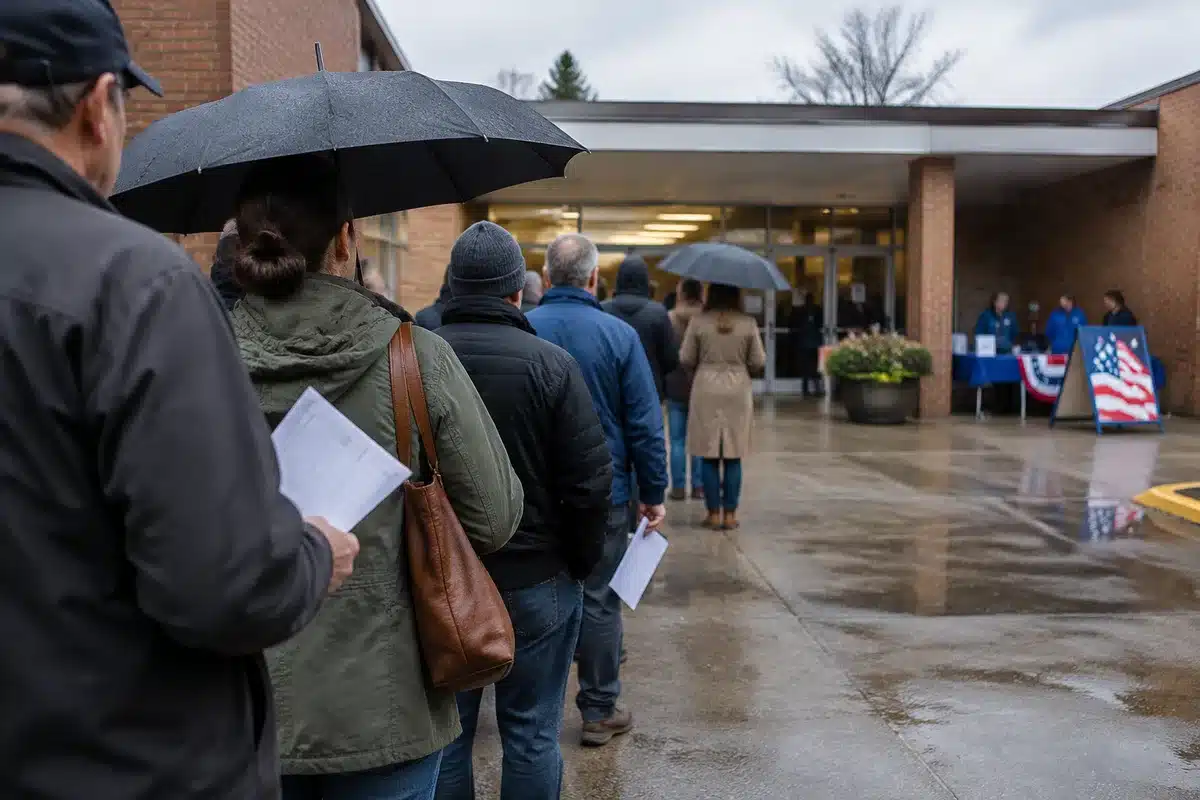
The Republican strategy, however, faces significant headwinds. The House merged the NDAA with the SAVE America Act, a Trump administration priority that would require voters to provide documentary proof of citizenship when registering and photo identification when casting ballots. This combination complicated the defense bill’s path forward, as Democrats objected both to its $1.15 trillion cost and to the voting restrictions attached to it.
The voting bill itself has stalled in the Senate. Trump’s patience with Senate Majority Leader John Thune over the blocked SAVE America Act escalated in late July, with White House Press Secretary Karoline Leavitt stating that Trump’s “patience is running out” as Thune struggled to find sufficient votes to advance the legislation. Senate Republicans have repeatedly said the bill does not have the 60 votes needed to overcome a filibuster and pass.
The SAVE America Act represents a sweeping overhaul of federal voting procedures. The bill would ban mail-in ballots except under limited circumstances, require absentee voters to submit sworn statements and documentary proof, and impose new identification requirements at registration and polling places. According to the Bipartisan Policy Center, the legislation would “fundamentally change how Americans register and vote” by requiring proof of citizenship as a prerequisite to voter registration in federal elections.

On the defense side, House Republicans framed the spending as necessary military readiness. Budget committee chair Jodey Arrington told the House floor on July 23 that the $95 billion would fund “baseline battlefield readiness,” describing it as money for “bullets and bombs to finish the job and come home safely and victoriously.” The framing avoided explicit reference to the Iran conflict, which polls show carries poor public approval ratings.
The Republican legislative blitz did not proceed without internal fracture. On July 23, four dissident House Republicans joined all Democrats to pass a symbolic war powers resolution directing Trump to withdraw troops from combat against Iran. The vote amounted to an embarrassing defeat for Johnson, underscoring the thin Republican majority and Democratic leverage on defense spending.
Senate Majority Leader John Thune subsequently placed the $95 billion budget blueprint on “hold” rather than advancing it, signaling he might use it as leverage in negotiations over government funding, which expires September 30. This raised the likelihood that Iran war spending decisions would remain unresolved heading into the fall, according to reporting from The Guardian.
The Republican strategy reflects a calculation that war spending and voting restrictions will energize their base heading into the midterms. Richard Hudson, chair of the National Republican Congressional Committee, argued that Republicans have “a great story to tell to the voters,” citing redistricting victories that favor the GOP. However, Democratic strategists argue the opposite: Congressman Jason Crow warned that House Republicans would face constituent backlash over $100 billion for “another endless war in Iran” while Americans struggle with healthcare, housing, and farm costs.
Sources
- The Guardian — House Republicans’ final week of work before recess, passage of $95bn Iran war budget, merger of NDAA with SAVE Act, Thune’s hold on the budget blueprint, and Democratic response
- New York Times — Trump’s escalating criticism of Thune over the stalled SAVE America Act, dated July 23, 2026
- CNN — White House Press Secretary Karoline Leavitt’s statement that Trump’s “patience is running out” with Thune, dated July 23, 2026
- USA Today — Trump’s frustration with Thune and the stalled SAVE America Act, dated July 24, 2026
- Congress.gov — H.R. 22 (119th Congress): SAVE America Act requirements for documentary proof of citizenship and voter ID
- Bipartisan Policy Center — SAVE America Act details on citizenship requirements, voter ID, and mail-in ballot restrictions, updated July 2026