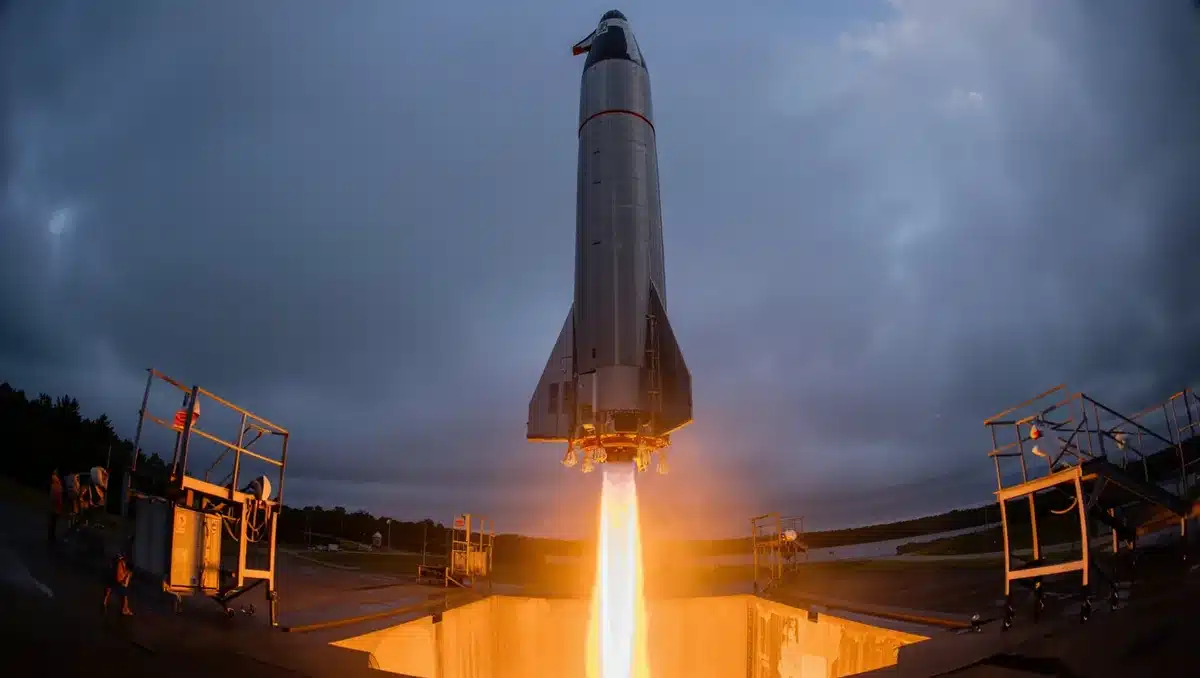
SpaceX targets Friday, July 24 for Starship Flight 13, the company’s next test of its mega-rocket from Starbase in South Texas, following a previous launch abort and engine repairs. The 90-minute launch window opens at 6:45 p.m. EDT, with the mission carrying 20 Starlink V3 satellites as the first operational payload to fly aboard Starship.
The July 16 launch attempt was aborted at T-0 when several of the vehicle’s Raptor engines failed to ignite, triggering an automatic safety shutdown. Elon Musk confirmed that “some of the engines didn’t start, triggering an automatic launch abort,” leading SpaceX to offload propellant and stand down from the attempt.
In response to the engine failure, SpaceX replaced engines on Booster 20 and conducted additional testing to verify the fixes. The company also rescheduled the launch from July 23 to July 24 due to unfavorable weather conditions in the launch zone, according to reports from July 22.
Flight 13 marks a significant milestone for Starship: the first time the vehicle will deploy real, operational Starlink satellites rather than test or dummy payloads. The 20 next-generation V3 satellites are designed to extend solar arrays and antennas and will attempt to connect with ground stations, demonstrating Starship’s payload deployment capabilities for commercial operations.
The booster’s primary test objectives include a successful launch, ascent, stage separation, boostback burn, and landing burn at an offshore location. The upper stage will also attempt a single Raptor engine relight in orbit, a critical capability for the vehicle’s future missions to the Moon and Mars.
Flight 13 comes after Starship’s twelfth test on May 22, 2026, which successfully demonstrated the vehicle’s engine-out capability despite losing one Raptor 3 vacuum engine mid-flight and achieved its planned trajectory. According to a tally as of late May, Starship has completed 12 launches with 7 successes and 5 failures, showing steady progress as SpaceX accelerates its testing cadence.

The mission is also notable as SpaceX’s first Starship test flight since the company’s initial public offering in June 2026. Earlier in July, SpaceX stock briefly fell below its IPO price of $135 following the engine abort, though the company has continued preparations for the rescheduled attempt. A successful Flight 13 would bolster confidence in Starship’s readiness for increasingly ambitious missions and commercial applications.
Weather and engine performance have been the main challenges in recent weeks. SpaceX had initially targeted July 16, then July 23, before settling on July 24 as conditions and repairs allowed. The company’s ability to quickly diagnose and fix the engine issues, then resume launch operations, reflects the rapid iteration approach that has defined Starship’s development.
Sources
- SpaceX — official launch information and mission objectives for Starship Flight 13
- Space.com — launch window timing, weather delays, and mission details
- Spaceflight Now — post-ignition anomaly details and abort circumstances
- New York Times — SpaceX stock performance following the abort
- Wikipedia — Starship launch history and success/failure tallies as of May 27, 2026
- MSN News — engine replacement efforts and rescheduling to July 23 and July 24