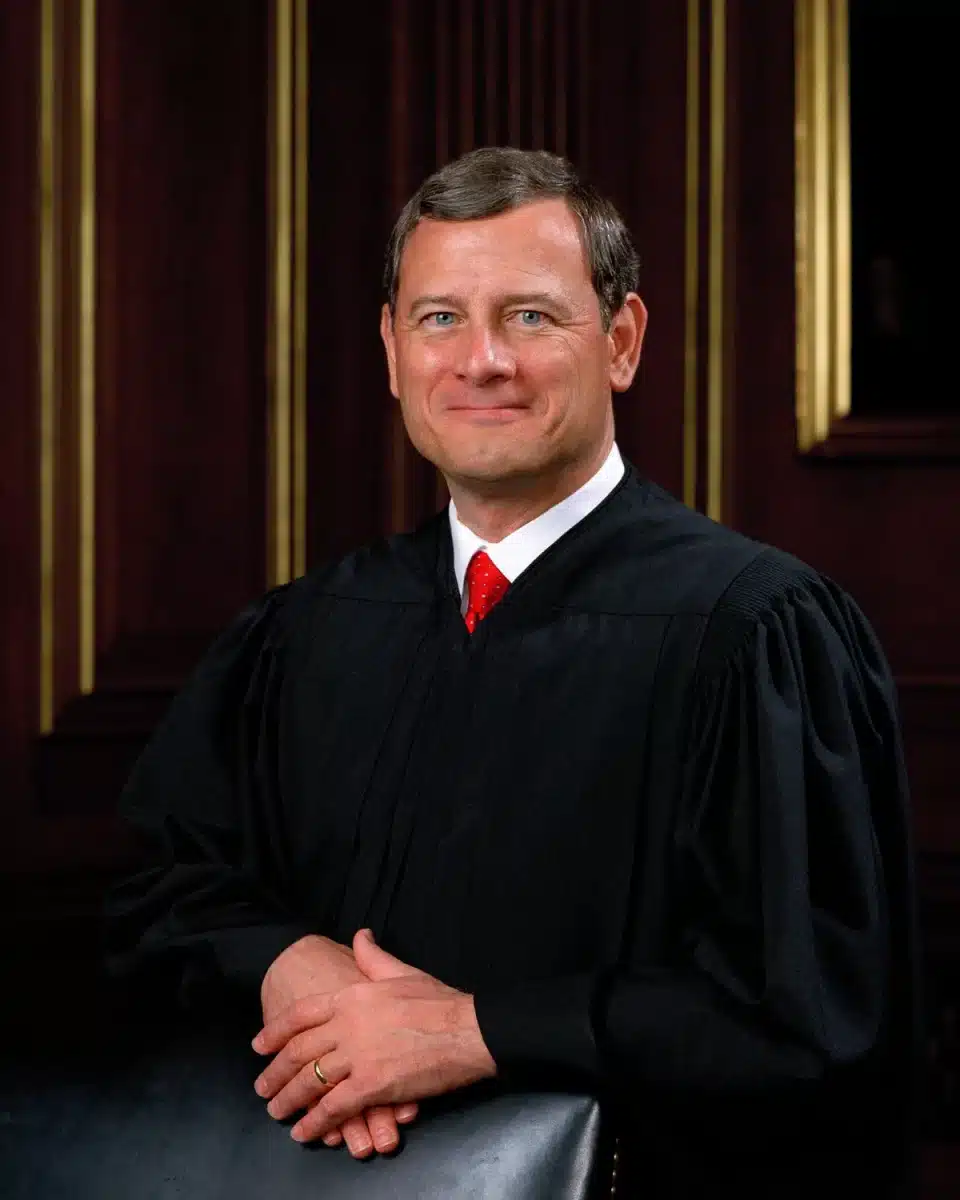
Chief Justice John Roberts led the Supreme Court to a 6-3 ruling on June 29, 2026, allowing President Trump to fire Federal Trade Commission Commissioner Rebecca Kelly Slaughter without cause, striking down a 91-year-old precedent that had protected the heads of independent agencies from at-will removal.
In Trump v. Slaughter, Roberts delivered the majority opinion holding that the FTC’s for-cause removal protections violated the separation of powers. Trump had fired Slaughter and fellow FTC Commissioner Alvaro Bedoya in March 2025, citing that their “continued service on the FTC [was] inconsistent with [his] Administration’s priorities” rather than invoking the statutory causes of “inefficiency, neglect of duty, or malfeasance in office.” Slaughter sued, and a lower court had blocked the removal, but the Supreme Court reversed.
The ruling overturned Humphrey’s Executor v. United States, a 1935 Supreme Court decision that had established for nearly nine decades that independent agencies like the FTC could shield their leaders from presidential removal at will. Roberts wrote that the FTC “unquestionably exercises executive power, and must therefore be controlled by the Chief Executive.” The majority concluded that officers exercising the president’s power must remain accountable to him and thus removable by him.

The FTC enforces and administers roughly 80 statutes covering nearly every sector of the economy. It can promulgate rules with the force of law, investigate businesses, conduct in-house adjudications, and file civil suits on behalf of the United States. Roberts emphasized that these functions represent “the very essence of ‘execution’ of the law,” placing them squarely within presidential authority.
Roberts’s opinion carefully carved out an exception for the Federal Reserve, noting that the Court had “left open the possibility” that the Fed, “to the extent that it follows in the tradition of the First and Second Banks of the United States,” might not be subject to at-will removal. This distinction reflected concern that weakening the Fed’s independence could destabilize financial markets and monetary policy.
Justice Sonia Sotomayor filed a dissent joined by Justices Elena Kagan and Ketanji Brown Jackson. Sotomayor argued that the ruling “rewinds the clock nearly 150 years” and warned that the decision hands the president “far greater power” over independent agencies than the Constitution permits. In her view, Congress had established multi-member agencies like the FTC precisely “to address complex problems while enjoying some insulation from political pressure.”

The decision stemmed from Trump’s March 2025 removal of Slaughter, a Democratic appointee. The District Court had initially granted Slaughter’s motion for summary judgment, acknowledging that while Myers v. United States (1926) generally permits at-will removal of executive officers, Humphrey’s Executor carved out an exception for the FTC. The Court of Appeals denied the government’s motion for a stay, but the Supreme Court intervened, staying the lower court’s order and taking the case on an expedited basis.
The ruling has broad implications for the administrative state. Agencies like the National Labor Relations Board, the Securities and Exchange Commission, and the Consumer Financial Protection Bureau—all structured with for-cause removal protections—now face uncertainty about whether their leaders can be dismissed at will. Roberts’s opinion left open the possibility that future litigation might address other types of agencies or non-Article III courts, but made clear that any office exercising executive power falls within the president’s removal authority.
When the Court issued its Slaughter decision, it simultaneously decided Trump v. Cook, a related case concerning Federal Reserve Governor Lisa Cook. In that 6-3 decision, the Court upheld Cook’s tenure protections, accepting the government’s concession that the Fed’s historical role and statutory structure warranted an exception from the general removal rule. That split outcome—weakening independent agencies while preserving the Fed—reflected the majority’s concern that monetary policy independence serves a distinct constitutional interest.
Sources
- Supreme Court of the United States — Trump v. Slaughter, 609 U.S. ___ (2026), Opinion of the Court delivered by Chief Justice John Roberts, June 29, 2026.
- SCOTUS Blog — Coverage of the 6-3 ruling, the majority’s reasoning on FTC executive power, and Sotomayor’s dissent.
- NPR — Reporting on the decision’s overturning of the 91-year-old Humphrey’s Executor precedent and its impact on independent agencies.
- Morgan Lewis — Analysis of the ruling’s implications for independent agency structure and the Federal Reserve carve-out.
- Congress.gov — Congressional Research Service summary of the decision and its effect on for-cause removal protections.