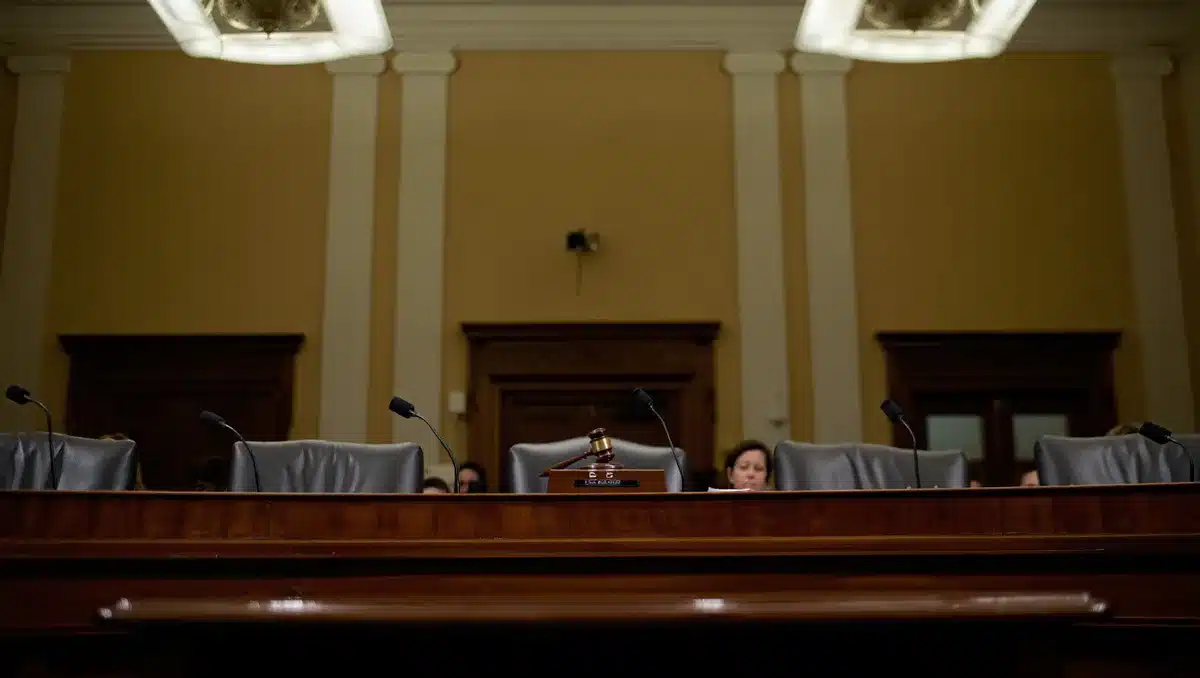
The Senate Banking Committee went into closed session on Wednesday to discuss FBI background investigations for three Trump nominees, after Ranking Member Elizabeth Warren raised significant concerns about their vetting during a scheduled markup vote.
Warren requested the closed session during the committee’s markup on Trump’s nominees for the National Credit Union Administration, Housing and Urban Development Inspector General, and Council of Economic Advisers chair. “We have both been briefed on the FBI background investigations for the nominees that we are scheduled to vote on this morning,” Warren said, according to the committee’s official transcript. “The briefing left me with some significant questions that have not yet been answered.”
The three nominees under discussion were John Crews for the NCUA, Jeffrey Ledbetter for HUD Inspector General, and Christopher Phelan for CEA Chair. The committee voted 12 to 10 to move into executive session, allowing only committee members and essential staff to remain in the room.
Warren had released detailed responses from the nominees earlier that day, stating that “these nominees’ failure to answer basic questions for the record indicate that they will do nothing but help facilitate the President’s corrupt and chaotic agenda.” In his written responses, Crews declined to confirm that federal law requires more than a single member to constitute a quorum at the NCUA and refused to answer straightforward questions about past presidential elections. Ledbetter, who has no background in housing policy, similarly declined to answer basic questions about election results. Phelan, the CEA nominee, dodged questions about the affordability crisis and refused to answer a hypothetical about what he would do if asked to falsely claim a candidate won an election.

FBI background checks have been standard procedure for Senate-confirmed nominees for nearly 75 years. The investigations typically examine a nominee’s employment history, criminal record, personal conduct, residence, and education. Warren invoked the committee’s constitutional power of advice and consent to move the session closed, citing Senate rules that limit what can be discussed publicly regarding ongoing background investigations.
The closed session reflected broader tensions over Trump nominee vetting. In late 2024 and early 2025, some Trump nominees initially sought to avoid FBI background checks or requested delays, though Republican senators insisted on the standard process. The Senate Banking Committee’s decision to move into executive session underscored concerns from Democratic lawmakers that the nominees were not adequately prepared or forthcoming about their qualifications and views.
Sources
- Senate Banking Committee — official transcript of July 23, 2026 markup and closed session, including Warren’s remarks and the vote tally
- Senate Banking Committee Minority Press Release — Warren’s statement on nominees’ responses and the three nominees’ written answers to questions for the record, released July 23, 2026
- U.S. Senate Finance Committee — background on the 75-year history of FBI background checks for nominees
- Federal News Network — reporting on 2025 confirmation delays due to background check vetting processes