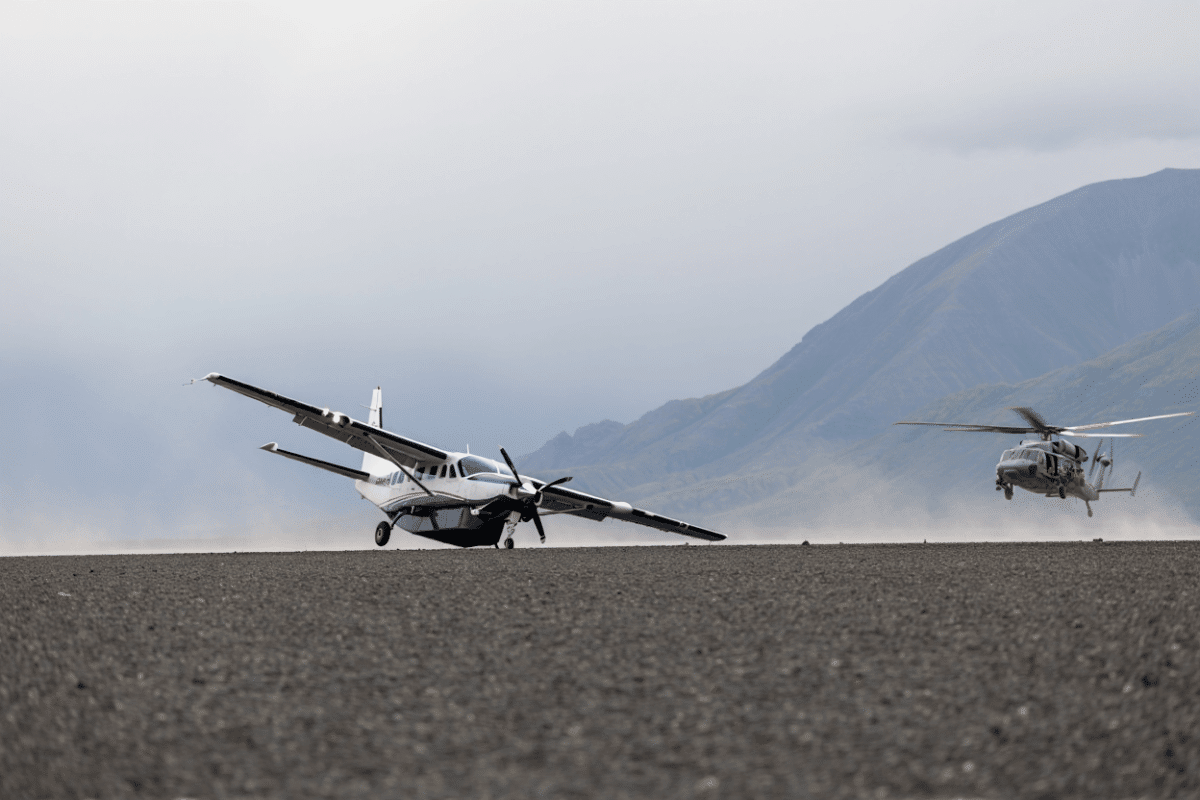
A Wright Air Service Cessna Caravan carrying ten people made an emergency landing in Alaska’s remote Brooks Range on June 22, 2026, after the pilot experienced engine trouble shortly after takeoff from Coldfoot. All aboard walked away uninjured despite the harrowing descent.
The pilot reported that the engine began surging and making an unusual whiny or groaning sound within five to ten minutes of departure, according to Clint Johnson, Alaska chief of the National Transportation Safety Board. The aircraft could not maintain altitude, forcing the pilot to select an off-airport landing site.
The Cessna Caravan, a fixed-gear commuter aircraft, touched down on flat terrain about 20 miles north-northwest of Coldfoot, near Wiseman in an area described as glacial runoff with gravel and trees. The pilot sustained a minor split lip, while the nine passengers remained unhurt. Johnson praised the pilot’s decision-making, saying he did an “excellent job” at picking the forced landing area.
Two helicopter operators working in the region responded immediately and evacuated all ten people back to Coldfoot within roughly an hour or two. The aircraft’s emergency locator transmitter—a 406 ELT—provided an immediate signal, and the operator’s SpiderTracks electronic tracking system helped pinpoint the plane’s location, speeding the rescue effort.
The NTSB investigation is focusing on a possible engine malfunction. Johnson noted that early indications do not suggest weather was a factor. Investigators are working to recover the wreckage from the remote site using a heavy-lift helicopter so they can examine the aircraft, with particular attention to the Pratt & Whitney Canada engine. The pilot is highly experienced, with thousands of hours flying the Cessna Caravan for Wright Air Service.
Because the Cessna Caravan and its Pratt & Whitney Canada engine are common across Alaska’s air taxi fleet, the NTSB is prioritizing the investigation to determine whether the engine problem is systemic or isolated to this aircraft. Johnson said investigators aim to issue a preliminary report about 15 days after the crash, depending on recovery progress, with a final report typically taking about 18 months.
Wright Air Service carries more than 40,000 passengers annually on scheduled flights to dozens of communities in Interior and northern Alaska, making the outcome of this investigation potentially significant for the regional aviation industry.
Sources
- Anchorage Daily News — NTSB statement confirming no injuries, Wright Air Service flight details, and rescue operations
- Alaska’s News Source — detailed NTSB investigation findings, pilot account of engine surging, landing site description, and recovery plans
- BBC — confirmation that all ten people walked away uninjured