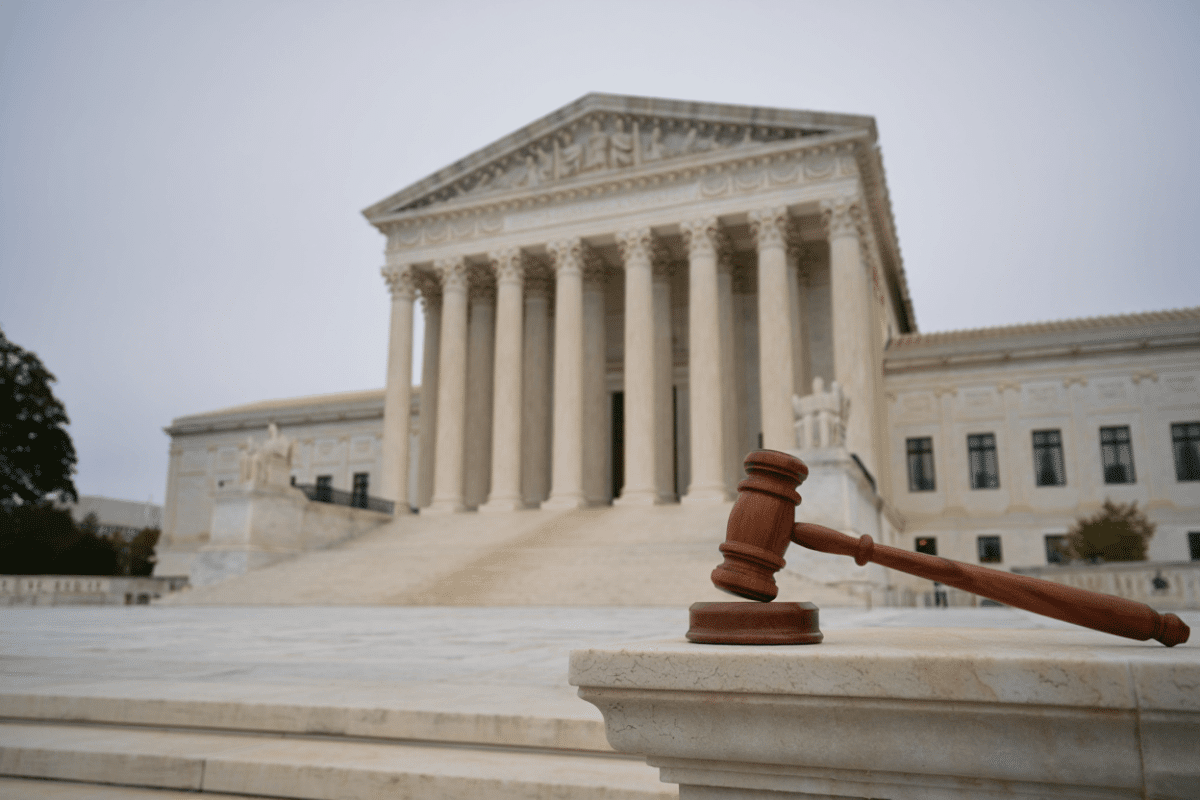
In a 6-3 decision on June 29, the Supreme Court struck down a 91-year-old precedent that had protected independent agency leaders from presidential removal without cause, handing Chief Justice John Roberts’ conservative majority a landmark victory that dramatically expands executive power over federal regulators.
The ruling in Trump v. Slaughter centered on President Trump’s 2025 firing of Federal Trade Commission Commissioner Rebecca Kelly Slaughter without providing a reason. Since the FTC’s creation in 1914, Congress had required that commissioners could only be removed for “inefficiency, neglect of duty or malfeasance in office.” Slaughter was told only that her “continued service on the FTC is inconsistent with [the Trump] Administration’s priorities.”
Writing for the majority, Roberts stated: “Although it is up to the Senate to decide whether to confirm those with whom the President would prefer to work, neither Congress nor the courts may saddle him with those with whom he cannot work. Subordinates who exercise the President’s power are subject to removal by him.” He added that “if anything more is left of Humphrey’s, the Court overrules it,” referring to the 1935 precedent by name.
Humphrey’s Executor v. United States, decided unanimously in 1935, had emerged from President Franklin D. Roosevelt’s attempt to fire an FTC commissioner over ideological disagreements. The Court then held that while the president could remove purely executive officers at will, that power did not extend to agencies like the FTC, whose duties were “neither political nor executive, but predominantly quasi-judicial and quasi-legislative.” That precedent had anchored the independence of federal agencies for over nine decades.
The FTC enforces and administers roughly 80 statutes covering nearly every facet of the economy. The ruling effectively converts FTC commissioners into at-will employees and ends Congress’ bipartisan requirement that no single party hold more than three of the five commission seats. After Trump’s firing of two Democratic commissioners, only Republicans remain on the board.
The decision throws the independence of numerous other agencies into question, including the Equal Employment Opportunity Commission, the Merit Systems Protection Board, and the Consumer Product Safety Commission. Congress created these agencies following Humphrey’s Executor, assuming they would operate with independence from the White House.
The three liberal justices dissented sharply. Justice Sonia Sotomayor wrote that the decision was “grievously wrong,” arguing: “The Court gives the President a power unknown even to the English Crown against which the Founders revolted, elevating him above his once-coequal branches by transforming a duty to take care that the laws be faithfully executed into a license to act in defiance of those very laws.”
In a separate 5-4 ruling the same day in Trump v. Cook, the Court preserved the Federal Reserve’s independence, at least temporarily. The justices ruled that Federal Reserve Board member Lisa Cook can remain in her position until litigation is resolved in lower courts. Roberts noted in the Slaughter opinion that the Federal Reserve occupies a “distinct historical tradition of central bank independence,” distinguishing it from other independent agencies.
During Trump’s first term, the Supreme Court had already begun chipping away at Humphrey’s Executor. In 2020, it allowed Trump to fire the head of the Consumer Financial Protection Bureau, holding that the firing was permissible because the CFPB is run by a single director rather than a multimember board. Thursday’s decision extends that logic to multimember agencies, finding that the FTC’s modern role in enforcing statutes represents “the very essence of ‘execution’ of the law.”
Sources
- NPR — Full reporting on the 6-3 decision, Chief Justice Roberts’ majority opinion, Justice Sotomayor’s dissent, and details on Humphrey’s Executor precedent
- Supreme Court official opinions — Trump v. Slaughter (25-332) and Trump v. Cook (25A312) decisions issued June 29, 2026
- Law.com — Confirmation that the Court overturned the 91-year-old precedent upholding independent agency constitutionality
- GovExec.com — Context on the nearly 100-year-old legal precedent and its expected impact on presidential removal powers
- Morgan Lewis — Analysis of the Federal Reserve carveout and its distinct historical tradition of independence