
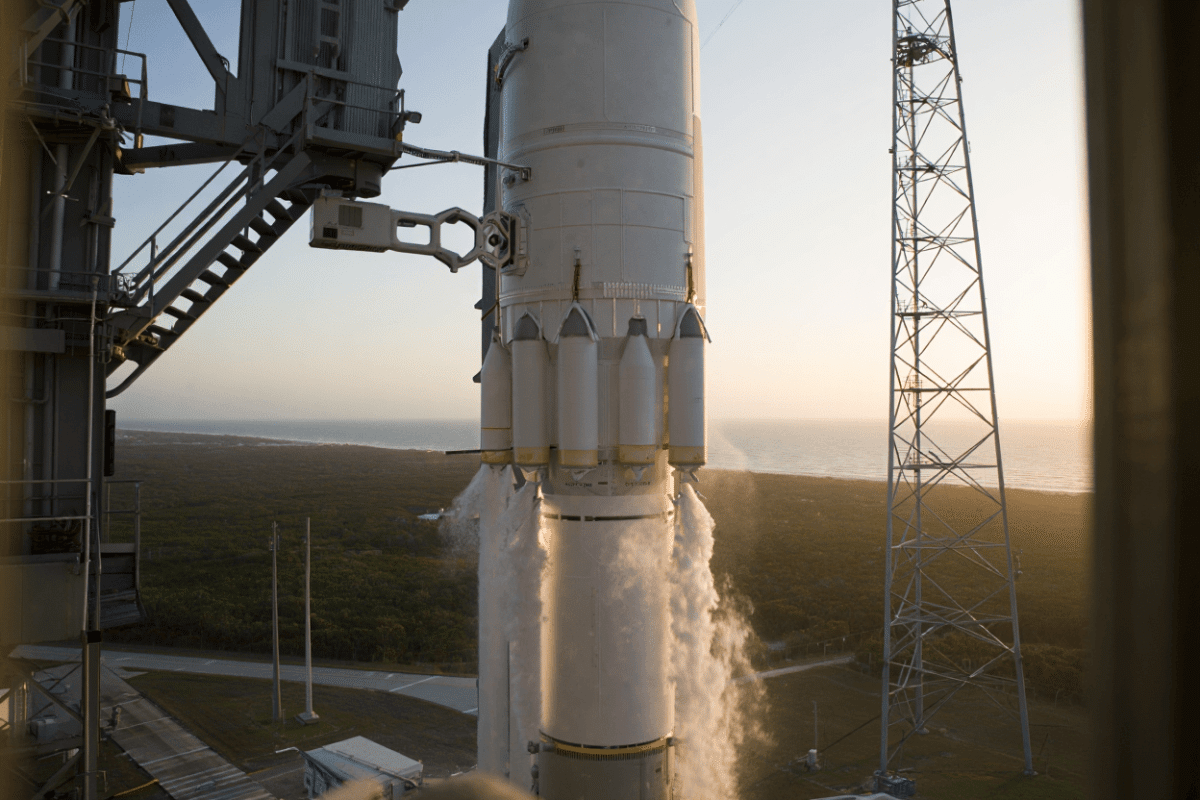
A United Launch Alliance Atlas V rocket launched 29 Amazon Leo broadband satellites to orbit early Thursday from Cape Canaveral Space Force Station in Florida, marking the final flight of the Atlas V 551 configuration after 24 years of service. The launch occurred at 12:30 a.m. ET on July 2, 2026, successfully deploying the satellites into low Earth orbit to expand Amazon’s growing internet constellation.
The mission, designated Amazon Leo 8 (LA-08), delivered another batch of advanced broadband satellites to support Amazon Leo’s global connectivity mission. Amazon Leo is a subsidiary of Amazon established in 2019 to deploy a large satellite internet constellation providing low-latency broadband connectivity, competing directly with SpaceX’s Starlink network.
This launch represents a major milestone for both Amazon and United Launch Alliance. The Amazon Leo constellation has now surpassed 365 active satellites in orbit, according to satellite tracking data, as the company works toward deploying its full planned network of 3,236 satellites across multiple orbital layers. The Federal Communications Commission authorized Amazon to deploy the full constellation in July 2020, with a requirement to have at least 50 percent of satellites in orbit by July 2026.
The final Atlas V 551 mission marks the end of an era for United Launch Alliance. In August 2021, ULA announced that the Atlas V would be retired, with all remaining launches already sold. Production of the rocket ended in 2024. After this Amazon Leo mission, only the remaining Boeing Starliner crewed missions will use the Atlas V before the rocket is fully retired in favor of ULA’s newer, cheaper, and more capable Vulcan rocket, according to Space Explored.
The Atlas V 551 configuration, distinguished by its five solid rocket boosters, 5-meter fairing, and single Centaur upper stage engine, has been a workhorse for national security missions and commercial launches. The final fairing for the Atlas V 551 was rolled out at Kennedy Space Center in late June 2026, symbolizing the end of the rocket’s production run. Amazon’s partnership with ULA has been central to the early deployment phase of the Leo constellation, with multiple Atlas V launches carrying batches of 29 satellites each since full-scale operations began in April 2025.
ULA’s transition to the Vulcan rocket reflects the aerospace industry’s shift toward more cost-effective launch vehicles. The Vulcan has already launched several times and gained the U.S. Space Force’s approval in 2026 to fly national security missions, positioning it as the successor to both the Atlas V and the retired Delta IV Heavy. Amazon’s future Leo launches are expected to utilize a mix of providers, including Arianespace, Blue Origin, and SpaceX, to accelerate constellation deployment.
Sources
- Space.com — confirmed launch time (12:30 a.m. ET July 2, 2026), location (Cape Canaveral Space Force Station), and 29-satellite payload
- Spaceflight Now — confirmed this is the final Atlas V 551 mission for Amazon Leo constellation
- Wikipedia — confirmed Atlas V retirement announcement (August 2021), production end (2024), and planned constellation size (3,236 satellites)
- Satellite Map tracker — confirmed 365 active Amazon Leo satellites in orbit as of mid-2026
- Space Explored — confirmed Vulcan as replacement rocket and its capabilities
- Ars Technica — confirmed FCC deployment deadline (50% by July 2026) and constellation authorization
- satnews.com — confirmed Amazon Leo constellation surpassed 330 satellites and rebranding from Project Kuiper










