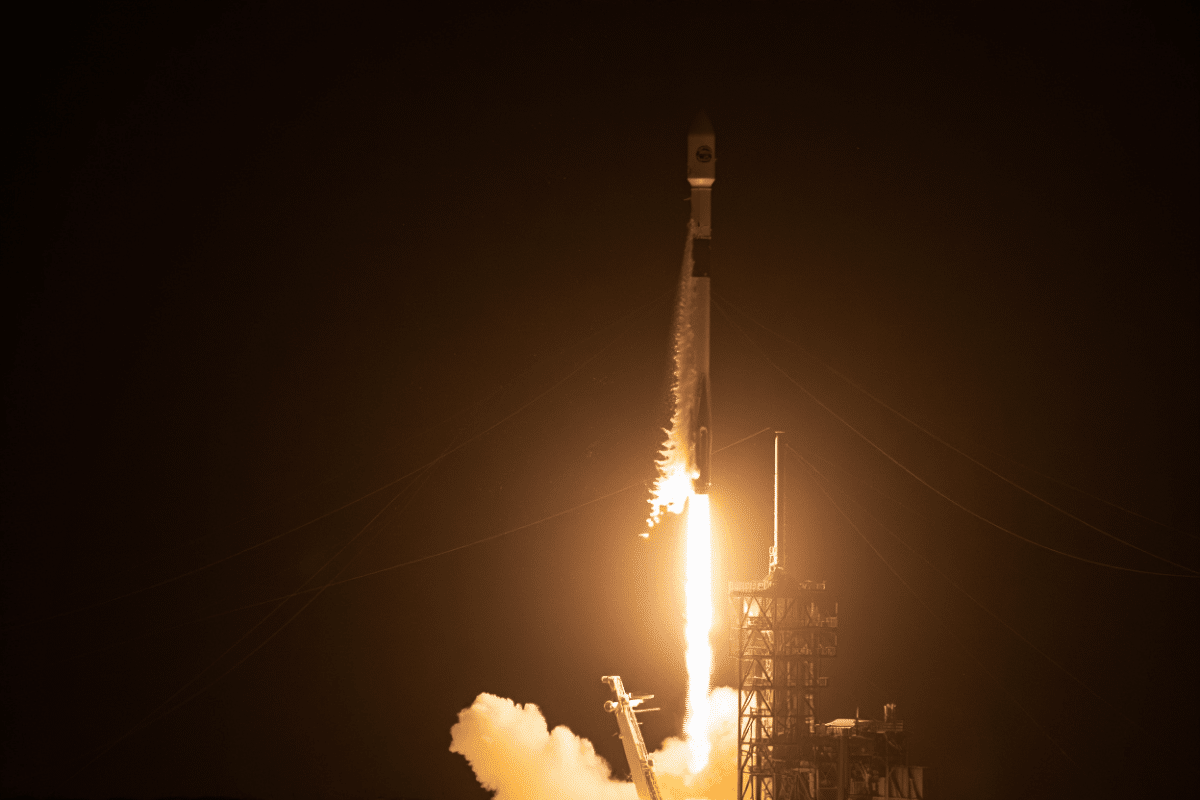
SpaceX launched a 7.5-ton SiriusXM satellite into orbit last night from Cape Canaveral Space Force Station, marking the company’s latest commercial mission to refresh the satellite radio operator’s aging constellation in geosynchronous transfer orbit.
The Falcon 9 rocket lifted off at 10:25 p.m. EDT on June 28, 2026, from Space Launch Complex 40 at the opening of a four-hour launch window. The SXM-11 satellite deployed from the rocket’s upper stage a little more than half an hour after liftoff, according to Spaceflight Now.
SXM-11 is the first of two new satellites designed to replace aging hardware in SiriusXM’s fleet. The satellite will replace the XM-5 satellite, which launched in 2010, and work alongside a future SXM-12 mission to replace the Sirius FM-5 satellite that launched in 2009. SiriusXM said the new satellite is the most powerful high-powered unit in its fleet and will enhance signal reception, expand coverage in Alaska, and support the delivery of audio entertainment and information services across the United States, Canada, and the Caribbean.
The SXM-11 satellite, weighing approximately 15,000 pounds, was manufactured by Lanteris Space Systems, a subsidiary of Texas-based Intuitive Machines. Intuitive Machines acquired the company—formerly branded as Maxar Space Systems—in January 2026 for about $800 million. The spacecraft is based on the IM-1300 satellite bus and spans 106 feet across when its solar panels are extended.
The Falcon 9 booster supporting the mission, designated B1085, completed its 17th flight. According to Spaceflight Now, the booster has previously launched NASA’s Crew-9, RRT-1 for the U.S. Space Force, Firefly Aerospace’s Blue Ghost Mission 1, Fram2, SiriusXM’s SXM-10, the MTG-S1 weather satellite for Europe, EchoStar XXV, and nine Starlink missions. About 8.5 minutes after liftoff, B1085 landed on the drone ship “A Shortfall of Gravitas,” stationed in the Atlantic Ocean, marking its 158th successful landing.
This launch follows SpaceX’s successful deployment of SXM-10 in June 2025. According to SiriusXM’s financial disclosures to the U.S. Securities and Exchange Commission, the SXM-10 satellite is estimated to remain in service until 2040, suggesting a similar operational lifespan for SXM-11. About 60 percent of the 7.5-ton satellite’s mass comes from the fuel onboard, which powers its orbital maneuvers and station-keeping throughout its mission life.
Sources
- Spaceflight Now — launch details, booster history, satellite specifications, and deployment confirmation
- SiriusXM investor relations — satellite capabilities and service lifespan estimates
- MSN — booster flight count confirmation