NASA launches a $30 million robotic rescue mission as early as Tuesday to save its aging Swift telescope from falling back to Earth, marking the first American attempt at such an ambitious on-orbit satellite servicing operation.
The Neil Gehrels Swift Observatory, which has hunted gamma-ray bursts since its launch in November 2004, is losing altitude rapidly due to intense solar activity. A spacecraft called LINK, built by Arizona-based startup Katalyst Space Technologies, will blast into orbit aboard a Northrop Grumman Pegasus XL rocket from Kwajalein Atoll in the Marshall Islands on Tuesday, June 30, at 6:23 a.m. EDT, according to NASA Science.
Swift needs to stay above 185 miles altitude to avoid burning up in Earth’s atmosphere. By the latest estimates, it could reach that point of no return as early as October without intervention. To buy time, NASA’s operations team has turned off Swift’s scientific instruments and reoriented the spacecraft to minimize atmospheric drag since February.
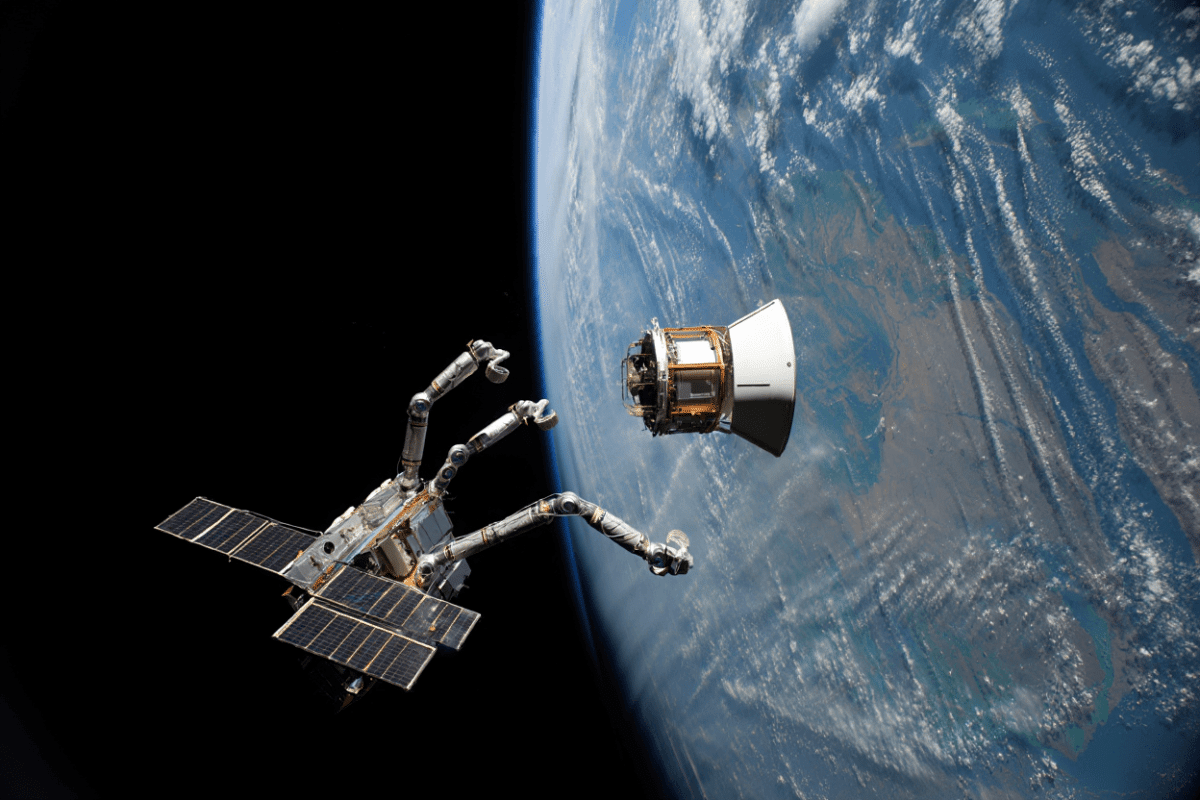
The LINK spacecraft weighs about 880 pounds and stands roughly 5 feet tall—about a third of Swift’s size. It carries three robotic arms with finger-like grippers, three ion thrusters, and nearly 20 feet of solar panels. After launch, LINK will spend about a month closing in on Swift, then another two to three months slowly raising the observatory’s orbit from its current 224 miles to 373 miles, according to AP News.
Swift was never designed to be serviced, making this rescue extraordinarily challenging. The 1.6-ton gamma-ray observatory is worth hundreds of millions of dollars and has spent two decades detecting and studying some of the universe’s most violent explosions. If the mission succeeds, Swift could return to science by September, according to Katalyst CEO Ghonhee Lee.
“No one thought it was going to be possible,” NASA’s astrophysics director Shawn Domagal-Goldman told the Associated Press. “No one thought we would get as far as we’ve already gotten today.” NASA awarded Katalyst the contract last September with a tight deadline: the company had less than nine months to design, build, test, and launch the satellite.
Only China has attempted a similar mission, successfully boosting a satellite to a higher graveyard orbit four years ago. This marks the first time an American commercial robot will attempt to service a spacecraft that was never designed for such work. Katalyst sees Swift as a proof-of-concept for a new industry. The company’s next-generation servicing spacecraft, scheduled to fly next year, will reach satellites as far as 22,300 miles up and could eventually refuel spacecraft, build solar farms, and construct data centers in orbit.
NASA’s science mission chief Nicky Fox emphasized the stakes. “If we let Swift reenter, we would lose that telescope. We would lose a lot of capability,” she said, per AP News. “We don’t currently have the budget to build another one to replace that.” The Hubble Space Telescope faces similar atmospheric drag from solar activity and could follow Swift into a boost mission as early as 2028, according to AP News reporting.
Sources
- AP News — launch timeline, $30M cost, Swift history, LINK specifications, mission timeline, Shawn Domagal-Goldman quote, Nicky Fox quote, Hubble future plans
- NASA Science — launch date and time, mission overview, LINK testing details, orbital requirements, operational changes to Swift
- Space.com — mission details and commercial context