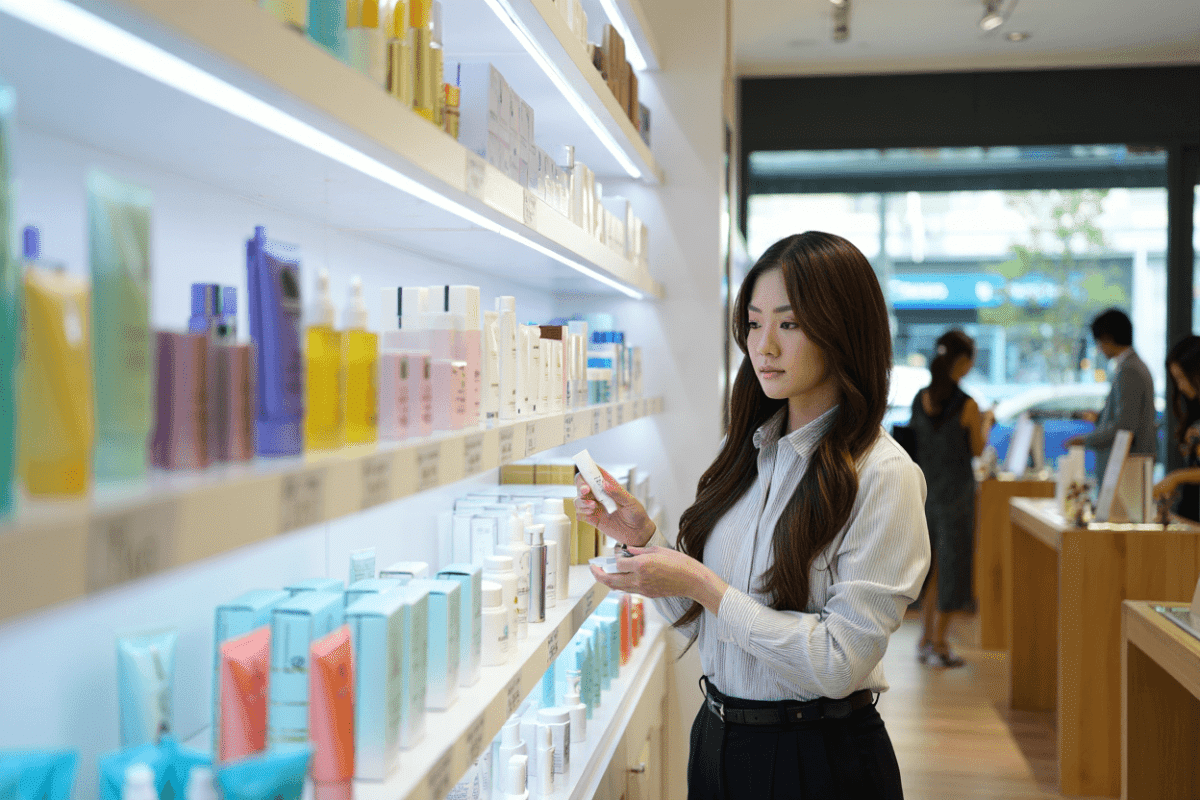
Olive Young, South Korea’s dominant K-beauty and wellness retailer, officially opened its first U.S. retail store in Pasadena, California on May 29, 2026, bringing curated access to approximately 400 beauty brands and 5,000 SKUs to American consumers. The 8,647-square-foot flagship at 58 W Colorado Boulevard represents a watershed moment for the K-beauty industry in America, marking Olive Young’s maiden overseas physical store and concluding a strategic 8-month U.S. entry preparation that began with the company establishing a dedicated American subsidiary in February 2026.
🔥 Quick Facts
- Olive Young opened its first U.S. store on May 29, 2026, in Pasadena, California
- The flagship carries approximately 400 brands and 5,000 SKUs across skincare, makeup, wellness, and inner beauty
- Olive Young operates 1,360+ stores across South Korea and dominates the domestic market since 1999
- A second U.S. store at Westfield Century City in Los Angeles is planned for 2026
- The company launches dedicated U.S. e-commerce platform alongside retail expansion
Olive Young’s Strategic Path to American Entry
Olive Young’s arrival in Pasadena punctuates a carefully orchestrated expansion strategy designed to target the rapidly growing American K-beauty consumer base. Founded in 1999 in South Korea, the retailer fundamentally reshaped beauty retail by treating wellness and K-beauty products as a unified lifestyle category—a model that struggled to gain domestic traction in the U.S. market until recent years.
The Pasadena location signals a deliberate West Coast strategy. California’s demographics—high K-beauty consumption, significant Korean American population, dense beauty-conscious millennial and Gen Z demographics—make it an optimal testing ground. The company established its U.S. subsidiary in Los Angeles in February 2026, laying groundwork for both immediate retail deployment and long-term logistics infrastructure. Industry analysis suggests the Pasadena store functions as an “advance base,” as described by executives, to validate operational models before broader U.S. market expansion.
This calculus differs markedly from typical fast-fashion retail expansion. Rather than rapid store proliferation, Olive Young prioritizes experience-focused flagships in high-traffic locations. The Pasadena store emphasizes curated discovery over volume, aligning with parent company CJ Group’s philosophy that healthy beauty requires expert curation backed by data analytics.
The Pasadena Flagship: Product Depth and Market Positioning
The Pasadena store’s product assortment reflects Olive Young’s U.S. stratagem of quality depth over breadth. At approximately 400 brands and 5,000 stock-keeping units (SKUs), the store surpasses typical Sephora locations in K-beauty inventory while remaining focused. Notable brands expected to anchor the curated section include Beauty of Joseon, Anua, Purito Seoul, Cosrx, and Hada Labo—all premium K-beauty labels positioned at the intersection of efficacy and accessibility.
The store’s square footage—8,647 square feet across a single level—enables experiential retail often absent in American beauty shopping. Demo stations, skin analysis technology, and staff trained in K-beauty ingredient literacy distinguish the format from Sephora or traditional department store beauty counters. Opening hours reflect California’s evening shopping culture: 10 AM to 8 PM Monday through Thursday and Sunday; 10 AM to 9 PM Friday and Saturday (Pacific Time).
Product categories span five core pillars: skincare, makeup, hair care, wellness supplements, and “inner beauty” offerings (collagen drinks, functional beverages). This wellness-integrated approach directly challenges the U.S. retail norm of compartmentalized beauty shopping and reflects K-beauty’s holistic beauty philosophy.
Competitive Landscape and Sephora Partnership
The Pasadena entrance parallels a significant industry shift: in late 2025, Sephora announced a strategic partnership with Olive Young to introduce curated K-beauty selections into Sephora stores and digital platforms beginning in late 2026. This dual-channel approach—company-operated flagships plus partner retail distribution—mirrors strategies deployed by luxury conglomerates like LVMH, where owned stores drive brand narrative while partner channels maximize market penetration.
Olive Young’s U.S. positioning explicitly targets market gaps overlooked by Sephora. Where Sephora historically focused on mainstream Western brands with selective K-beauty curation, Olive Young inverts the model: K-beauty as the dominant narrative with emerging Western indie and established brands as secondary. This differentiation is deliberate. K-beauty consumption in America has grown 40% year-over-year since 2023, driven by TikTok-fueled discovery, dermatologist endorsements of Korean formulation science, and Gen Z skepticism of traditional beauty marketing.
Operational Infrastructure and E-Commerce Integration
Olive Young’s retail-first approach belies sophisticated omnichannel logistics. The company simultaneously launched a dedicated U.S. e-commerce platform (us.oliveyoung.com) on May 29, 2026, coordinating digital and physical inventory. This integrated approach contrasts with competitors who treat online and offline channels as separate P&Ls.
From a supply-chain perspective, the U.S. subsidiary positioned inventory distribution centers to service both the Pasadena flagship and the planned Westfield Century City location in West Los Angeles. The second store—also experience-focused—targets the affluent, beauty-conscious Century City demographic. Both locations anchor a California-wide expansion roadmap for 2026-2027, with retail expansion into other major U.S. metropolitan areas dependent on Pasadena performance metrics.
What This Means for the U.S. K-Beauty Market
Olive Young’s U.S. entry signals institutional confidence in K-beauty as a permanent market category, not a trend. When South Korea’s largest beauty retailer—commanding 20%+ of Korea’s domestic beauty retail market—allocates capital to U.S. expansion, it validates market maturation theories. Sephora’s partnership announcement, reportedly struck months before Olive Young’s store opening, indicates defensive positioning: secure K-beauty supply relationships before Olive Young captures market mindshare.
For American consumers, the implications are straightforward: authentic K-beauty retail, native Korean brand representation, and operational models designed around ingredient science rather than fragrance-centered beauty merchandising. The Pasadena store’s May 29 opening coincides with peak beauty shopping season (approaching summer vacation prep), giving Olive Young optimal consumer volume to stress-test operations and brand messaging.
Industry observers tracking K-beauty’s mainstream inflection point cite this Pasadena opening as indicative. Korean brands have penetrated U.S. retail incrementally—through Sephora, YesStyle, Amazon, independent boutiques. Olive Young’s owned-retail model represents vertical integration: controlling both discovery and transaction in a single location, data-capturing consumer behavior at unprecedented granularity.
What Questions Remain About U.S. Market Success?
Will American consumers embrace a K-beauty-centric retail model, or do they prefer Korean brands positioned within familiar Western retail frameworks? Olive Young’s original success in South Korea relied on Korean consumer cultural identity—the assumption that Korean brands (made by Korean scientists studying Korean skin) resonated with Korean shoppers. The U.S. market lacks that cultural baseline. K-beauty appeals through credibility, ingredient transparency, and TikTok discovery, not nationality.
Success metrics will include foot traffic, basket size, repeat customer rates, and most critically, online-to-offline conversion data. Does the Pasadena flagship drive omnichannel engagement, or does it function as a destination tourist attraction with limited ongoing engagement? A second indicator: the Westfield Century City store timeline. If Olive Young accelerates this opening (planned for later in 2026) based on strong Pasadena metrics, expect rapid expansion announcements into New York, Miami, and Chicago by late 2026.
Sources
- CJ Newsroom – Official announcement of Olive Young Pasadena opening, inventory, and operational details
- Women’s Wear Daily (WWD) – U.S. expansion strategy and market positioning analysis
- The Wall Street Journal – Korean beauty giant market entry and competitive implications
- Global Cosmetics News – Product assortment and e-commerce launch details
- Pasadena Star News – Local retail implications and opening date confirmation