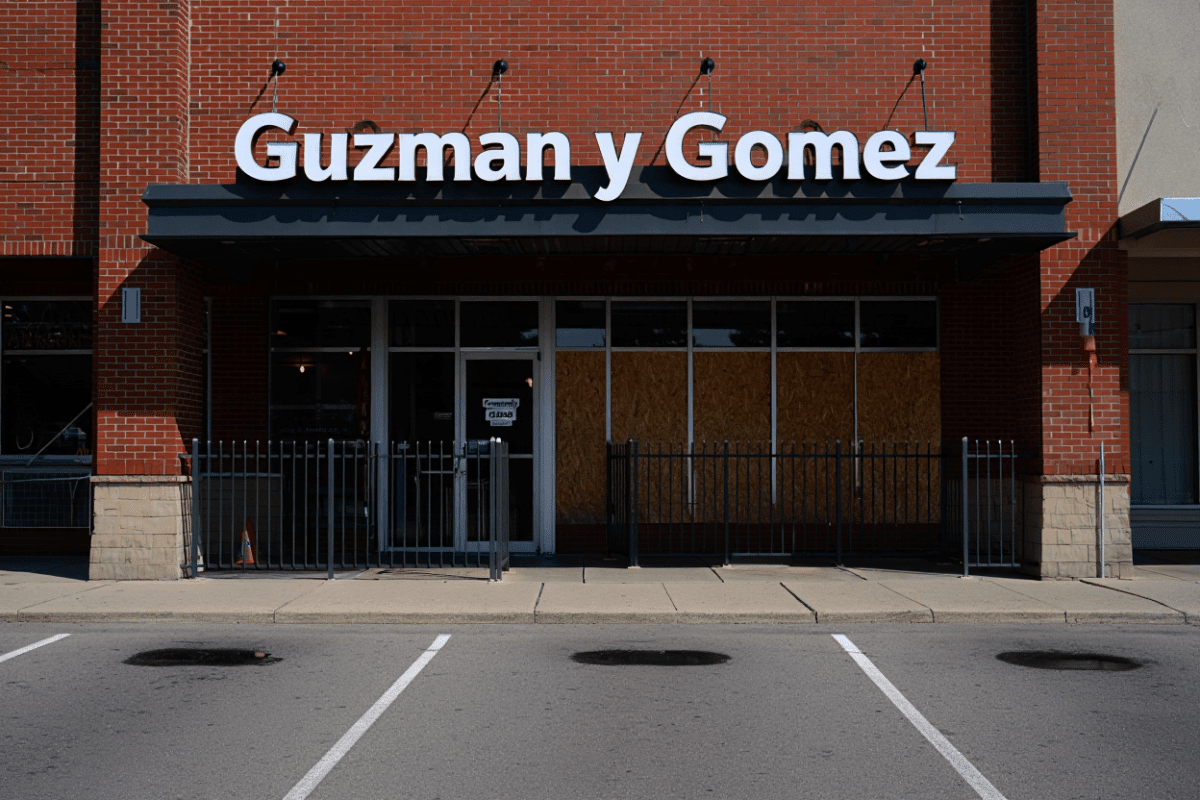
Guzman y Gomez, the Australian fast-casual Mexican chain founded by Steven Marks and Robert Hazan, abruptly closed all 8 US locations across the Chicago area on May 22, 2026, ending its 6-year expansion into the American market. The company—which had invested approximately $115 million into the US venture—cited poor financial performance as the reason for the immediate exit. The closure underscores a pattern of failed international expansion attempts by Australian restaurant chains in a highly competitive US market dominated by established players like Chipotle and Taco Bell.
🔥 Quick Facts
- All 8 US restaurants closed across Chicago area on May 22, 2026
- $115 million invested in failed US expansion over 6 years
- Stock surge of 20% following US exit announcement
- Company continues operating 240+ locations in Australia, Japan, and Singapore
- Class action lawsuit filed by workers over sudden termination
How Guzman y Gomez Built Its US Presence
Guzman y Gomez, founded in Sydney in 2006, established itself as a premium fast-casual competitor to Chipotle with fresh ingredients and customizable bowls and burritos. The chain expanded successfully across Australia, Japan, and Singapore, eventually operating over 200 locations globally. International success prompted the company to target the US market in 2020, focusing initially on the Chicago area—a region with established Mexican cuisine preferences and significant food-service competition.
Founder Steven Marks, a New York native, relocated to Chicago to personally oversee the expansion, signaling the company’s commitment to penetrating American customers. This represents a significant personal investment in the venture. The chain opened 8 locations across the greater Chicago region, including areas like Schaumburg, Naperville, and Evanston, targeting suburban families and young professionals who frequented fast-casual Mexican concepts.
What Went Wrong: Market Penetration Challenges
Despite $115 million in investment over six years, Guzman y Gomez failed to achieve acceptable financial returns. According to Marks during earnings calls, “financial performance of the US business has not been acceptable and is not capable of justifying the continued substantial investment required to build out a presence in the US market.” This statement provides key insight: the company had calculated the cost-to-profitability ratio and determined the investment was economically unsustainable.
The US fast-casual Mexican sector represents one of the most saturated segments in American food service. Chipotle Mexican Grill operates over 3,200 locations across North America, while Taco Bell maintains 8,000+ locations. Qdoba, another direct competitor, offers similar price points and menu customization. For an unknown Australian brand entering this landscape, customer acquisition costs proved prohibitively high. Market analysts noted that GYG charged premium prices ($14-16 for bowls) similar to Chipotle, but lacked the brand recognition that drives traffic.
The Broader Pattern: The “Graveyard” of Australian Chains
The collapse of Guzman y Gomez’s US operations reflects a troubling trend. Crust Pizza, an Australian pizza chain, attempted US expansion and failed. Oporto, another Australian brand, also abandoned US operations. According to industry analysts quoted in coverage by The Guardian, the US market has become a “graveyard” for Australian fast-food chains attempting global expansion without sufficient market differentiation.
Several factors contribute to this pattern: (1) Regulatory complexity — US food safety, labor, and franchise laws differ significantly from Australia; (2) Real estate costs — Chicago suburban rents increased post-pandemic, eroding unit economics; (3) Labor availability and wages — US fast-casual chains face wage pressures ($17-20/hour in Illinois) that compress margins further; (4) Cultural preferences — American consumers favor established brands with deep local heritage over unknown imports.
Financial Impact and Market Reaction
| Metric | Details |
| Total US Investment | $115 million (6-year period) |
| Locations Closed | 8 restaurants (100% of US operations) |
| Stock Movement (May 21) | +20.58% (reached A$20.61) |
| Global Operations Unaffected | 240+ locations across Australia, Japan, Singapore |
| Announcement Date | May 22, 2026 (Friday earnings call) |
| Effective Closure Date | Immediate (May 22, 2026) |
The 20% stock surge following the announcement reflects investor sentiment that the company was better off cutting losses than continuing to hemorrhage capital in an unprofitable market. This represents a shift in strategy toward geographic consolidation—focusing resources on mature, profitable markets rather than pursuing growth in highly competitive regions. Analysts interpreted the move positively for shareholder value, suggesting that the US expansion had been viewed pessimistically by the market for years.
“The financial performance of the US business has not been acceptable and is not capable of justifying the continued substantial investment required to build out a presence in the US market.”
— Steven Marks, Co-Founder and Co-CEO, Guzman y Gomez
Consequences for Employees and Legal Challenges
The closure triggered immediate legal action. Workers at shuttered Chicago-area locations filed a class action lawsuit against Guzman y Gomez, alleging violations of federal labor law. The complaint centers on claims that the company terminated approximately hundreds of employees without adequate notice or severance, potentially violating the WARN Act (Worker Adjustment and Retraining Notification Act), which requires 60 days’ notice for mass layoffs. A Guardian report published May 25, 2026 stated that workers received termination notices with insufficient compensation and allegedly lacked proper closure procedures.
This legal exposure represents an additional financial burden. Employment litigation in Illinois typically results in settlements ranging from thousands to millions of dollars, depending on the number of employees and wage losses claimed. The company’s abrupt closure strategy, while designed to minimize operational losses, may cost significantly more in legal settlements.
What This Reveals About International Expansion Strategy
The Guzman y Gomez case demonstrates that strong domestic performance does not guarantee international success. Despite 240+ profitable locations across its core markets, the company underestimated the barriers to US entry. Key lessons include: (1) Market saturation matters more than brand quality — superior food alone cannot overcome entrenched competition; (2) Founder involvement insufficient — despite Marks’ relocation to Chicago, organizational factors beyond personal leadership drive outcomes; (3) US fast-casual market consolidation favors scale and brand power, making it difficult for new entrants; (4) Regional focus strategy may be superior to global diversification for restaurant operators.
Successful international restaurant expansion—such as Chipotle’s entry into European and Asian markets—typically requires either: (a) a distinctive, defensible concept unavailable locally, or (b) willingness to operate at losses for 5-10 years to build brand awareness. Guzman y Gomez appeared to lack both the differentiation and patience. The company’s menu replicated Chipotle’s format closely (bowls, burritos, customization), offering incremental improvements rather than genuinely novel offerings that might justify premium positioning against entrenched competitors.
Will Guzman y Gomez Return to the US Market?
Company leadership has not ruled out future US expansion, but investor sentiment and financial realities suggest this is unlikely in the medium term. Marks emphasized that resources will now focus on 5-country expansion within Australia itself—specifically targeting 1,000 additional locations domestically. This pivot suggests the company views its domestic market as far more attractive than international growth. Australia’s population of 26 million provides significant untapped geographic potential, with less fierce competition than the US market.
If the company were to return to the US, it would likely require: (1) new investor capital or partnerships; (2) a fundamental repositioning of menu or value proposition; or (3) acquisition by a larger parent company that could absorb losses. None of these scenarios appear imminent. For current American consumers who enjoyed Guzman y Gomez burritos, the closure represents a permanent loss of a competing option in their local markets.
Sources
- Fox Business (May 24, 2026) — Guzman y Gomez closure announcement and market context
- Chicago Tribune (May 22, 2026) — Local operational details and co-CEO statements
- The Guardian (May 22, 2026) — Industry analysis and Australian restaurant expansion patterns
- Wall Street Journal (May 21, 2026) — Financial performance and US market challenges
- Reuters (May 21, 2026) — Stock performance and investor reaction
- CNBC (May 22, 2026) — Market analysis of exit strategy