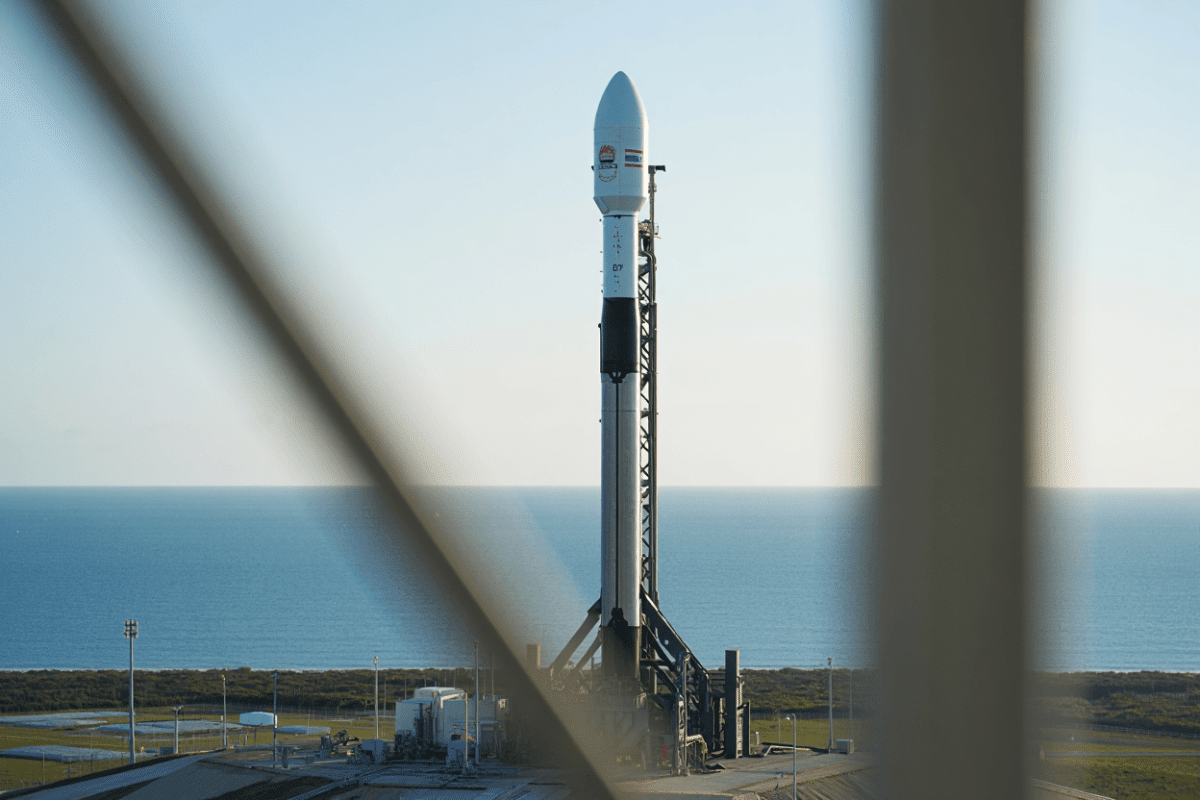
SpaceX is targeting a 6:04 AM EDT launch on May 21, 2026 from Space Launch Complex 40 (SLC-40) at Cape Canaveral Space Force Station to deploy 29 Starlink satellites into low Earth orbit. The Falcon 9 Block 5 rocket will carry the Starlink Group 10-31 mission, continuing SpaceX’s rapid deployment cadence that has already placed over 10,296 satellites in the constellation as of early May. This early morning launch represents another routine addition to the global broadband network serving 2.7+ million active customers across expanded service regions.
🔥 Quick Facts
- 29 Starlink satellites scheduled for deployment to low Earth orbit
- Launch window: 5:26 AM to 9:26 AM EDT on May 21, 2026, from Florida
- Falcon 9 Block 5 first stage has achieved 611 successful recoveries from 624 attempts
- Starlink constellation grew by 2.7 million customers in the past year alone
- Expected deployment altitude: 550 km (342 miles) above Earth’s surface
The Falcon 9 Block 5: SpaceX’s Proven Workhorse
The Falcon 9 Block 5 represents the most advanced variant of SpaceX’s reusable orbital rocket, equipped with 9 Merlin engines generating 1.71 million pounds of thrust at liftoff. Each Merlin engine produces 125,000 pounds of thrust individually, combining liquid oxygen and rocket-grade kerosene as propellant. This configuration delivers 8,227 kilonewtons (1.85 million pounds force) in vacuum, with a sea-level specific impulse of 283 seconds and vacuum performance reaching 312 seconds—metrics that define the rocket’s efficiency across atmospheric and space phases. The Block 5 upgrade introduced higher-thrust engines compared to earlier variants, streamlined recovery mechanisms, and improvements to landing legs that enhance turnaround time between flights. SpaceX has optimized the first stage refurbishment process to cost approximately $1 million per booster reuse, fundamentally changing spaceflight economics.
The reusability edge of the Falcon 9 Block 5 cannot be overstated. Since the historic December 21, 2015 successful landing of the first orbital-class rocket booster, SpaceX has landed and recovered 611 first-stage boosters out of 624 attempts, achieving a 97.9% success rate. Leading boosters have flown as many as 34 times, demonstrating that reusability at scale is not merely theoretical. This track record has reduced launch costs dramatically and accelerated SpaceX’s cadence to multiple missions per week across facilities in Florida and California.
Starlink Group 10-31: Expanding Global Coverage
The 29 satellites in this batch join a constellation that has grown exponentially. As of May 5, 2026, 10,296 Starlink satellites were operational in orbit, with 10,280 working properly according to independent tracking. Starlink expanded to 42 new countries and territories in the past year and increased its active subscriber base by over 2.7 million customers, reaching critical mass in markets across Europe, Asia-Pacific, and the Americas. The constellation now supports both fixed residential broadband and expanding maritime and aviation connectivity services.
The Group 10-31 mission payload will be deployed to approximately 550 kilometers (342 miles) altitude, which is the operational height of SpaceX’s primary second-generation Starlink shells. However, a significant infrastructure upgrade is underway: SpaceX announced plans to lower approximately 4,400 satellites orbiting at 550 km to 480 km (298 miles) throughout 2026. This lowering improves latency further—critical for competitive advantage in gaming, video conferencing, and real-time trading applications. A related article on recent high-growth tech exits highlights how infrastructure investments by companies like SpaceX drive broader economic momentum in the connectivity sector.
Mission Performance and Technical Specifications
| Specification | Value |
| Rocket | Falcon 9 Block 5 |
| Launch Site | SLC-40, Cape Canaveral SFS, Florida |
| Launch Time (EDT) | 6:04 AM (Window: 5:26–9:26 AM) |
| Payload | 29 Starlink Satellites (Group 10-31) |
| Target Orbit | 550 km (342 mi) low Earth orbit |
| First Stage Thrust | 1.71 million pounds at liftoff |
| Vacuum Thrust | 8,227 kN (1.85M lbf) |
| Primary Engines | 9 Merlin sea-level + 1 Merlin vacuum |
| Booster Recovery Target | Autonomous Spaceport Drone Ship (ASDS) |
| Booster Success Rate | 611 of 624 (97.9%) |
Flight duration from ignition to satellite deployment typically spans 60-65 minutes for Starlink missions. The first stage will ignite its 9 sea-level Merlin engines, accelerate the rocket through the densest atmospheric layers, separate at roughly 70 kilometers altitude, and execute a powered descent for landing. Meanwhile, the second stage—powered by a single Merlin Vacuum engine rated at 981 kN (220,500 lbf)—will continue to orbit, deploy the 29 satellites, and execute deorbit burns. This division of labor has become routine: SpaceX has successfully landed boosters while upper stages delivered payloads to precise orbital slots hundreds of times.
“Reusability allows SpaceX to refly the most expensive parts of the rocket, which in turn drives down the cost of space access.”
— SpaceX Official, Falcon 9 Launch Services
Starlink’s Competitive Advantage in Satellite Internet
The Starlink constellation’s rapid expansion reflects SpaceX’s strategic focus on coverage density and latency reduction. With over 10,296 satellites now operational, the network achieves global coverage while maintaining latency targets under 50 milliseconds—competitive with fiber in many markets. The recent growth of Elon Musk’s net worth is substantially driven by Starlink’s market expansion, reflecting investor confidence in the service’s revenue trajectory.
Starlink aims to achieve download speeds exceeding 1 gigabit per second by late 2026 through deployment of third-generation satellites offering over 1 terabit per second downlink capacity and 200 gigabits per second uplink per satellite. The competitive landscape has intensified: Amazon’s Project Kuiper, OneWeb, and other LEO operators are launching competing constellations, making each deployment mission critical for market share. SpaceX’s current 1000+ launches-per-year cadence provides decisive first-mover advantage in delivering satellite density ahead of competitors’ rollout schedules.
Why Today’s Launch Matters for the Broader Market
Routine Starlink deployments like Group 10-31 represent capital-intensive, sustained infrastructure investment that underpins future profitability. Each satellite carries multi-year operational lifespan, contributing revenue from day one of commercial service. The $10 billion constellation cost has been amortized across thousands of launches, and unit economics improve with scale. Financial markets view continued Starlink launches as validation of SpaceX’s execution capability and cash generation potential—factors that influence valuation in potential future IPO scenarios. Recent developments in adjacent sectors, such as cloud infrastructure growth, demonstrate investor appetite for high-margin connectivity and data platforms where Starlink plays a strategic role.
For consumers across the US, each launch inches closer to ubiquitous broadband coverage in rural regions where terrestrial options remain limited or prohibitively expensive. SpaceX’s aggressive schedule targets continuous network redundancy and service reliability improvements. The company has already demonstrated maritime and aviation partnerships, laying groundwork for revenue diversification beyond traditional fixed residential service.
What to Expect Post-Launch?
Following the 6:04 AM EDT liftoff, live video feeds will be available from SpaceX’s official channels. The booster landing typically occurs 8–10 minutes after liftoff on the autonomous drone ship stationed in the Atlantic. Satellite deployment occurs roughly 40–60 minutes into the flight once the upper stage reaches final orbital altitude. SpaceX publishes mission status updates in real-time; no official public admission of failure is made until all recovery and deployment data is confirmed. For tracking purposes, newly deployed satellites become visible from ground-based telescope networks within 24 hours and reach full operational status after drift-to-operational-orbit maneuvers conclude over 2–4 weeks. Will the continuous deployment cadence prove sufficient to Starlink’s revenue growth targets, or will competitive pressure from Amazon, OneWeb, and others reshape the satellite internet market before SpaceX achieves monopoly-grade coverage? The answer will unfold across dozens of similar launches through 2026–2027.