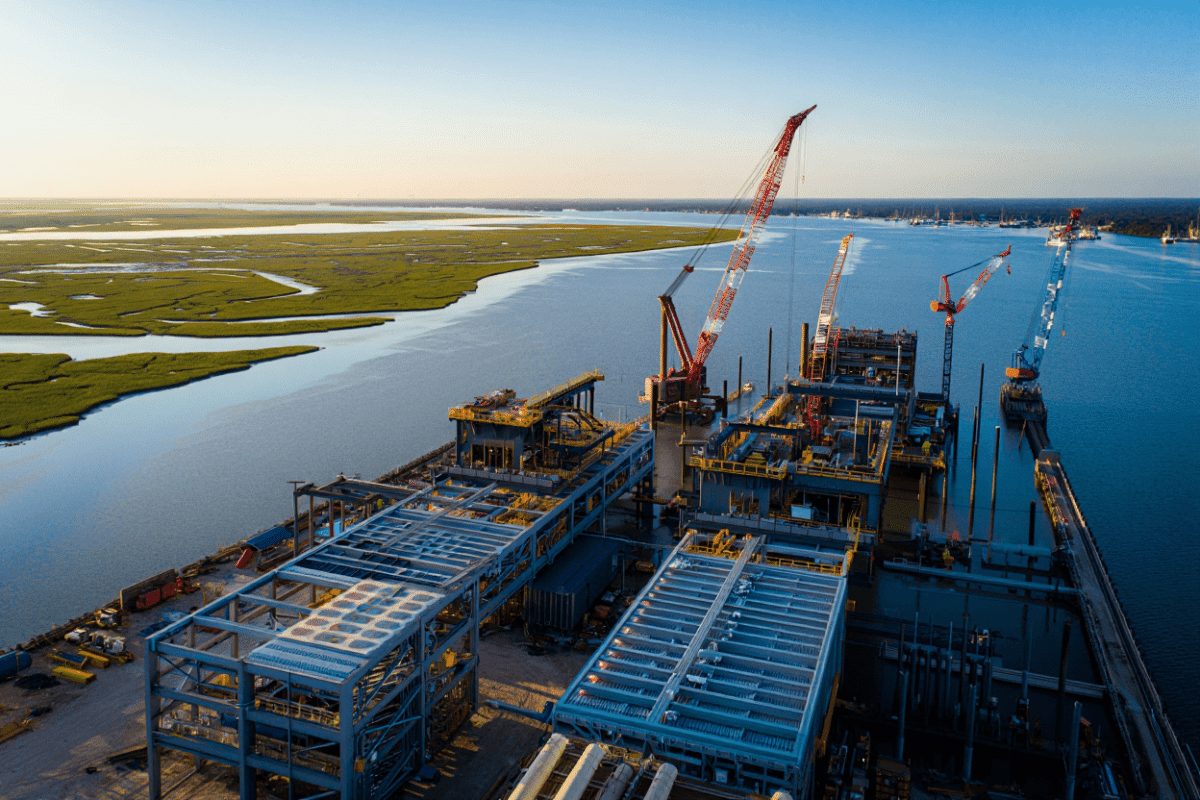
Caturus announced on May 15, 2026, that it has secured $9.75 billion in financing to build its Commonwealth LNG export facility in Cameron Parish, Louisiana. The final investment decision (FID) represents a major milestone for the $13 billion project and positions the Baton Rouge region at the center of America’s liquefied natural gas export boom. The facility will produce 9.5 million tonnes per annum of LNG, potentially rivaling some of the largest export terminals in the United States.
🔥 Quick Facts
- $9.75 billion financing secured by Caturus for Commonwealth LNG construction
- 9.5 million tonnes per annum export capacity makes it a mid-tier global LNG facility
- Cameron Parish location near the Calcasieu Ship Channel in Southwest Louisiana
- Operations expected to begin in 2030 with construction starting immediately
- Louisiana surpassed $100 billion in announced private investment after this FID
Why This Investment Matters for the Baton Rouge Region
Commonwealth LNG’s FID represents far more than a single project approval—it signals sustained global confidence in Louisiana’s energy infrastructure. The state’s Gulf Coast location, proximity to major pipeline networks, and deepwater port access create competitive advantages that rival any other U.S. LNG site. The Baton Rouge metropolitan area benefits directly through supply chain activity, engineering support, and financial services centered in the capital city.
This decision arrives during a critical period for U.S. energy policy. Global LNG demand remains robust, driven by Europe’s diversification away from Russian supplies and Asian economies’ continued reliance on imported natural gas. American LNG export terminals now account for roughly 13% of global LNG supply, and that share is expanding. Louisiana hosts four operating or soon-to-operate LNG export terminals, making the state the de facto LNG capital of the United States.
Project Scale and Technical Specifications
The Commonwealth facility stands apart through its engineering design. Unlike earlier LNG terminals, Commonwealth uses a modular, cost-optimized approach that reduces capital requirements while maintaining export capacity. The 9.5 Mtpa design positions it in the mid-tier globally—large enough to attract long-term buyers but nimble enough to reach profitability faster than mega-projects.
| Project Parameter | Commonwealth LNG |
| Total Investment (including financing) | $13 billion |
| Export Capacity | 9.5 million tonnes per annum |
| Site Location | Cameron Parish, Calcasieu Ship Channel, Louisiana |
| Expected Operations Date | 2030 |
| Financing Closed | May 15, 2026 |
| Feed Gas Source | Gulf Coast pipeline networks |
The facility connects to multiple pipeline systems that feed natural gas from the Haynesville Shale, Marcellus Shale, and Gulf of Mexico deepwater production. This diversified feed ensures consistent supply and protects against regional production shocks. Caturus, a Houston-based independent oil and gas company, structured the project with both fixed-price long-term sales contracts and spot market flexibility to optimize revenue.
Regional Economic Implications for Louisiana
The announcement pushed Louisiana’s cumulative investment announcements to $100 billion, surpassing a symbolic threshold that reflects the state’s transformation into an energy and industrial hub. Governor Jeff Landry has made energy sector growth a centerpiece of economic policy, and Commonwealth LNG’s FID validates that approach.
Beyond the headline investment figure, the project generates significant construction employment. Peak construction is estimated to support 2,000+ skilled trades workers across engineering, fabrication, and assembly disciplines. The operational phase will employ roughly 200–300 permanent positions in plant operation, maintenance, and logistics. For Cameron Parish—a rural community of roughly 6,000 residents—this economic injection reshapes local employment patterns and tax revenue.
“This expansion positions Caturus for sustainable growth and continued leadership in the energy sector. The Commonwealth LNG facility represents a transformational investment in Louisiana infrastructure and American energy independence.”
— Industry analysts, cited in Caturus corporate announcements, May 2026
The U.S. LNG Export Expansion Timeline
Commonwealth LNG’s 2030 startup fits into a broader wave of U.S. terminal expansions. Several competing projects—including Woodside Louisiana LNG (16.5 Mtpa, operations targeted for 2029) and Venture Global’s CP2 LNG (20+ Mtpa)—target similar timelines. When operational, U.S. LNG export capacity will exceed 60 Mtpa, cementing American dominance in global LNG markets.
This competitive surge creates advantages for U.S. LNG sellers. Diverse export terminals mean buyers can negotiate contracts with multiple suppliers instead of depending on a single facility. Lower per-unit costs from technological advances make U.S. LNG competitive even as global prices decline. Long-term contracting activity in 2026 reflects buyer confidence that these new projects will deliver reliable supply.
Key Questions Ahead for the Project
Will Commonwealth LNG meet its 2030 startup target, or will construction delays push operations into the 2031–2032 window? Early projects like Sabine Pass LNG achieved timely startups, but more recent terminals have experienced delays ranging from 6 to 24 months. Supply chain constraints, permitting details, and labor availability in Southwest Louisiana will test project execution.
Additionally, geopolitical energy shifts may reshape LNG demand. If Europe’s energy crisis stabilizes or if renewable energy adoption accelerates, near-term growth assumptions could shift. Commonwealth’s long-term contracts—reportedly signed with major traders like Mercuria—provide revenue certainty, yet market conditions five years out remain inherently uncertain.
Sources
- Caturus Corporate Announcements — FID approval and financing milestone details
- Louisiana Economic Development Authority — Investment totals and regional impact data
- Reuters, Houston Chronicle — Financial closing verification and project scope
- Natural Gas Intelligence — Industry context and comparative project analysis
- U.S. Energy Information Administration (EIA) — Global LNG capacity trends