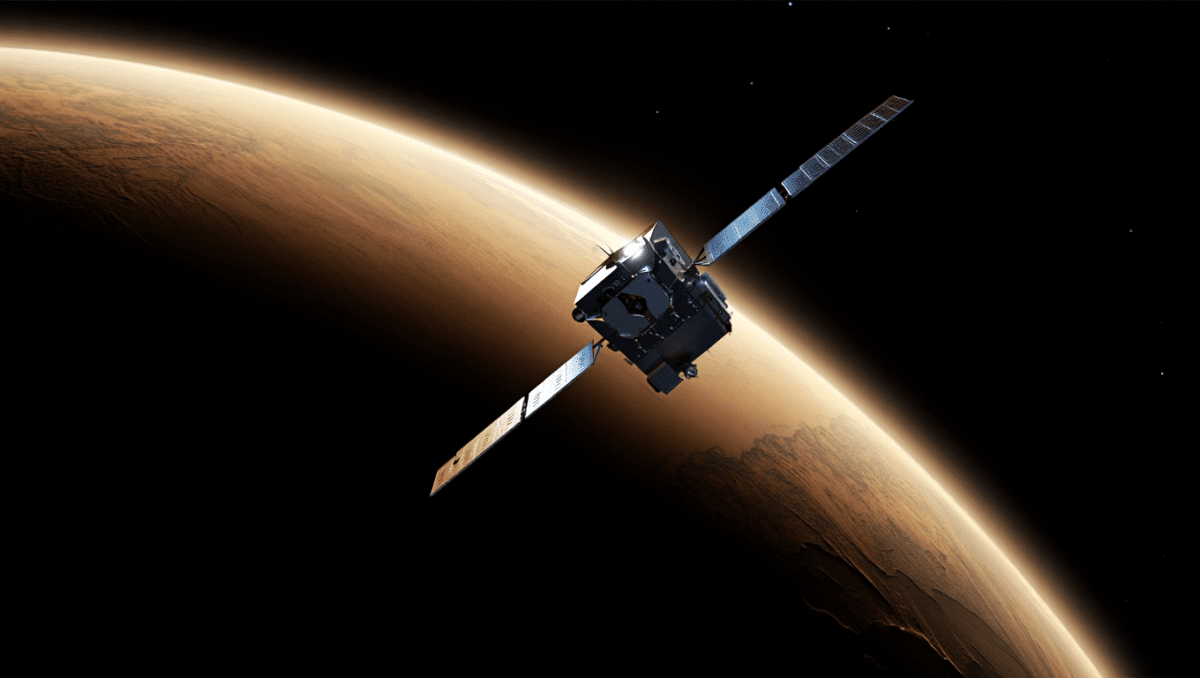
NASA’s Psyche spacecraft just completed a dramatic Mars flyby today, skimming closer than typical orbits at blistering speeds. This close encounter marks a critical milestone toward reaching an asteroid worth more than Earth’s entire economy.
Today, May 15, 2026, the Psyche mission executed its Mars planetary gravity assist, passing just 2,800 miles above the Red Planet’s surface at 12,333 mph. The spacecraft is accelerating toward an extraordinary destination in the asteroid belt.
🔥 Quick Facts
- Flyby Date: May 15, 2026, at approximately 2,800 miles from Mars’ surface
- Spacecraft Speed: 12,333 mph during the gravity assist maneuver
- Mission Launch: Psyche launched on October 13, 2023, from Kennedy Space Center
- Asteroid Arrival: Expected in late July or August 2029 to begin orbital study
Why This Space Exploration Milestone Matters for Science
The Psyche spacecraft just used Mars’ gravity like a cosmic slingshot, gaining acceleration without burning precious fuel. This gravity assist technique saves propellant and refines the spacecraft’s trajectory toward its destination. Scientists described this moment as a critical checkpoint on the journey to study one of the most unusual objects in the solar system.
NASA mission planners emphasized that today’s flyby provides more than just a velocity boost. The encounter allows the spacecraft’s instruments, particularly the multispectral imager, to conduct critical calibration tests. These observations will improve accuracy when the spacecraft reaches asteroid 16 Psyche later this decade.
The Crescent Mars Views Captured During Approach
On May 3, 2026, twelve days before today’s dramatic close pass, the Psyche spacecraft captured stunning images of Mars as a thin crescent. The unusual angle of approach means the planet appeared like a sliver, similar to a crescent Moon seen from Earth. Sunlight reflected through the Martian atmosphere created an extended glow around the planet’s silhouette.
Mission specialists expect to process multiple observations during the encounter itself. A time-lapse video of today’s flyby should emerge in coming weeks, revealing details about the spacecraft’s closest approach and departure. The gamma-ray and neutron spectrometer is also measuring changes in cosmic ray intensity as Psyche passes near Mars’ magnetic field.
Understanding 16 Psyche, the Metal-Rich Asteroid Target
Asteroid 16 Psyche represents one of space exploration’s greatest scientific mysteries. Located in the asteroid belt between Mars and Jupiter, this 220-kilometer-wide body contains approximately 1% of all asteroid belt material. Scientists believe it may be the exposed metal core of a failed planet from the early solar system.
| Characteristic | Details |
| Diameter | Approximately 220 to 222 kilometers (140 miles) |
| Composition | 30-60% metal, with nickel and iron-rich mixture |
| Location | Main asteroid belt between Mars and Jupiter |
| Significance | Possible exposed core of early protoplanet, unlocks planetary formation secrets |
“We are now exactly on target for the flyby, and we have programmed the flight computer with everything that the spacecraft will do throughout May. This is our first opportunity in flight to calibrate Psyche’s imager with something bigger than a few pixels, and we will also make observations with the mission’s other science instruments.”
— Sarah Bairstow, Psyche Mission Planning Lead, NASA Jet Propulsion Laboratory
How the Gravity Assist Changes Everything for Psyche’s Journey
Gravity assists represent one of space exploration’s most elegant physics solutions. Rather than relying solely on thrusters to change course, Psyche used Mars’ immense gravitational pull to alter velocity and orbital plane. Today’s maneuver saves fuel while accelerating the spacecraft toward its 2029 destination.
Mission teams at NASA’s Jet Propulsion Laboratory confirmed the spacecraft is performing flawlessly. Navigation data from NASA’s Deep Space Network tracked Psyche throughout the encounter, measuring slight Doppler shifts in radio signals that revealed the spacecraft’s new velocity and trajectory. Multiple Mars orbiters and rovers, including Mars Reconnaissance Orbiter, Curiosity, and Perseverance, coordinated observations to validate Psyche’s instruments and gather complementary data.
What Will Scientists Discover When Psyche Reaches the Metal Asteroid in 2029?
When Psyche arrives at asteroid 16 Psyche in late 2029, it will become the first spacecraft ever to closely study a metal-rich asteroid. Scientists expect groundbreaking insights into how planets form and why some planetary cores remain exposed. The multispectral imager, magnetometer, and gamma-ray spectrometer will map the asteroid’s composition, magnetic properties, and internal density variations.
Understanding 16 Psyche’s structure could revolutionize planetary science by revealing how Earth and other rocky planets developed their metal cores billions of years ago. The spacecraft’s data may answer fundamental questions about planetary differentiation and the violent collisions that shaped our solar system during its chaotic first million years.
Watch: NASA’s Psyche Spacecraft Prepares for Mars Flyby

Sources
- NASA Science – Official mission updates on Psyche’s gravity assist and Mars flyby procedures
- NASA Jet Propulsion Laboratory – Real-time flight operations and spacecraft telemetry analysis
- Arizona State University – Scientific oversight and imaging instrument calibration data