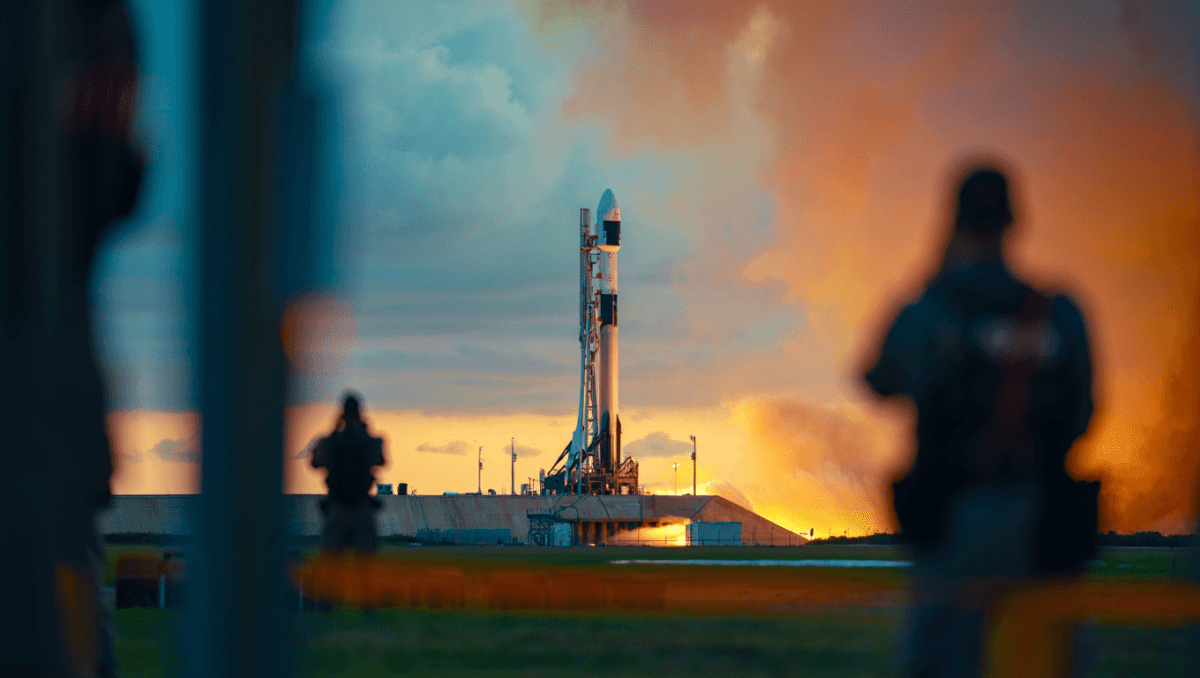
SpaceX’s Falcon 9 launches CRS-34 resupply mission to the International Space Station today from Florida. The Dragon spacecraft carries 6,500 pounds of critical supplies and science experiments. Liftoff is targeted for 4:16 p.m. PST from Cape Canaveral Space Force Station.
🔥 Quick Facts
- Launch Time: May 12, 2026 at 4:16 p.m. PDT (7:16 p.m. EDT) from Space Launch Complex 40
- Cargo Payload: 6,500 pounds of science, supplies, and equipment for the ISS
- Mission Number: 34th Commercial Resupply Services mission, marking another cargo success
- Dragon Reuse: Cargo Dragon C208-5 flying its 6th mission to support space exploration
Historic Launch Marks 34 Successful Cargo Deliveries
SpaceX’s Falcon 9 rocket stands ready to deliver critical cargo to humanity’s orbital laboratory. The CRS-34 mission represents 34 consecutive successful resupply flights for NASA since 2012. Each mission strengthens America’s leadership in commercial spaceflight. The Dragon spacecraft design has become synonymous with reliability and mission success in low-Earth orbit operations.
This launch demonstrates SpaceX’s operational tempo and proven booster recycling program. Booster B1096 has been carefully refurbished for another flight. The reusability of rockets continues cutting costs while maintaining perfect safety records. Industry observers credit this efficiency as key to America’s space competitiveness.
6,500 Pounds of Innovation Heading Skyward
The Dragon cargo module carries over 6,500 pounds of carefully selected experiments and supplies. Science investigations ranging from biology research to physical experiments will advance human knowledge aboard the station. Critical crew provisions, equipment replacements, and hardware upgrades also ride this vehicle to orbit.
Unpressurized cargo in Dragon’s trunk includes essential hardware for station maintenance. The modular design allows flexibility for mission-specific requirements. NASA’s Commercial Resupply Services program continues demonstrating American partnership with private industry, reducing government costs significantly.
Mission Timeline and Key Milestones
| Mission Event | Scheduled Time (EDT) |
| Falcon 9 Liftoff | 7:16 PM, May 12, 2026 |
| First Stage Landing | 8-10 minutes post-launch |
| Dragon Orbital Insertion | Approximately 10 minutes |
| Docking to ISS (Harmony Module) | May 14, 9:50 AM EDT |
| Return to Earth | Approximately 31 days later |
“SpaceX and NASA continue demonstrating the power of public-private partnerships to sustain human spaceflight operations and advance scientific discovery aboard the International Space Station.”
— NASA Mission Operations, Commercial Spaceflight Division
SpaceX’s Record-Breaking Reusability Program
Cargo Dragon C208-5 has successfully completed five previous missions to the ISS. This sixth flight showcases SpaceX’s unprecedented vehicle recovery and reuse statistics. The company now routinely refurbishes boosters for consecutive flights within weeks, not months. This acceleration of operational tempo reduces costs for taxpayers while maintaining maximum safety standards.
The Falcon 9 Block 5 design enables 10-flight reusability with minimal refurbishment. Booster B1096 continues contributing to this legacy. Industry analysis shows commercial competition has fundamentally transformed space access economics. What once required government-only resources now flows through private company pipelines serving government and commercial customers equally.
Why Does Today’s Launch Matter for American Space Leadership?
Every CRS mission represents $100+ million in government value delivered through cost-effective commercial partnerships. The Space Station depends on regular logistics resupply flights from multiple providers. SpaceX maintains America’s most reliable cargo delivery service.
With competition driving innovation, launch cadence accelerating, and costs declining steadily, how far can SpaceX push the boundaries of reusable rocket technology? Upcoming developments in Starship heavy-lift capability promise even greater cargo capacity and lower per-pound launch costs. Today’s mission is just another chapter in the ongoing story of commercial spaceflight transformation.
Sources
- SpaceX – Official CRS-34 mission details and webcast information
- NASA – Commercial Resupply Services program overview and mission operations schedule
- Space.com – Real-time mission coverage and live launch commentary