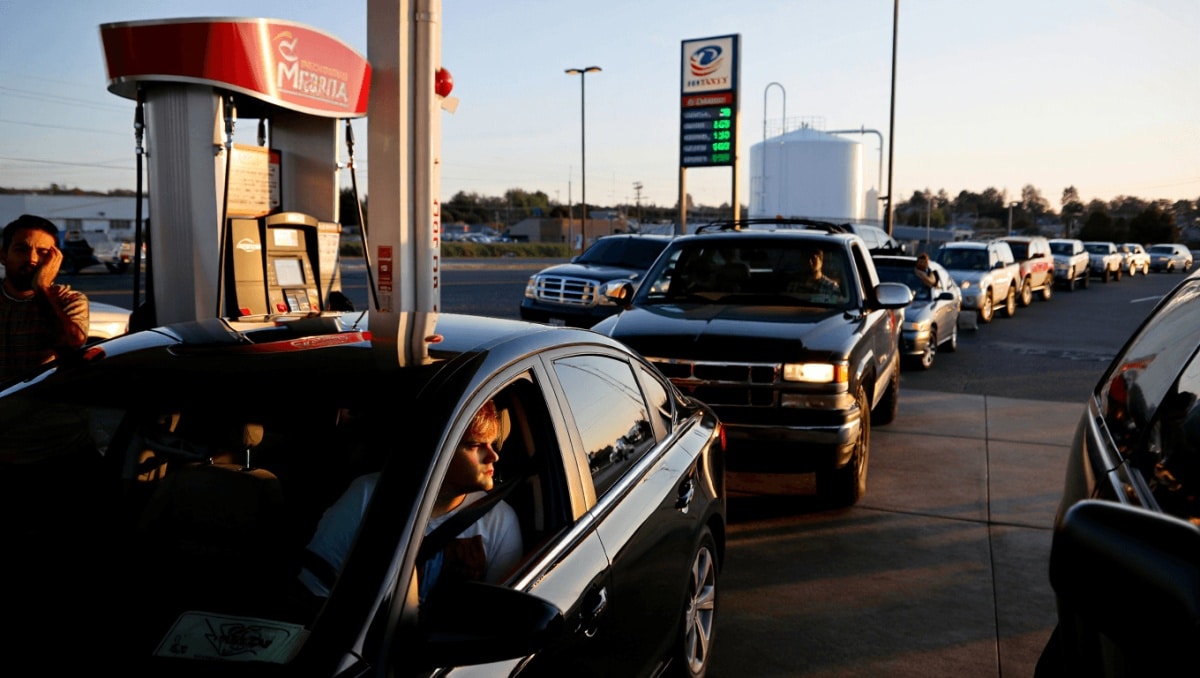
U.S. drivers are confronting another surge at the pump: the national average price for a gallon of regular gasoline climbed just above $4 at the end of March, raising fresh questions about household costs and inflation. New data from AAA show a rapid increase this spring, driven by higher crude prices and disruptions in the Middle East that have tightened global supply.
Short-term jump, immediate consequences
AAA reported the national average at about $4.02 per gallon on March 31, up from $3.99 the day before. That marks a sharp rise from late February, when the average stood near $2.98—a gap that highlights how quickly energy costs can swing and affect everyday budgets.
The immediate impact is straightforward: more expensive commutes and higher costs for goods that rely on transport and fuel inputs. Analysts warn that sustained fuel price increases can feed into broader price growth across the economy.
Where prices are highest — and lowest
Regional differences are pronounced. States across the West have seen pump prices exceed $4 for weeks; California remains the most expensive state, with an average near $5.89 per gallon as of March 31, while drivers in Oklahoma paid roughly $3.27, the lowest average reported nationally.
- National average (March 31): about $4.02 per gallon (AAA)
- February 27 average: $2.98 per gallon (AAA)
- Brent crude price: roughly $117 per barrel on March 30
- Highest state average: California — $5.89 per gallon
- Lowest state average: Oklahoma — $3.27 per gallon
- Western states: many above $4 per gallon since mid-March
Why prices moved so quickly
Two clear forces pushed crude and pump costs higher. First, geopolitical tensions in the Middle East disrupted shipping flows through the Strait of Hormuz, a chokepoint for roughly one-fifth of the world’s seaborne oil trade. Second, attacks on regional production sites have intermittently taken supply offline, tightening the market and lifting global benchmarks.
Those pressures helped lift Brent crude to multi-year highs late in March. When benchmark oil prices climb, refiners and traders pass at least part of those costs through to consumers at retail stations.
Wider ripple effects
Rising fuel costs are rarely confined to the pump. A retail analyst interviewed for this report noted that higher energy prices tend to raise transportation and production costs for groceries, airlines and many consumer goods — expenses that are difficult for small, local businesses to absorb.
That dynamic can reshape consumer behavior: smaller specialty stores may see fewer in-person visits, while large chains that combine convenience with delivery, and online platforms that eliminate travel entirely, may gain an advantage.
What could bring relief?
There are several potential moderating factors if the situation changes: reduced geopolitical tensions, a pickup in regional production, or coordinated releases from strategic petroleum reserves could increase supply and push prices lower. Each is uncertain and would likely unfold over weeks rather than overnight.
For now, motorists and businesses face a familiar problem: higher costs that filter through many parts of daily life, from commuting expenses to the price of goods on store shelves.