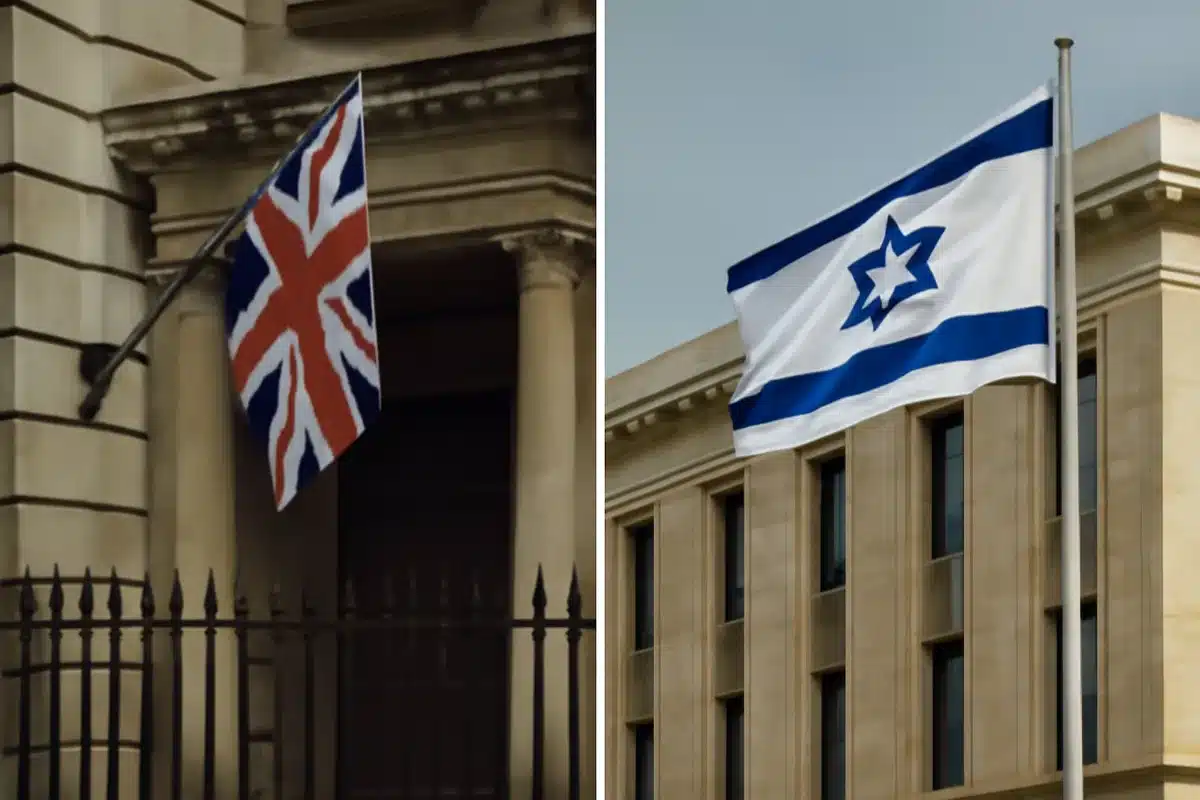
The UK announced sweeping sanctions on Israeli West Bank settlements on Tuesday, marking a dramatic shift in British Middle East policy, as Foreign Secretary Ed Miliband declared the Israeli occupation of the West Bank unlawful and accused settlers of carrying out “ethnic cleansing” of Palestinians. The move prompted an immediate and furious response from Israel, which announced it would close the British consulate in occupied East Jerusalem and ban entry to several UK lawmakers.
Miliband told Parliament that the UK government views the violence and forced displacement of Palestinians in the West Bank as ethnic cleansing perpetrated by “settler terrorists,” often with tacit backing from the Israeli government. He said the UK would introduce over the next six to nine months a comprehensive sanctions regime targeting illegal settlements and settlement expansion, including a ban on importing goods produced in the settlements and restrictions on companies and individuals providing services for settlement development.
The UK coordinated the announcement with 11 other countries—France, Canada, Denmark, Spain, Finland, Ireland, Iceland, Norway, Poland, Portugal, and Sweden—in a joint statement affirming commitment to a two-state solution. Britain, France, and Canada said they would bring forward national measures immediately to ban trade in settlement goods, while the other nations said they would support European restrictions.

The sanctions follow Israel’s recent opening of tenders for construction of approximately 1,200 settlement homes in the E1 area, a strategically important zone east of Jerusalem that international observers say would effectively cut through Palestinian territory and render a two-state solution unviable. Miliband said this development prompted the UK’s accelerated timeline for action. He also noted that the UK’s position aligns with a 2024 advisory opinion from the International Court of Justice on the legality of the Israeli occupation.
Israel’s Foreign Minister Gideon Saar responded within hours, describing Miliband’s accusations as “outrageous lies” and “blatant interference” in Israeli affairs. Saar announced four counter-measures: closure of the British consulate in East Jerusalem, which focuses on Palestinian issues in the occupied territories; entry bans on 11 UK MPs, including former Labour leader Jeremy Corbyn, Labour MPs Diane Abbott, Naz Shah, John McDonnell, and Richard Burgon, and all five sitting Green Party MPs; termination of British training of Palestinian Authority security forces on the West Bank; and removal of British representatives from the International Gaza Support Center in southern Israel.

Saar said he had coordinated Israel’s response with Prime Minister Benjamin Netanyahu, who faces elections in late October. Israel’s President Isaac Herzog called the UK decision “a grave miscalculation” and “gross interference in the democratic elections of a sovereign nation,” urging foreign governments to pursue dialogue rather than sanctions.
The escalation marks the lowest point in UK-Israel relations since Israel’s founding, according to reporting from the Telegraph. The UK Labour government under Prime Minister Andy Burnham has progressively toughened its stance on Israeli settlements over recent months, following the government’s recognition of Palestinian statehood in 2025. Miliband began his parliamentary statement by emphasizing his Jewish identity and support for Israel’s right to exist, but said the UK’s “moral responsibility” required action on what he characterized as violations of international humanitarian law in both the West Bank and Gaza.
The US response was notably divided. US Secretary of State Marco Rubio said Washington would not follow Britain, France, and Canada in blocking settlement imports and did not want moves that would destabilize the West Bank. However, US Ambassador to Israel Mike Huckabee warned of potential US retaliation against British businesses, calling the sanctions “discrimination against the Jewish people.” The Palestinian Authority welcomed the UK decision as an important step toward confronting Israel’s colonial system.
The UK’s Chief Rabbi Sir Ephraim Mirvis called Tuesday “a truly dark day for British Jews,” and the Board of Deputies of British Jews expressed “deep regret,” urging both governments to avoid pursuing “party interests over national interests.” Conservative opposition figures thanked Israeli leadership for its firm stance, with Foreign Minister Saar saying he had spoken with Conservative shadow foreign secretary Tom Tugendhat and party leader Kemi Badenoch.
Sources
- BBC News — UK sanctions announcement, Foreign Secretary Miliband’s parliamentary statement, Israeli retaliatory measures, and international responses.
- The Guardian — Israel’s consulate closure, entry bans on UK MPs, broader diplomatic escalation, and context on settlement violence.
- Reuters — Confirmation of UK, France, Canada sanctions coordination and Israel’s counter-measures.
- Al Jazeera — Details on the 12-country joint statement and coordinated sanctions approach.
- Euronews — List of 12 countries announcing trade sanctions and their individual positions.