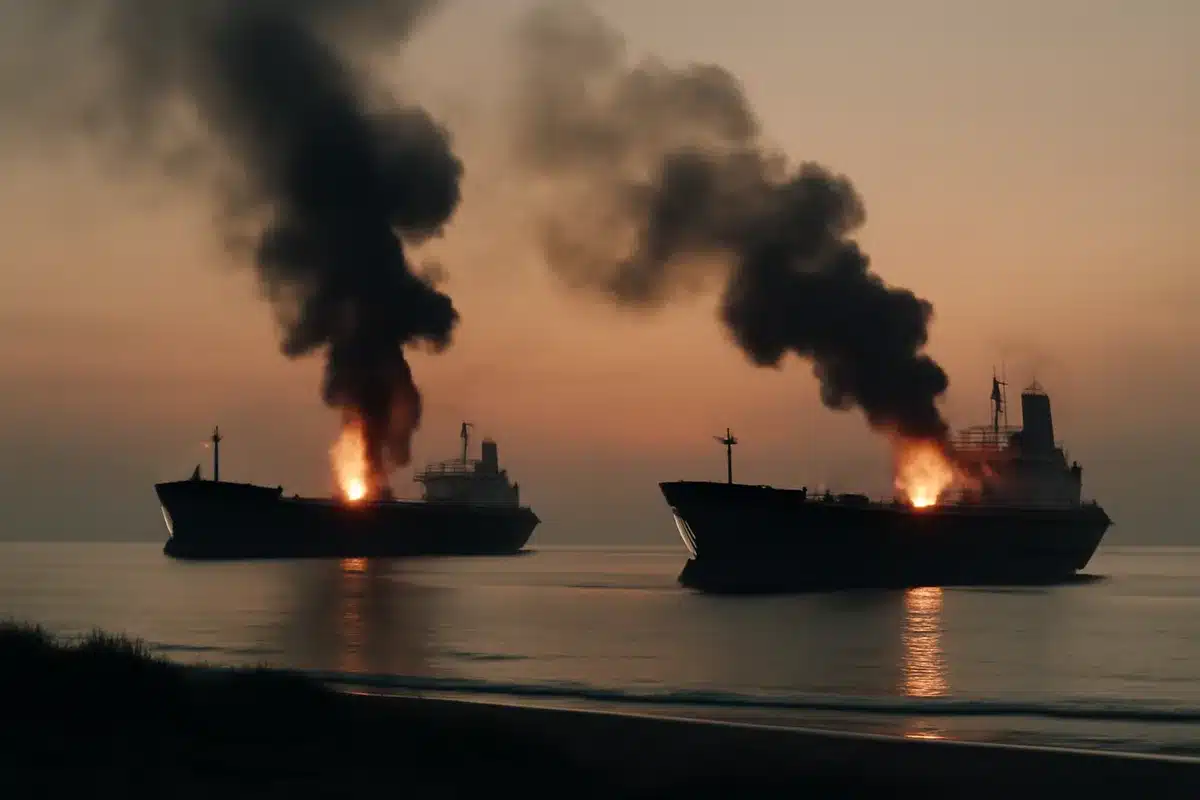
The U.S. military struck two Iranian government oil tankers on September 1 as part of a new “tanker for tanker” retaliation policy approved by President Trump, marking the first time American forces have targeted Iranian tankers in response to Iranian attacks on commercial shipping in the Strait of Hormuz.
The strikes hit the engine rooms of the two vessels, which were anchored off Iran’s coast north of the U.S. naval blockade line, according to U.S. officials. The tanker strikes were part of a broader round of operations that targeted approximately 100 military installations across Iran, including Islamic Revolutionary Guard Corps (IRGC) bases, air defense systems, radar facilities, cruise missile and drone launch platforms, mine-laying capabilities, and communications centers.
U.S. officials said the strikes were in response to the IRGC’s recent attacks on commercial vessels and American military bases in the region. A U.S. official told Axios that the new strikes degraded Iran’s attack capabilities in the strait and “bought at least a month” of lowered threat levels for commercial ships.
The “tanker for tanker” policy represents a deliberate escalation in Washington’s approach to the Strait of Hormuz standoff. Under the strategy, the United States will target an Iranian oil tanker for every vessel attacked by Iran in the region, according to U.S. officials. The policy aims to deter Iranian aggression by imposing direct and immediate costs on Iranian oil infrastructure each time Tehran attacks international shipping, according to Kurdistan 24.
The strikes occurred as part of a tit-for-tat cycle that has escalated tensions in the Persian Gulf since a ceasefire deal collapsed in early July. Iran had initiated attacks on commercial vessels to assert control over the Strait of Hormuz, a critical global shipping lane. In response, the U.S. expanded its military operations and restored a naval blockade of Iran’s ports.
Despite the ongoing strikes, U.S. forces continued escorting commercial vessels through the strait. A U.S. official said approximately 40 ships safely transited on Tuesday, carrying millions of barrels of oil, after American forces intercepted several anti-ship cruise missiles and drones that the IRGC fired toward the convoy.
Iran responded to the American strikes with its own retaliation. The country launched around 25 ballistic missiles, but U.S. officials said only half reached Jordanian airspace, with 10 intercepted and 3 landing without causing casualties. Iran also fired two dozen drones at U.S. bases in Bahrain, most of which were intercepted, and launched ballistic missiles and drones at U.S. bases in Kuwait and Erbil in the Kurdistan region of Iraq, all of which were intercepted, according to Axios.
A U.S. official told Axios that Iran “lost control of the Strait of Hormuz” and “also lost control over the conflict,” adding that “they got nothing today.” The broader military operation represents the most comprehensive single round of American strikes since the conflict began, according to Kurdistan 24. The policy’s logic is to deter Iranian aggression by making Iranian tankers the direct price of every commercial vessel attack, without committing to a broader military campaign that would risk full-scale renewed hostilities.
Sources
- Axios — reporting on the “tanker for tanker” policy, the two Iranian tankers struck, the approximately 100 targets hit, Iran’s retaliatory strikes, and U.S. official statements on the operation’s outcome
- Kurdistan 24 — reporting on the policy announcement, Trump’s approval, the deliberate disabling of the tankers, the 100 military targets, the 40 ships transiting, Iran’s retaliatory strikes across the region, and the policy’s strategic logic