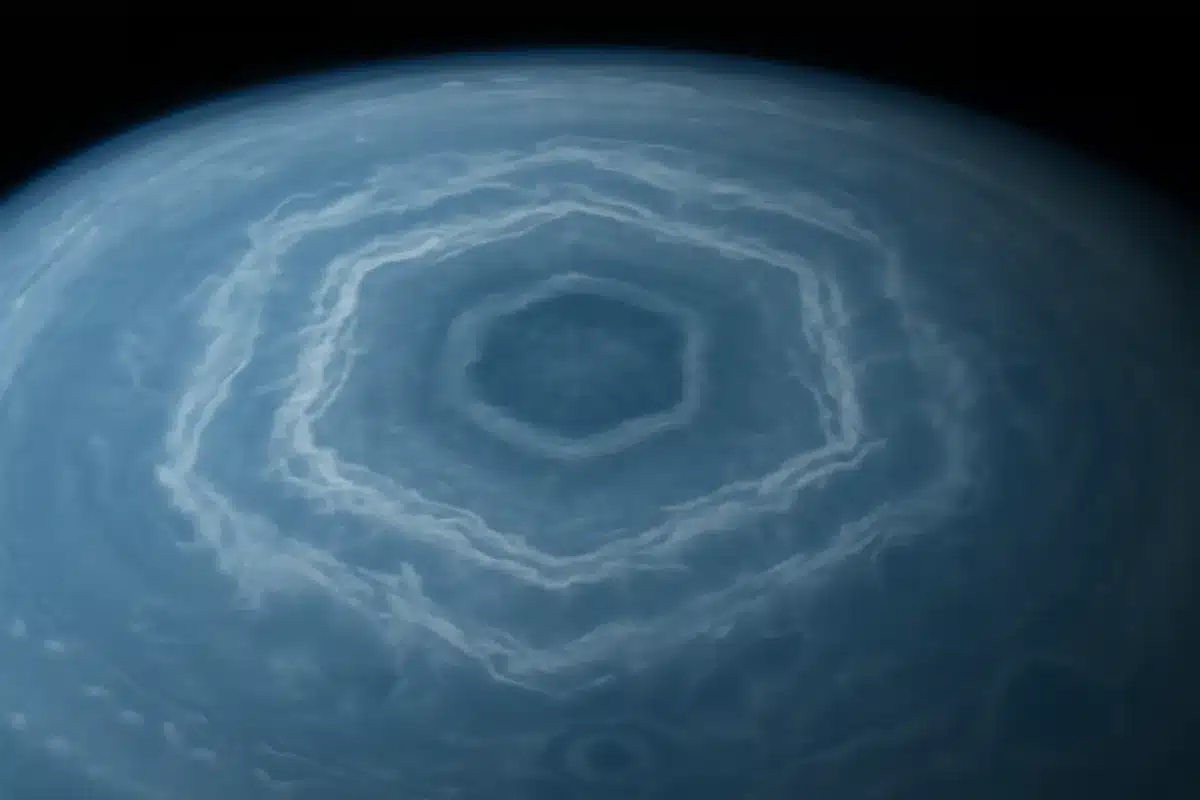
NASA’s Hubble Space Telescope has spotted a striking 10-sided atmospheric wave encircling Saturn’s south pole, marking the first large, regularly-shaped jet pattern ever observed in the planet’s southern hemisphere. The discovery, detailed in a study published September 2 in Science Advances, reveals a giant decagon—a geometric shape with 10 sides—that sits within one of Saturn’s powerful jet streams and extends through multiple atmospheric layers.
Researchers reconstructed the decagon’s development using Hubble observations dating back to 2023, when faint signs of the structure first appeared. By August and September 2025, the pattern had fully developed and become clearly defined in Hubble images. Ground-based observers had also noticed an undulating band along Saturn’s south pole in 2024 imagery, contributing to the detection. The feature appears to be strengthening over time, giving scientists what Amy Simon, principal investigator of Hubble’s Outer Planet Atmospheres Legacy (OPAL) program at NASA’s Goddard Space Flight Center, called “a rare opportunity to watch a giant atmospheric pattern develop.”
The decagon differs markedly from Saturn’s famous hexagon at its north pole. The northern hexagon, discovered during the Voyager mission in 1981, has remained stable for over 40 years with six consistently dark sides and points. By contrast, the new decagon shows fuzzy, variable edges across its features, suggesting it is unstable or still evolving. Agustín Sánchez-Lavega, lead author of the study and a researcher at the University of the Basque Country in Spain, noted that scientists had been searching for a southern counterpart to Saturn’s hexagon in Hubble images since 1990, but earlier observations—including data from NASA’s Cassini spacecraft, which orbited Saturn from 2004 to 2017—showed no sign of such a long-lived formation.
Why the decagon formed remains a mystery. Sánchez-Lavega suggested the cause could be disturbances in gas flows, possibly linked to a nearby storm with a high-pressure center similar to Jupiter’s Great Red Spot, or it may result from an instability in the jet stream itself or a wave forced from deeper atmospheric levels. If seasonal changes over Saturn’s southern polar region played a role in its formation, Sánchez-Lavega predicted the structure may become more pronounced in coming years, potentially peaking around 2032 when solar insolation reaches its maximum at the decagon’s latitude. However, the wave’s unstable appearance suggests it could continue to evolve or eventually dissipate, unlike the robust northern hexagon.
Scientists plan to continue observing Saturn using Hubble and NASA’s James Webb Space Telescope, along with computer modeling, to determine whether the decagon will settle into a stable configuration like its northern counterpart or remain a transient phenomenon. Mike Wong, study co-author at the University of California, Berkeley, emphasized the value of sustained observation: “A lot of the discoveries we see coming from OPAL are not just based on one observation, but on years and years of data. Regular observations over time are enabling a lot of new findings.” The decagon’s discovery underscores how Saturn’s south pole reveals massive 10-sided wave pattern in clouds through decades of continuous monitoring from space-based telescopes.
Sources
- Science Advances — peer-reviewed publication of the decagon discovery led by Agustín Sánchez-Lavega et al., September 2, 2026
- ScienceDaily — detailed reporting on the discovery, expert quotes from Amy Simon and Mike Wong, and timeline of observations
- ECIKS.org — comprehensive article on the decagon discovery with researcher background and future outlook