Klystron 9, the advanced Doppler radar system operated by Spectrum Bay News 9, delivers real-time weather tracking across the Tampa Bay area with 1 million watts of power and sophisticated dual-polarization technology that sets it apart from standard weather radars.
The system was launched on January 5, 2009, replacing the older Doppler 9000 and delivering nearly three times the power of its predecessor. In that inaugural year, Klystron 9 became one of the first five television radars in the country to employ dual-polarization, a capability that allows the radar to perform both vertical and horizontal scans simultaneously.
This dual-polarization feature enables meteorologists to distinguish between different types of precipitation and detect debris lofted by tornadoes or strong hurricanes—critical information for severe weather warnings. The radar sends out 500 to 2,000 pulses per second depending on its operating mode, scanning the region with precision that extends 300 miles into the Gulf of Mexico.
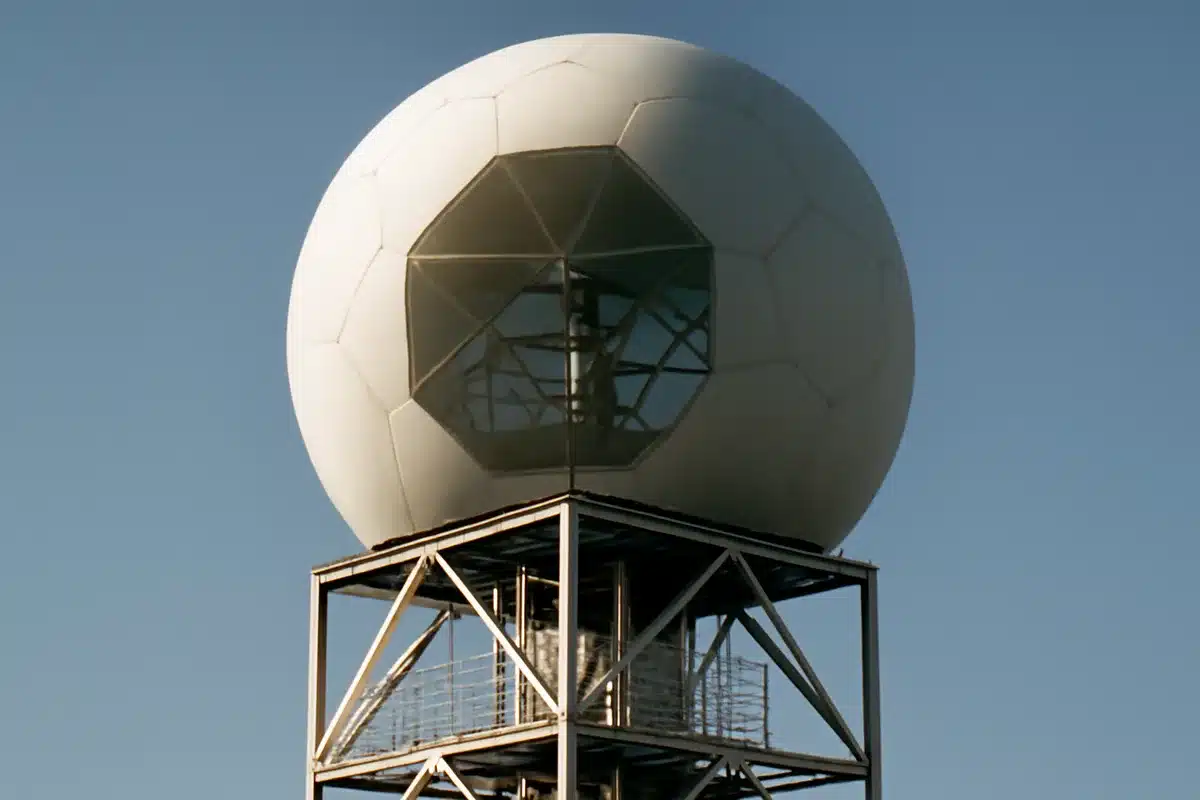
In 2020, Klystron 9 underwent a comprehensive upgrade that replaced nearly every component except the tower itself. The new system included a fresh Klystron tube, transmitter, receiver, pedestal, and a larger antenna, accompanied by an innovative new radome designed using technology first developed by the U.S. Navy.
The radome’s Navy-derived design improves rain shedding efficiency, preventing heavy precipitation from degrading the radar’s ability to detect storms. The receiver, mounted on the antenna’s back, rotates twice per minute while maintaining sensitive electronics at a constant 80 degrees Fahrenheit through an integrated air conditioning unit.
Data processing adds another layer of sophistication. Raw radar returns are transmitted to a computer facility in Huntsville, Alabama, where machine-learning algorithms filter out non-meteorological echoes—birds, insects, buildings, and aircraft—that would otherwise clutter the display. The cleaned data returns to the Tampa Bay weather center with only a 30-second delay, enabling meteorologists to provide viewers with an accurate, unambiguous view of active storms and precipitation patterns.

The system’s range varies by altitude. Near the radar site in Pinellas Park, the beam travels just 100 feet above ground, providing detailed local coverage. By the time the beam reaches southeastern Polk County, it has climbed to 8,600 feet, a natural consequence of Earth’s curvature. This geometry means nearby areas receive the most detailed picture, while distant regions may miss lower-altitude storm features, though tall severe thunderstorms remain detectable up to 200 miles away.
Doppler radar technology itself evolved over decades. Research on applying the Doppler effect to atmospheric observation began in 1960, and the WSR-88D NEXRAD system—the first operational Doppler radar with velocity-measuring capability—began deployment in 1992. Klystron 9’s advancement over those systems lies in its combination of raw power, dual-polarization, and real-time machine-learning data processing, making it one of the most capable weather radars operated by a local television station.
Sources
- Spectrum Bay News 9 — specifications and history of Klystron 9 radar system, including 2009 launch date, power output, dual-polarization capability, and 2020 upgrade details
- Meteorologist Kyle Hanson, Spectrum Bay News 9 — technical details on radar operation, including pulse rate, range, beam altitude, and machine-learning processing
- Wikipedia (Bay News 9 entry) — confirmation of Klystron 9 launch date and replacement of Doppler 9000
- National Weather Service and weather history sources — context on Doppler radar development timeline and WSR-88D NEXRAD deployment