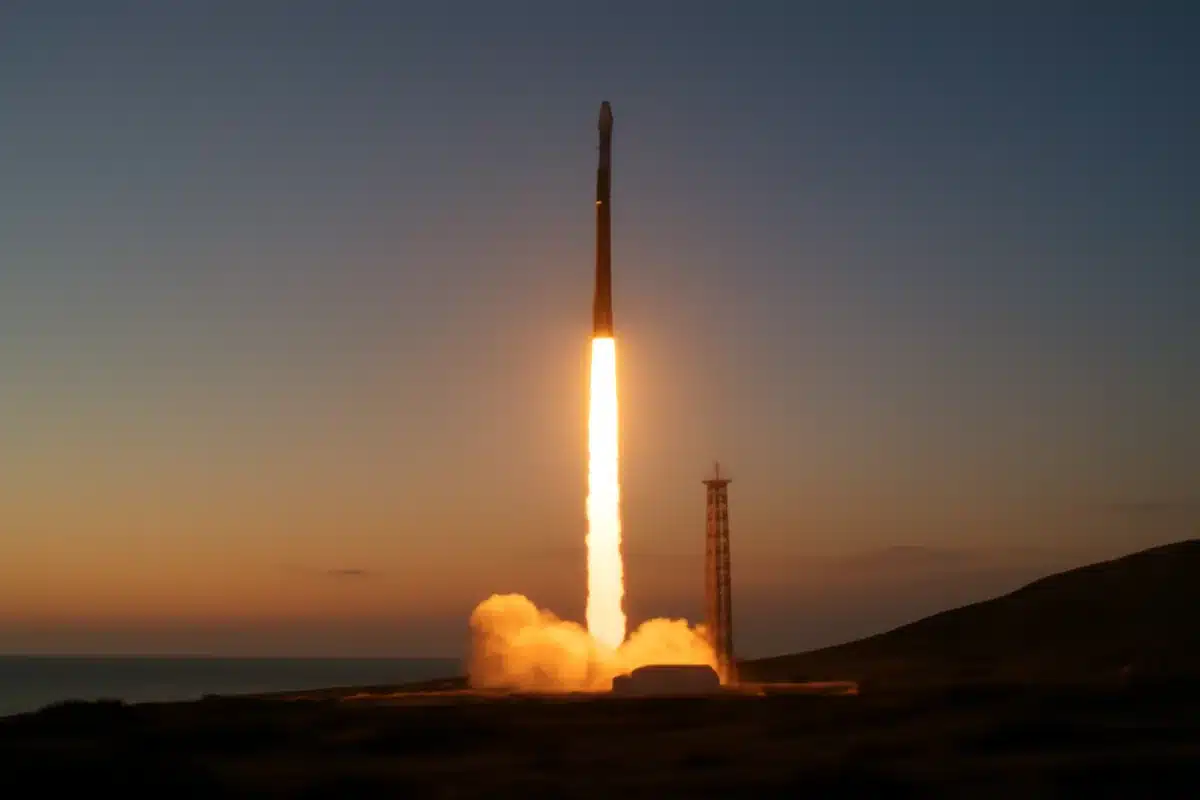
SpaceX reached its 100th launch milestone of 2026 early Wednesday morning, August 19, when a Falcon 9 rocket lifted off from Vandenberg Space Force Base in California carrying 24 Starlink satellites to low Earth orbit. The Starlink Group 17-50 mission marks an extraordinary acceleration in the company’s launch cadence and underscores its dominance in the commercial space sector.
The milestone arrived less than two weeks after SpaceX set a new aerospace record by launching two Falcon 9 rockets just 38 minutes apart on August 16. That doubleheader brought the company’s 2026 tally to 96 launches before the Starlink Group 17-50 mission pushed it past the century mark.
SpaceX’s 100-launch milestone in a single year is a relatively recent achievement. The company first surpassed 100 launches in 2024, when it completed 138 missions total across its Falcon 9, Falcon Heavy, and Starship fleets. In 2025, SpaceX conducted 167 launches, extending its operational lead over all other launch providers combined. The 2026 pace on track to exceed both prior years, with about 75 percent of missions carrying Starlink satellites to expand the company’s broadband constellation.
The concentration of Starlink missions reflects SpaceX’s dual strategy: the company generates revenue from commercial and government customers while simultaneously building out its own satellite internet network. Each Starlink Group 17-50 flight deploys 24 of the V2-Mini satellites, which are smaller than SpaceX’s V2 variant and optimized for the company’s current launch cadence. Starlink has grown to more than 10,000 satellites in low Earth orbit, a threshold SpaceX crossed for the first time in March 2026.
The rapid launch cadence depends heavily on SpaceX’s reusable rocket technology. Falcon 9 first-stage boosters routinely fly multiple times, with some individual boosters now approaching 35 or more flights. This reusability has allowed SpaceX to reduce launch costs far below traditional expendable rocket operators, giving the company a decisive edge in pricing and frequency. The company’s operational efficiency—launching from multiple sites across Florida and California, recovering boosters for rapid turnaround, and maintaining a steady production pipeline—has made the 100-launch-per-year target routine.
For SpaceX, the 100-launch milestone reflects not a one-time achievement but an operational baseline. The company is on pace to exceed its prior-year totals again in 2026, a trajectory that no competitor has approached. Falcon 9 remains the world’s most-flown orbital rocket, with nearly 700 successful flights logged since its first launch in 2010.
Sources
- Space.com — SpaceX launched its 100th mission of 2026 on August 19, carrying 24 Starlink satellites from Vandenberg Space Force Base, California; SpaceX first topped 100 launches in 2024 with 138 total missions.
- Wikipedia — Falcon 9 and Falcon Heavy launch list; Starlink Group 17-50 mission details and launch date/time.
- SpaceX Launch Statistics (spacexnow.com) — Annual launch counts: 2024 (136 missions), 2025 (167 missions), 2026 year-to-date (99 of 99 successful).
- NextSpaceFlight — Starlink Group 17-50 mission payload (24 satellites) and launch vehicle (Falcon 9 Block 5).