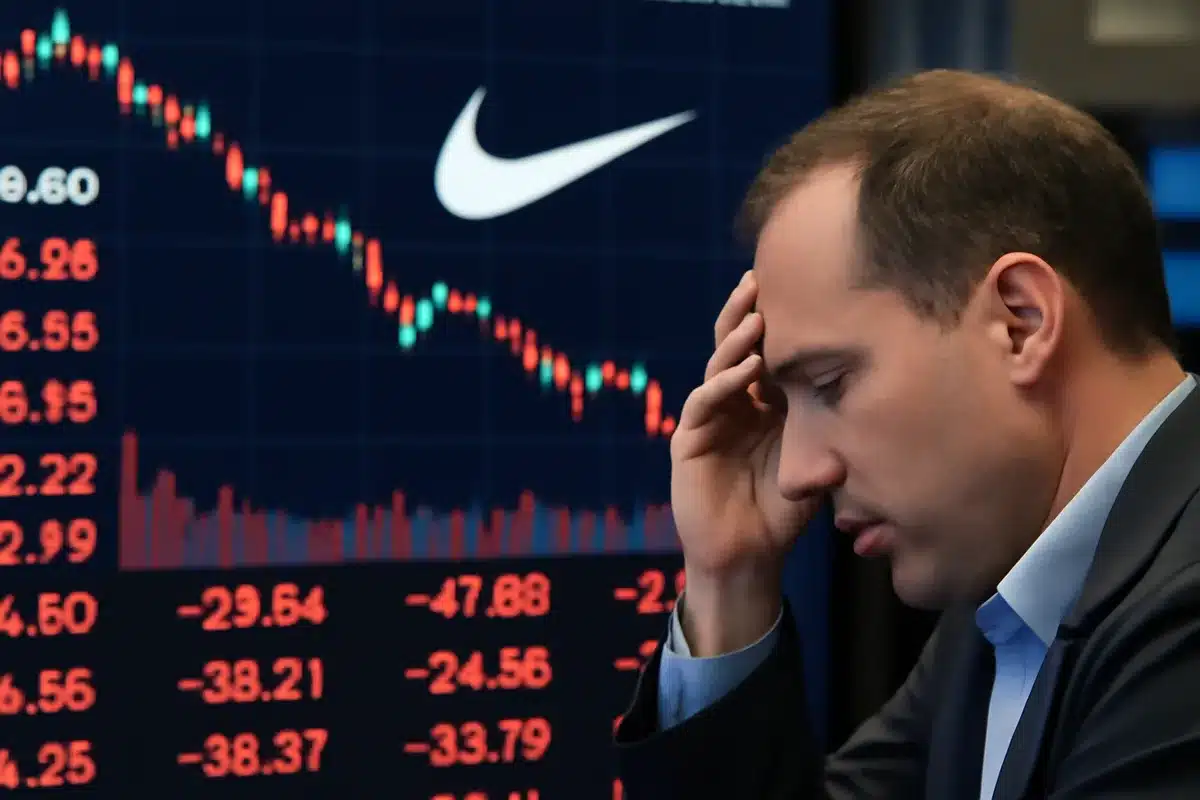
Nike stock hit a 12-year low at $39.09 on August 17, 2026, as JPMorgan’s recent downgrade and warnings about the company’s prolonged turnaround deepened investor concerns about the athletic apparel maker’s path to recovery.
JPMorgan analyst Matthew Boss downgraded Nike to Underweight from Neutral on August 4, cutting his price target to $40 from $47. Boss cited the company’s “Win Now” turnaround strategy, led by CEO Elliott Hill, as a major headwind that will continue to pressure earnings into 2028.
In his research note, Boss explained that the financial impact of decisions made through the end of 2026 “will linger and impact NKE’s P&L in 2H27 and into FY28.” The bank also identified multiple revenue pressures ahead, including Nike’s planned reduction of its U.S. store footprint by about 10 percent, which will create financial drag until the closures are fully annualized around July 2027.
China’s Deepening Challenges
The most significant headwind for Nike is its struggling China business. According to JPMorgan’s analysis, Nike faces a roughly $1 billion revenue headwind as it works to overhaul its digital marketplace presence in the region—a move that could wipe out about 20 percent of Nike’s fiscal 2026 China sales.
Nike’s China revenue has collapsed 30 percent since 2021, hitting its lowest level in eight years by the end of May 2026. Sales have fallen year-over-year for eight consecutive quarters, with Greater China revenue down 17 percent on a constant-currency basis in the company’s most recent quarter. The decline reflects a combination of factors: a shift toward domestic “China Chic” brands among younger consumers, increased competition from local rivals like Anta and Li-Ning, and Nike’s complex, fragmented distribution model that accumulated during the pandemic.
Nike’s outgoing finance chief Matt Friend told analysts that revenue trends in China “will be in line” with recent performance in the near term, and that profitability would “bottom before sales,” signaling no near-term recovery is expected.

Experts told CNBC that Nike has struggled to adapt to Chinese consumers’ evolving preferences. The company has historically relied on a global product strategy, replicating designs and marketing from its U.S. headquarters in Portland, Oregon. By contrast, Adidas has gained traction by empowering its local China team to create region-specific products—such as its viral Chinese Track Top jacket that sold out in 27 minutes during Chinese New Year celebrations.
Nike has begun to address these gaps. In July 2026, the company hired Cathy Sparks as vice president and general manager of Greater China, and last week announced the hiring of its first-ever Greater China vice president of local product creation. The company plans to launch two lifestyle capsules designed, developed, and made in China for Chinese shoppers in time for the holidays, followed later by performance apparel and footwear.
Shareholders will look to Nike’s Investor Day in November 2026 for clarity on the company’s three-year plan through fiscal 2030. However, Boss said he expects Nike to recover from its current position by the start of the next decade—though at a slower pace than the growth the company once achieved.
Sources
- CNBC — JPMorgan downgrade details, analyst Matthew Boss commentary, and Nike’s China challenges
- Yahoo Finance — Nike stock price at $39.09 as of August 17, 2026
- Benzinga — JPMorgan downgrade to Underweight and price target cut to $40
- Investing.com — JPMorgan downgrade confirmation and analyst details