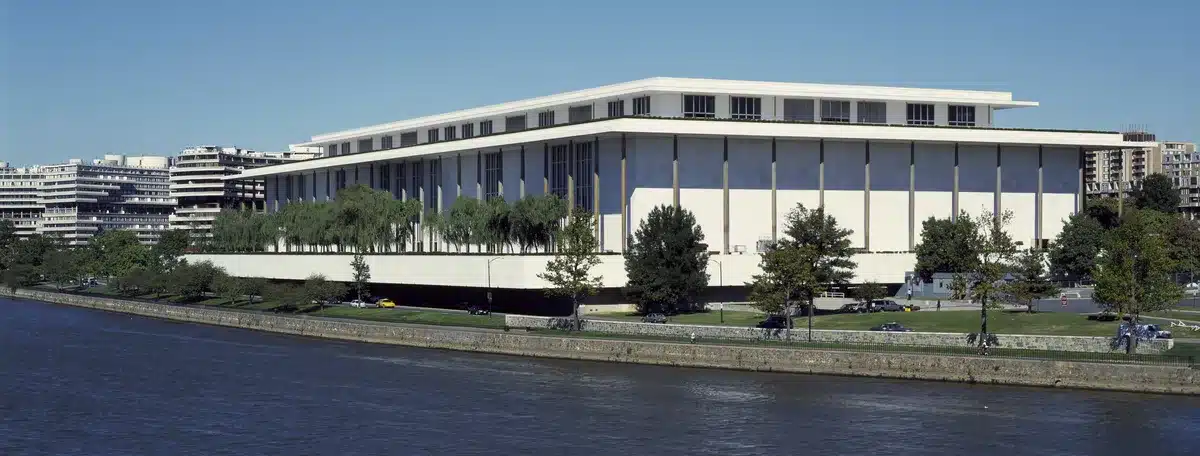
The Kennedy Center board voted 20-3 on Thursday to inscribe President Trump’s name on the performing arts venue’s exterior, defying a federal court order issued just two months earlier that directed the center to remove it. The inscription, to be placed below the building’s main signage, will read “Restored and Renovated by President Donald J. Trump,” and the board also voted to close the center for two years of renovations.
The vote represents an aggressive test of U.S. District Judge Christopher Cooper’s May ruling that only Congress has the authority to change the Kennedy Center’s name. Cooper had ordered all references to Trump removed from the building, its website, and other materials by June 12, 2026, finding that the board had “overstepped its statutory bounds” when it first added Trump’s name in December 2025.
The new approach attempts to circumvent the judge’s ruling by framing the text as an inscription rather than a formal renaming. According to Axios, the board also designated the exterior space as “the President Donald J. Trump Plaza.” However, federal law governing the Kennedy Center explicitly states that “no additional memorials or plaques in the nature of memorials shall be designated or installed in the public areas,” presenting another potential legal obstacle.
Rep. Joyce Beatty (D-Ohio), who sits on the board as an ex officio member and successfully sued the administration to force Trump’s name removed in June, issued a statement calling the decision “a transparent effort to circumvent the Court’s ruling, and flies in the face of the statutes that Congress passed.” Beatty added, “I will continue to fight for this treasured national monument.”
When Judge Cooper issued his ruling in May, he determined that the board—which Trump had filled with allies and appointed himself chairman of—had violated the Kennedy Center’s founding statute. In 1964, Congress had deliberately renamed the “National Culture Center” the “John F. Kennedy Center for the Performing Arts” as a living memorial to the slain president. Cooper noted that when Congress authorized the REACH expansion in 2012, it “was so wary of diluting the power of the public dedication to the slain president” that it required private contributors to be acknowledged inside the building rather than on the exterior.
The Justice Department had argued that adding Trump’s name was not a renaming but merely a secondary designation, comparing it to calling the Bureau of Financial Protection the Consumer Financial Protection Bureau. Cooper rejected this reasoning, writing that the position was “too cute by half” and that placing Trump’s name on the front portico and relegating Kennedy’s name to second place constituted a clear renaming.
The board’s August vote also moves forward with the two-year closure for renovations, which Cooper had temporarily blocked in May. The renovation plan includes refurbishing aging infrastructure, polishing the marble facade, and upgrading the Concert Hall with a $24.7 million investment, along with work on the red carpeted Grand Foyer for the first time since the 1990s. The center plans to allow some programming at the REACH, an adjacent indoor-outdoor space where the National Symphony Orchestra might perform during the closure.

White House spokesperson Liz Huston said in a statement to Axios, “Under President Trump’s bold leadership, the Kennedy Center is on its way to becoming the finest cultural institution anywhere in the world.” The administration has appealed Cooper’s May ruling, and the board’s latest decision sets the stage for further legal battles over whether the inscription strategy succeeds where the direct renaming failed.
Sources
- Axios — board vote details, inscription language, court ruling background, White House statement
- Washington Post — board vote, inscription text, closure plans, legal challenge details
- Courthouse News Service — Judge Cooper’s May ruling, statutory authority findings, Trump’s name removal order
- Time — board vote tally (20-3), Trump-aligned board composition
- The Hill — inscription language and board approval