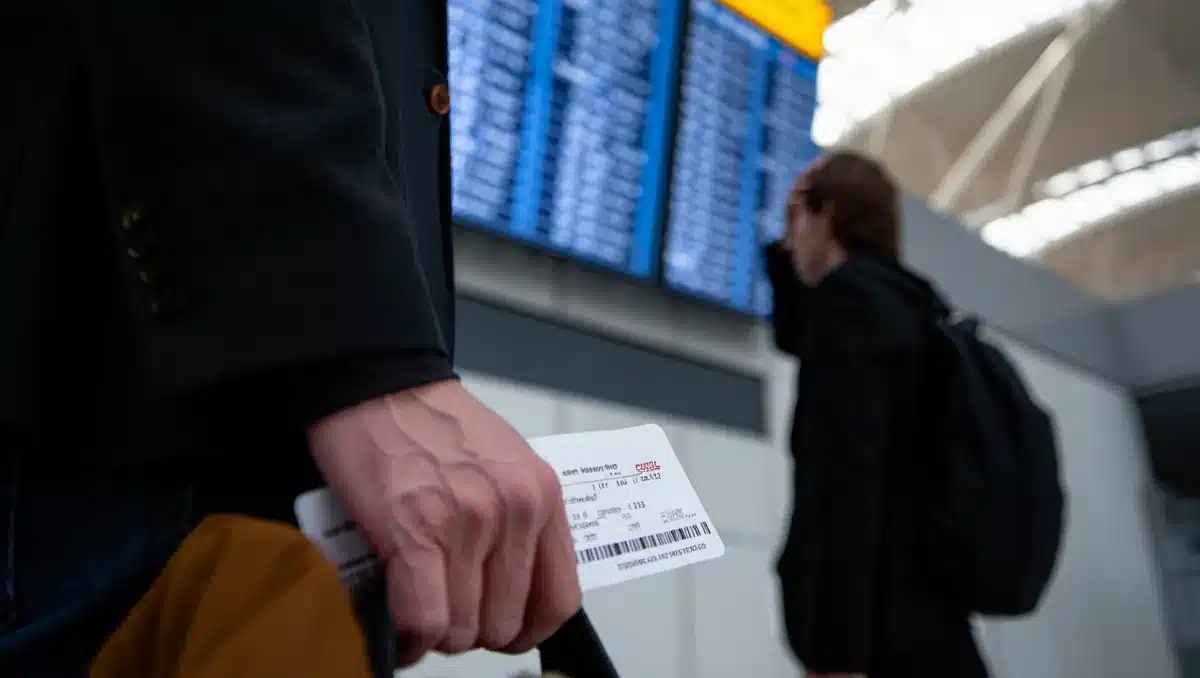
American Airlines’ artificial intelligence systems are automatically rebooking delayed passengers onto later flights and deleting their original seat assignments without seeking permission, leaving travelers stranded at gates despite arriving on time to board.
The problem stems from AURA (Automated ReAccommodation), the airline’s predictive rebooking tool, which identifies passengers the system believes will miss connecting flights and proactively rebooks them onto later departures. This process, known internally as “discovered inventory,” frees up seats for other passengers who may need that space. The issue: the algorithm often predicts misconnections that never actually occur.
High-profile cases have exposed the system’s flaws. Marc Thiessen, a former chief speechwriter to George W. Bush and Washington Post columnist, was denied boarding in Chicago despite arriving at his gate with an hour to spare before his connecting flight. “Since when do you change my itinerary without asking?” he posted on social media. Media consultant Beverly Hallberg reported the same experience, noting she had to call the airline to switch back to her original itinerary after being rebooked without consent.
AURA was fully rolled out in 2023 to reduce manual rebooking work and lower staffing needs at the gate. According to an internal American Airlines memo obtained by industry observers, the system processes more rebookings automatically by “identifying passengers that are certain to misconnect and utilizing that available inventory for protecting other passengers who may need that space.” In 2025, American expanded the system by introducing Connect Assist, an AI tool that works alongside AURA to handle rebooking decisions.
The system prioritizes operational efficiency over passenger certainty. By processing rebookings before delays actually cause missed connections, American reduces the number of customers calling reservations and manually reconstructing itineraries. However, passengers frequently arrive at gates to find their seats reassigned, even when they can still make their flights.
Under Department of Transportation regulations, passengers who are involuntarily denied boarding—even by an algorithm—are entitled to compensation if they checked in on time, held assigned seats with boarding passes, and arrived at the gate 15 minutes before departure. That compensation can reach $2,150 for delays exceeding two hours and must be offered within 24 hours. Multiple sources indicate American has initially resisted paying this compensation, forcing affected passengers to file formal DOT complaints to receive what they are legally owed.
The backlash has spread across social media, with numerous passengers reporting similar experiences since at least 2023. Industry observers note that American’s situation illustrates a broader challenge facing airlines: balancing automation designed to improve efficiency with the customer service failures that automation can create. Rival carriers have begun leveraging American’s difficulties in marketing campaigns to attract dissatisfied customers.
American Airlines has not publicly acknowledged systemic failures in the AURA system or announced changes to how the algorithm makes rebooking decisions. The airline’s website currently displays information about involuntary denied boarding compensation that some observers say contradicts current DOT regulations, suggesting the airline may lack adequate oversight of its automated systems and their legal compliance.
Sources
- View from the Wing — detailed reporting on AURA’s mechanism, passenger cases, and DOT compensation requirements
- InsideFlyer — coverage of Marc Thiessen and Beverly Hallberg cases, DOT compensation rules
- ePlane AI — analysis of AURA’s operational impact and regulatory implications
- Simple Flying — confirmation that AURA and Connect Assist systems automatically rebook and delete seat assignments