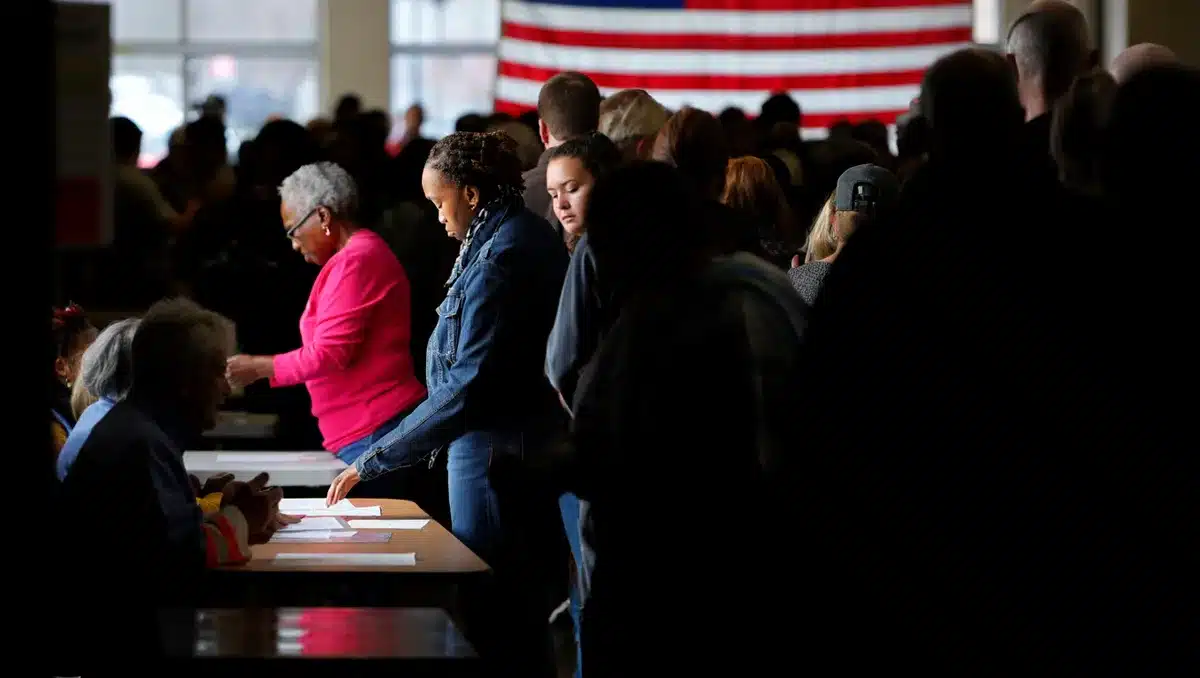
Wisconsin voters are casting ballots today in a Democratic primary for governor that could reshape the state’s political future, with democratic socialist State Representative Francesca Hong leading the race against three moderate rivals. The August 11 primary marks the first open gubernatorial contest in Wisconsin since 2010, after incumbent Democratic Governor Tony Evers declined to seek a third term.
Four candidates remain on the Democratic ballot: Hong, Milwaukee County Executive David Crowley, state Senator Kelda Roys, and former Department of Administration Secretary Joel Brennan. In the most recent Marquette Law School poll, Hong held 38 percent support among all Democratic primary voters and 66 percent among voters aged 18 to 29, while Crowley trailed with single-digit support among younger voters but performed better with older voters over 45.
Hong, 37, a chef and former restaurant owner from Madison, became the first Asian American member of the Wisconsin Legislature when elected to the state assembly in 2020. She has raised over $1.1 million for her campaign and built what supporters describe as a grassroots movement, hosting hundreds of events across Wisconsin from karaoke nights to ramen pop-ups. Her platform includes universal childcare, fully funding public schools, and a one-year moratorium on datacenter construction—a position she argues differentiates her from other Democratic candidates and resonates with voters concerned about artificial intelligence’s rapid expansion.

The race has been marked by dramatic shifts. The primary narrowed to four candidates after several dropped out, including former Lieutenant Governor Mandela Barnes on July 30 and Lieutenant Governor Sara Rodriguez after campaign finance irregularities emerged. Crowley initially exited the race in early July but re-entered on July 17, two days after Rodriguez’s departure, with the backing of Governor Tony Evers—a rare move by the outgoing governor that surprised many Democrats and energized Hong supporters who viewed it as establishment interference.
The stakes are substantial. Democrats aim to win full control of Wisconsin state government for the first time since 2010, requiring them to flip two state Senate seats and five Assembly seats while keeping the governor’s office. Republicans have held the state legislature since 2011 and enacted aggressive conservative policies, including gerrymandered districts that protected their majority even during the 2018 Democratic wave that elected Evers. Whoever wins the Democratic primary will face Republican U.S. Representative Tom Tiffany, who is running unopposed in the Republican primary with endorsements from the state GOP and President Donald Trump.
Hong’s rise has drawn national attention and criticism from Democratic establishment figures. She has faced scrutiny over old social media posts, including one from 2020 in which she called for canceling Thanksgiving—comments she later said reflected the political moment and that her views have evolved. Governor Evers told reporters that Hong had spent more time responding to her social media posts than focusing on issues, though Hong countered that she is fighting harder than any other campaign to win the most votes. Democratic strategist David Axelrod criticized her as “a font of zany liberal, faculty lounge exotica,” while political analyst Michael Wagner of the University of Wisconsin-Madison’s journalism school noted that while Republicans have nominated increasingly extreme candidates, Democrats have believed only moderate candidates can win statewide in swing states—a strategy he said lacks evidence.
A Marquette poll from late July showed Tiffany leading Hong in a hypothetical general election matchup by 3 percentage points, though among voters certain to vote in November, the two were tied. Hong is set to lead the Democratic primary, but Democratic voters remain divided on electability concerns and the proper direction for the party as it seeks to regain power in a state that has decided five of the last seven presidential elections by less than one percentage point.
Sources
- Wisconsin Watch — final primary polling, voter interviews, candidate backgrounds, stakes for state control
- The Guardian — Hong’s campaign strategy, grassroots organizing, Crowley’s re-entry and Evers endorsement, polling data, general election matchup
- Ballotpedia — candidate list, primary date, first open race since 2010
- PBS Wisconsin — primary date, state control stakes, candidate information
- New York Times — polling data, Hong’s social media controversy