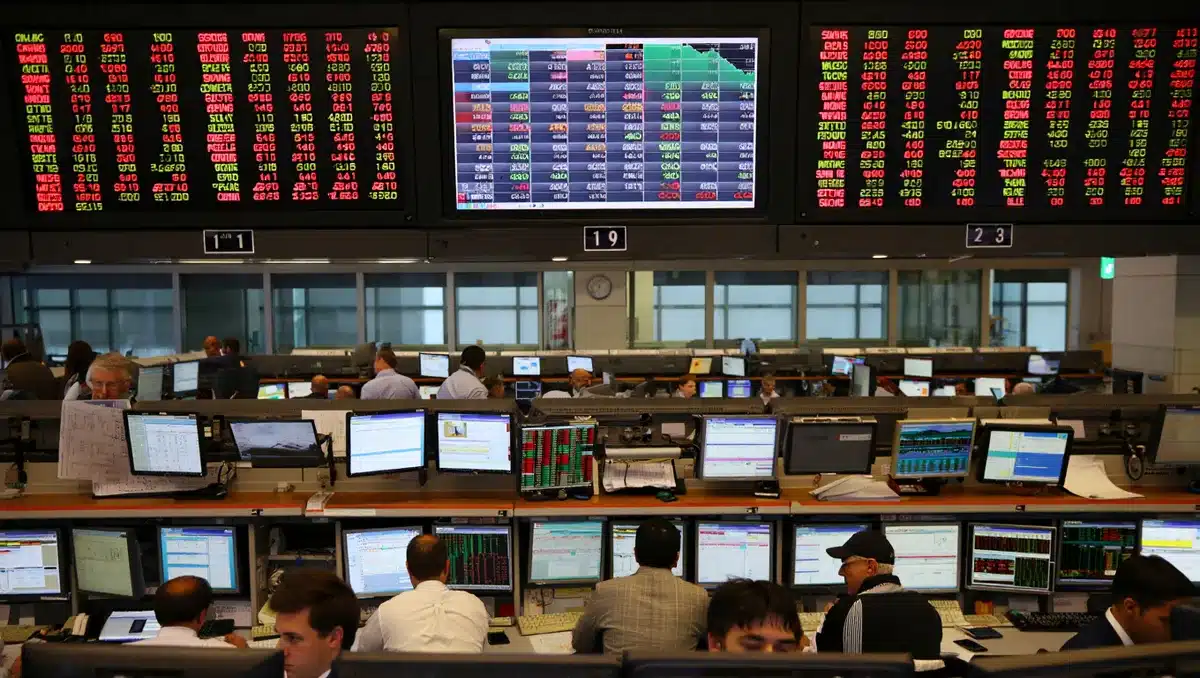
The stock market ended July with solid gains despite a turbulent week dominated by Big Tech earnings, Federal Reserve uncertainty, and sharp volatility that tested investor confidence. The S&P 500 rose 0.7% on Friday to close the month at 7,489.72, while the Dow Jones Industrial Average added 0.5% to 52,485.03 and the Nasdaq composite jumped 1% to 25,373.85, according to reporting from the Washington Post and Wall Street Journal.
The week’s dramatic swings began on July 28 when the Dow plunged more than 1,100 points — its worst decline since April 2025 — after the Federal Reserve decided to hold interest rates steady. Bond yields spiked sharply as investors worried the Fed was falling behind in its fight against inflation, with the 30-year Treasury yield reaching 5.274%, a new 19-year high, according to CNBC and WSJ reporting.

The market recovered swiftly over the next three days, driven primarily by blockbuster earnings from major technology companies. Microsoft surged 15% to 16% on July 29 after reporting fiscal fourth-quarter revenue of $90.01 billion, beating analyst estimates of $87.62 billion, with Azure cloud growth reaching 43% at constant currency, CNBC reported. The company also announced that Azure revenue surpassed $100 billion for the first time in its fiscal year.
Amazon delivered the largest positive surprise on July 30, rocketing 15% after reporting stronger-than-expected profits and accelerating cloud-computing sales that suggested its heavy artificial intelligence investments were paying off, according to the Washington Post. The surge gave Amazon its largest market-cap gain ever. In contrast, Apple fell 7.4% the same day after delivering a lackluster forecast for upcoming revenue growth, dragging its market capitalization down by $358 billion.
Meta Platforms took a different path, falling 9% on July 29 after the social media giant missed earnings expectations and failed to provide spending guidance for 2027, with its cash pile dwindling. The company posted earnings per share of $6.18, missing analyst estimates by $1.04 per share, and forecasted third-quarter revenue between $61 billion and $64 billion — below the $63.15 billion analysts expected, per CNBC.

For the full week, all three major indexes gained more than 1%, with the S&P 500 up 1%, the Dow up 1%, and the Nasdaq up 1.6%, according to the Washington Post. Year-to-date, the S&P 500 has climbed 9.4%, the Dow 9.2%, and the Nasdaq 9.2%, reflecting a market buoyed by strong earnings growth despite economic headwinds and persistent inflation concerns.
The earnings-driven rally also extended to semiconductor stocks, which surged as investors anticipated that AI infrastructure demand would drive sustained memory chip growth. The iShares Semiconductor ETF rose more than 8%, with Micron Technology up 18% and Advanced Micro Devices up more than 13% on July 30, according to CNBC. The rally came as JPMorgan analysts noted that hedge funds had likely finished selling off their tech positions to reduce debt, suggesting limited room for further deleveraging.
Sources
- CNBC — Market close data, Microsoft and Meta earnings details, semiconductor performance, and hedge fund deleveraging analysis
- Wall Street Journal — July 31 market close, Amazon and Apple earnings reactions, Treasury yield movements, and weekly performance
- Washington Post — Final July monthly close, S&P 500 and Dow performance, Amazon and Apple earnings impact