Business Insider has abandoned news aggregation as its primary strategy, shifting to original reporting that now comprises more than 80% of its output, up from roughly 40% in 2024, according to the publication and reporting from Nieman Lab.
The dramatic pivot marks a fundamental departure from the outlet’s founding identity. Business Insider, launched in 2007, built its early digital advertising business on quick-hit summaries that repackaged reporting from other outlets, a model that thrived during the peak of social media referral traffic in the 2010s. But that era has ended.
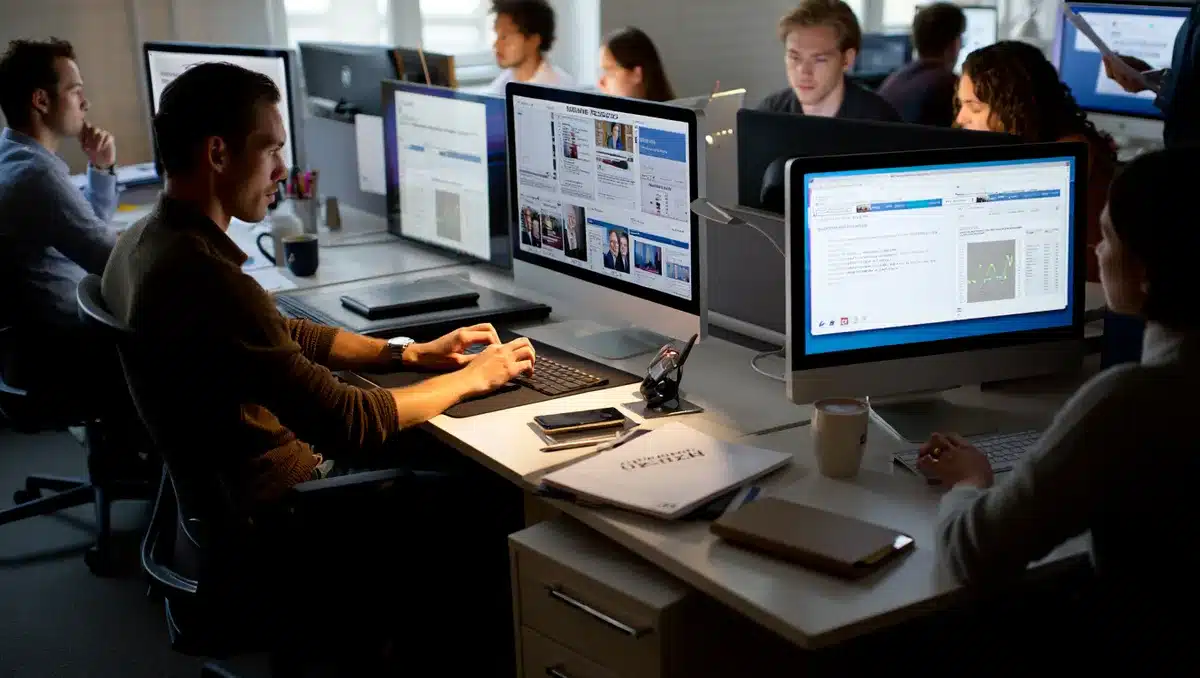
Editor-in-Chief Jamie Heller, who joined Business Insider in September 2024 after more than 20 years at The Wall Street Journal, spearheaded the transformation. Under her leadership, the newsroom stopped accepting rewrites of other outlets’ reporting. Reporters were given beats for the first time and expected to independently confirm news with their own sourcing or move stories forward with new analysis, according to Nieman Lab’s reporting on the shift.
The pivot is a direct response to collapsing search traffic. Google’s AI Overviews and chatbots like ChatGPT now provide summaries of trending topics in seconds, eliminating the need for readers to click through to aggregated articles. Publishers worldwide are bracing for a 43% drop in search traffic over the next three years, according to a January 2026 Reuters Institute survey of 280 news executives. Aggregation—once a pillar of digital publishing strategy—has become economically unviable as AI tools do the summarizing faster and cheaper than humans can.
Business Insider faced acute pressure. The publication laid off 21% of its workforce in May 2025 as traffic declined sharply, and former CEO Barbara Peng wrote at the time that the company had to “be structured to endure extreme traffic drops outside our control.” The company has cut positions for four consecutive years.
Early results suggest the gamble is working. In the first quarter of 2026, stories marked as “exclusive” saw almost two times the subscription conversions of non-exclusive stories, according to Nieman Lab. Business Insider also saw year-over-year growth in both visits and return visits in January and February 2026—a significant achievement when Google’s AI Overviews have reduced traffic across most publishers. The newsroom recorded 788 scoops in 2025, the most in its history, and won its first George Polk Award in 2026. Major outlets are increasingly citing Business Insider stories that can only be found there, with pickups up 47% year-over-year.
The shift reflects a broader industry realization. Mathias Döpfner, CEO of Axel Springer (Business Insider’s parent company), wrote in 2023 that AI would soon outperform journalists at aggregation, and that “only those who create the best original content will survive.” The Reuters Institute survey found that the majority of news executives worldwide now believe “future success lies in being more distinctive, even if that means losing some overall reach and reducing the amount of general news.”
Business Insider hired its first-ever standards editor, Tracy Connor (former editor-in-chief of The Daily Beast), to enforce rigor around sourcing, comment-line placement, and the handling of leaked documents—the machinery of original reporting. The publication also launched an “exclusive” tag to signal original scoops to readers and created newsletters like Tech Memo and First Trade to spotlight industry-specific exclusives. In early 2026, the company invited around 100 PR professionals to headquarters to communicate that it no longer wanted press releases or stories available everywhere—it wanted exclusive access to executives and unique angles.
The transformation is not without risk. A smaller, more specialized newsroom produces fewer total stories, which could limit reach. But for a publication once nearly synonymous with aggregation, the bet is clear: in an age of AI summaries and zero-click searches, survival depends on producing journalism readers cannot find anywhere else.
Sources
- Nieman Lab — detailed reporting on Business Insider’s editorial strategy shift, Jamie Heller’s approach, and early engagement metrics from the first quarter of 2026.
- Business Insider — CEO Barbara Peng’s statement on transformation, original content percentage, scoops recorded, Polk Award win, and pickup growth.
- Reuters Institute for the Study of Journalism — January 2026 survey of 280 news publishers on traffic decline expectations and editorial strategy.