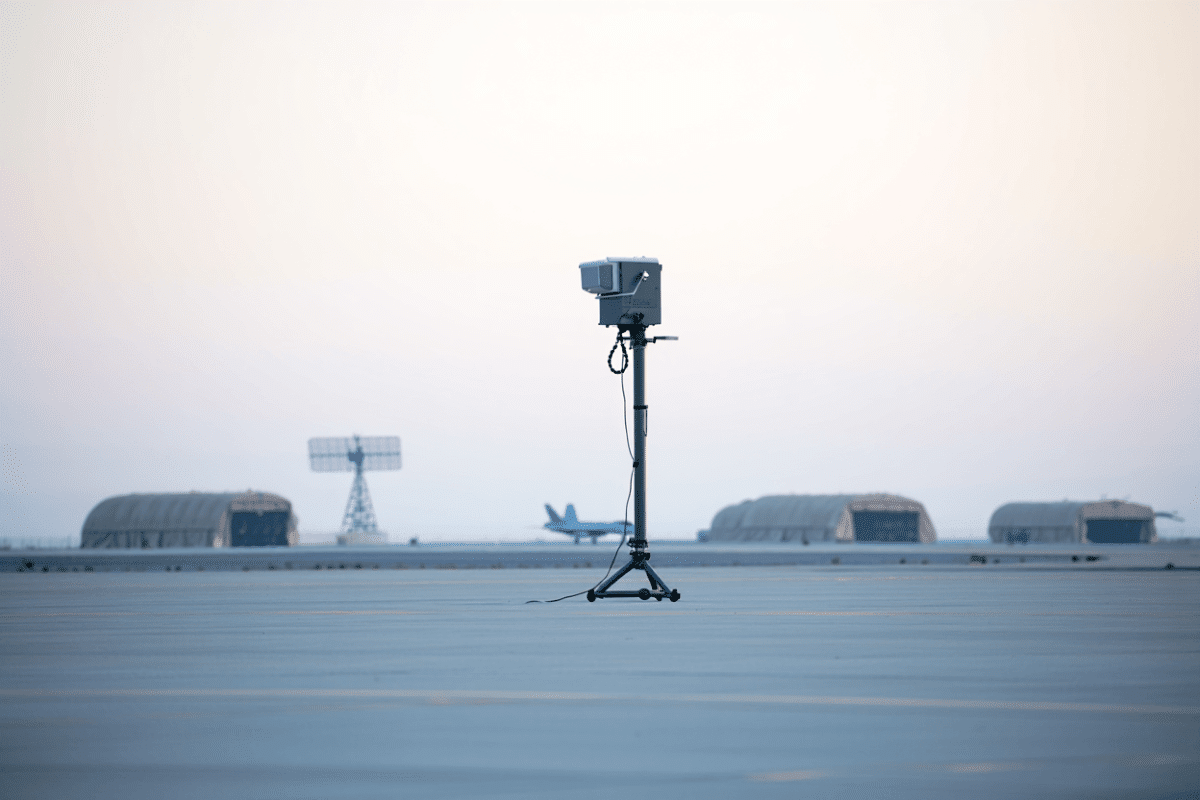
The U.S. Air Force is bolstering defenses against drone and missile threats to its military bases through multiple procurement initiatives and organizational changes. On July 6, 2026, the Pentagon awarded AeroVironment a $80.5 million task order for its Titan-MS counter-drone system to protect Air Force bases from small unmanned aerial systems.
The Titan-MS is an AI-powered detection and defeat platform that fuses data from multiple sensors to identify and neutralize both remote-controlled and autonomous drone threats. The system will provide layered defense for Air Force Global Strike Command, which oversees strategic bombers and intercontinental ballistic missiles.
The push for enhanced defenses follows alarming incidents at military bases. Barksdale Air Force Base in Louisiana, which falls under Air Force Global Strike Command, experienced multiple unauthorized drone incursions in March 2026, varying in duration and number of aircraft. More broadly, Operation Epic Fury—a recent conflict involving Iranian forces—resulted in significant damage to U.S. air bases in the Middle East, including the destruction of an E-3 Sentry Airborne Warning and Control aircraft at one installation and severe damage to the Combined Air Operations Center at Al Udeid Air Base in Qatar.
Beyond the Titan-MS procurement, the Air Force is requesting $1.4 billion in its fiscal 2027 budget for the Air Base Air Defense Systems (ABADS) missile defense variant, which includes $318 million for the ABADS-MD and $518 million for a counter-drone variant. This represents a significant expansion of the service’s air base protection capability, addressing what Air Force leadership has identified as a critical gap in domestic and overseas base security.
The Air Force is also creating a new enlisted job specialty dedicated to air base defense, with personnel trained to operate and maintain these systems. Air Force leaders announced at a June semiannual “Corona” meeting at Wright-Patterson Air Force Base, Ohio, that the service will establish new “Point Defense Flights” at select installations to coordinate air defense responsibilities across multiple career fields. The Air Force’s Point Defense Battle Lab, established in October 2025, is developing tactics and procedures for defending bases with both commercial and military counter-drone technologies.
The multi-layered approach reflects growing concern among military planners about the vulnerability of U.S. air bases to low-cost drone attacks. In congressional testimony in May 2026, Air Force Secretary Troy E. Meink stated that defending air bases has become “an increasingly high priority,” adding that the service is focusing on “electronic warfare to directed energy to kinetic capabilities” to protect personnel and aircraft.
The Titan-MS award is the first task order executed under a broader $500 million Army-awarded contract with AeroVironment announced in July 2026. That contract was established as part of the Domestic Shield initiative led by Joint Interagency Task Force 401, an Army-led organization created in 2025 to accelerate counter-drone technology development for U.S. military installations worldwide.
Sources
- DefenseScoop — AeroVironment’s $80.5 million task order for Titan-MS counter-drone systems for Air Force Global Strike Command
- Air & Space Forces Magazine — Air Force creating new job specialty code for air base defense, Point Defense Flights, and ABADS budget requests
- Air & Space Forces Magazine — Barksdale Air Force Base drone incursions and Operation Epic Fury damage to air bases