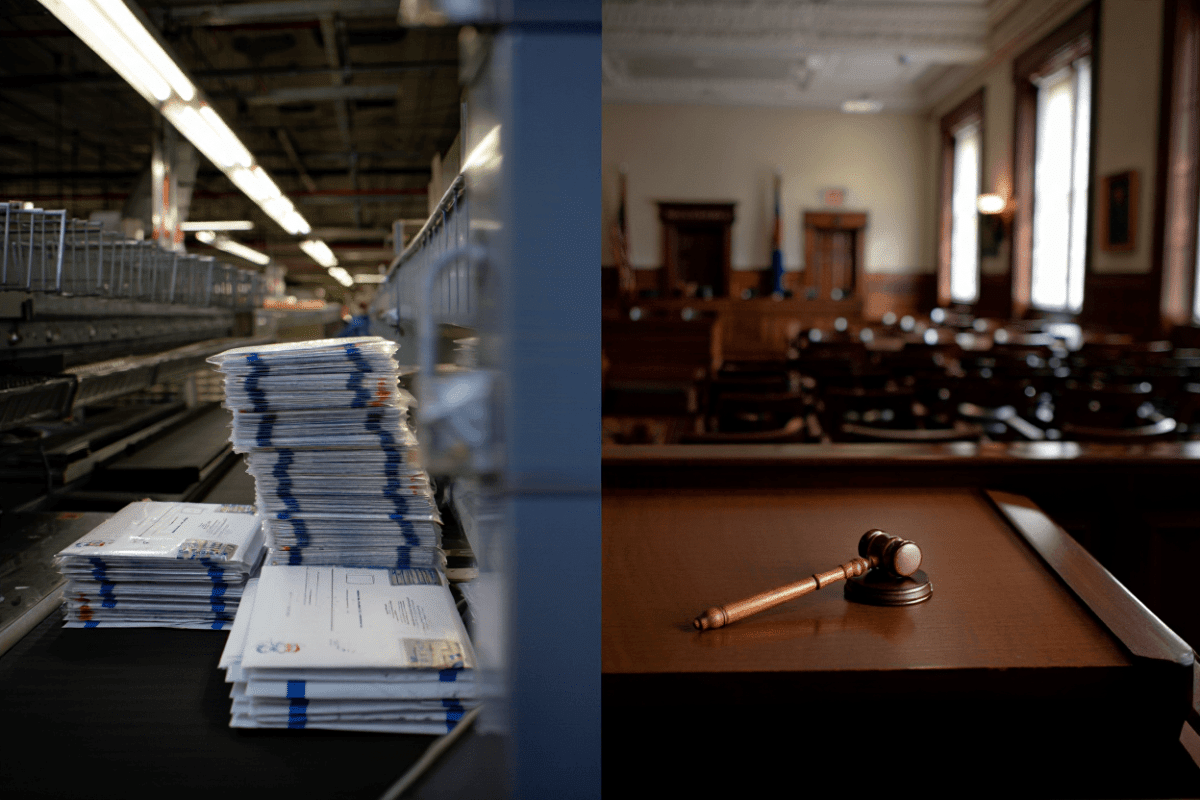
A federal appeals court on Friday allowed the U.S. Postal Service to move forward with proposed changes to its mail-in ballot procedures while legal challenges continue, marking a temporary victory for the Trump administration’s effort to restrict voting by mail ahead of the 2026 midterms. A three-judge panel of the D.C. Circuit Court of Appeals unanimously halted a lower court order that had blocked USPS from implementing the rule, finding the Postal Service made a “strong showing” it would likely succeed in its legal arguments.
The proposed rule stems from Trump’s March 2026 executive order directing USPS to propose a final rule by August 3 requiring states to submit lists of voters eligible to receive mail-in and absentee ballots, along with barcode information tied to those ballots. Under the proposal, USPS would use those lists to determine whether to transmit ballot mail. Postmaster General David Steiner confirmed earlier this month that the agency would not deliver mail-in ballots in states that refuse to hand over sensitive voter data to the Trump administration.
District Judge Emmet Sullivan had blocked the rule in early July, finding that Trump’s order was “designed to exert federal control over who in the United States may be sent a mail-in or absentee ballot in federal elections by the Postal Service.” The appeals court panel, however, credited USPS’s argument that it would suffer “irreparable harm” if unable to finalize and implement the rule before the November 2026 general election, writing that there “can be no do over” once the election occurs.
The NAACP challenged the rule in late June, arguing that the proposal violates a December 2021 settlement agreement reached after the organization sued USPS over mail delivery delays during the 2020 election. That settlement required USPS to “prioritize monitoring and timely delivery of election mail” through 2028. The appeals court panel found that USPS was likely to succeed on two key arguments: that the NAACP’s challenge was “not yet ripe for review” and that the proposed rule would not violate the settlement even if finalized.
The ruling provides only a partial victory for the Trump administration. A separate judge in Massachusetts, Judge Indira Talwani, blocked the underlying executive order itself in nearly two dozen states last month, finding that the directive infringed on states’ constitutional authority to regulate elections and that efforts to remove individuals from voter rolls were unconstitutional. That injunction remains in effect, preventing USPS from implementing the rule in those states regardless of Friday’s appeals court decision.
Voting rights advocates have warned that Trump’s rule could allow USPS to refuse delivery of ballots to eligible voters if they are not on approved lists or if states fail to comply with new federal requirements. The appeals court decision does not end the broader legal battle or determine whether the rule is ultimately lawful, but it gives USPS a temporary green light to continue moving toward finalizing the proposed rule while the appeal plays out. Friday’s decision signals that the Trump administration may be able to convince other appeals courts to allow implementation of the policy while lawsuits proceed through the courts, potentially past the November elections.
Sources
- The Hill — Appeals court ruling on Friday, three-judge D.C. Circuit panel decision, Judge Sullivan’s earlier block, Judge Talwani’s separate order in Massachusetts
- Democracy Docket — Details on appeals court decision, USPS arguments, NAACP settlement agreement violation claims, rule mechanics
- ABC News — Appeals court ruling, Postmaster General Steiner’s testimony, NAACP settlement background, separate Massachusetts injunction status