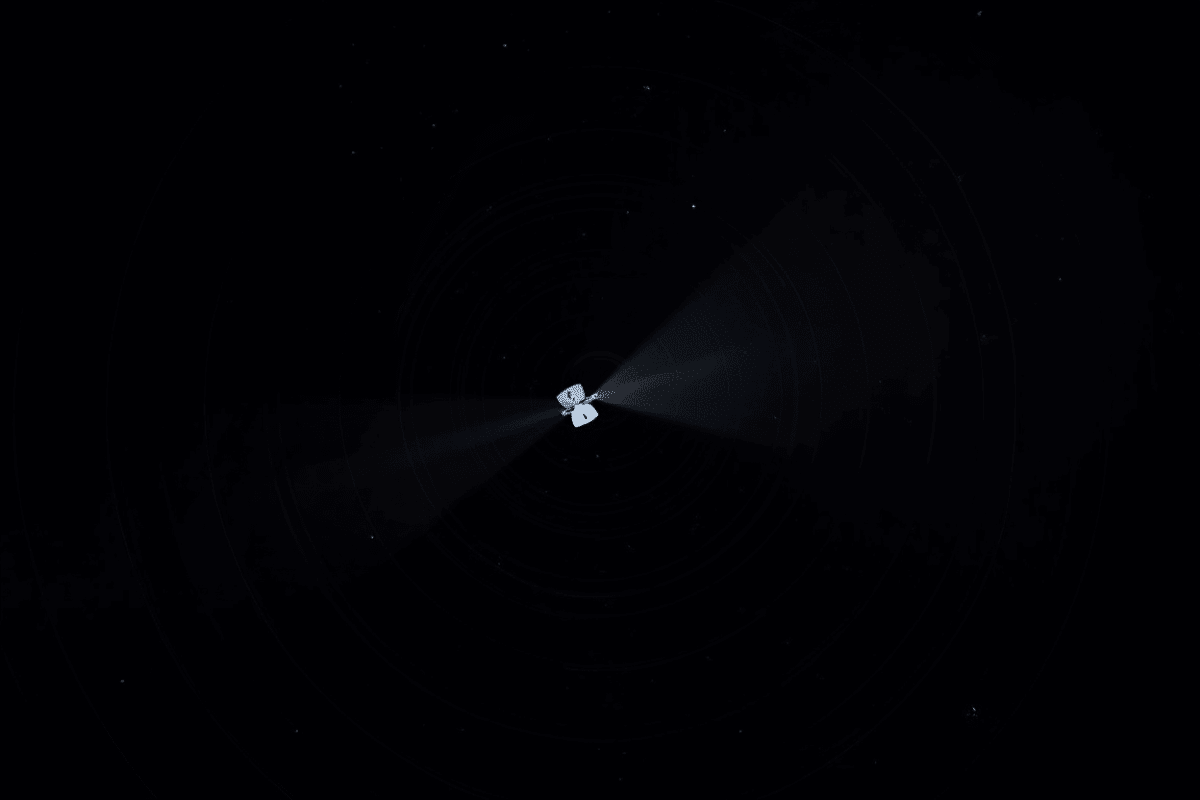
NASA’s New Horizons spacecraft has awakened from its longest hibernation period in nearly a year, emerging in good health after 321 days in sleep mode at a distance of approximately 5.9 billion miles from Earth deep in the Kuiper Belt. The spacecraft’s confirmation signal reached mission control at Johns Hopkins Applied Physics Laboratory on June 23, 2026, taking 8 hours and 52 minutes to traverse the solar system via NASA’s Deep Space Network station near Madrid, Spain.
Flight controllers at the Johns Hopkins Applied Physics Laboratory in Laurel, Maryland, confirmed the wake-up after New Horizons executed commands that had been uploaded to its main computer the previous July. The spacecraft reported back with a weekly status beacon throughout the hibernation period, with every single report marked “green,” indicating all systems remained operational, according to Alice Bowman, the New Horizons mission operations manager at APL.
The mission team regularly places New Horizons in hibernation mode during long cruise periods to conserve power and resources. While sleeping, the spacecraft does not receive new commands or transmit data to Earth, but it continues gathering information around the clock from its heliospheric plasma sensors, the Solar Wind at Pluto and Pluto Energetic Particle Spectrometer Science Investigation, and its Venetia Burney Student Dust Counter. The new hibernation wake-up marks the longest such rest period in the spacecraft’s two-decade history.
Now that New Horizons has resumed active operations, mission controllers will begin downlinking spacecraft health and safety data, followed by information from its three scientific instruments. Within approximately three weeks, the spacecraft’s Alice ultraviolet spectrograph will examine hydrogen gas distribution in the outer heliosphere, while its other sensors continue their measurements and the ground team conducts comprehensive spacecraft and instrument checkouts.
The mission team is also completing upgrades to ground-system software designed to make it easier to maintain operations of the distant spacecraft. New Horizons operates on updated autonomy logic designed for operations farther from the Sun and to accommodate the expected reduction in power and the naturally increasing radio-signal travel time as it ventures deeper into space.
NASA extended New Horizons’ operations through 2028 or 2029, when the spacecraft is expected to exit the Kuiper Belt. The spacecraft has already achieved historic milestones: it conducted the fastest launch on record in January 2006, flew past Jupiter in February 2007, became the first spacecraft to explore the Pluto system in July 2015, and reached the Kuiper Belt object Arrokoth in January 2019. Its continued exploration of the distant outer solar system represents the latest chapter in a journey that has redefined humanity’s understanding of the solar system’s far reaches.
Sources
- NASA Science — Official announcement of New Horizons wake-up from hibernation, confirmation signal timing, hibernation duration, spacecraft distance from Earth, and mission operations details
- Space.com — Confirmation of June 23, 2026 wake-up date, 321-day hibernation period, and spacecraft health status
- NASA Official Announcement — Extension of New Horizons operations through 2028-2029 and expected Kuiper Belt exit timeline