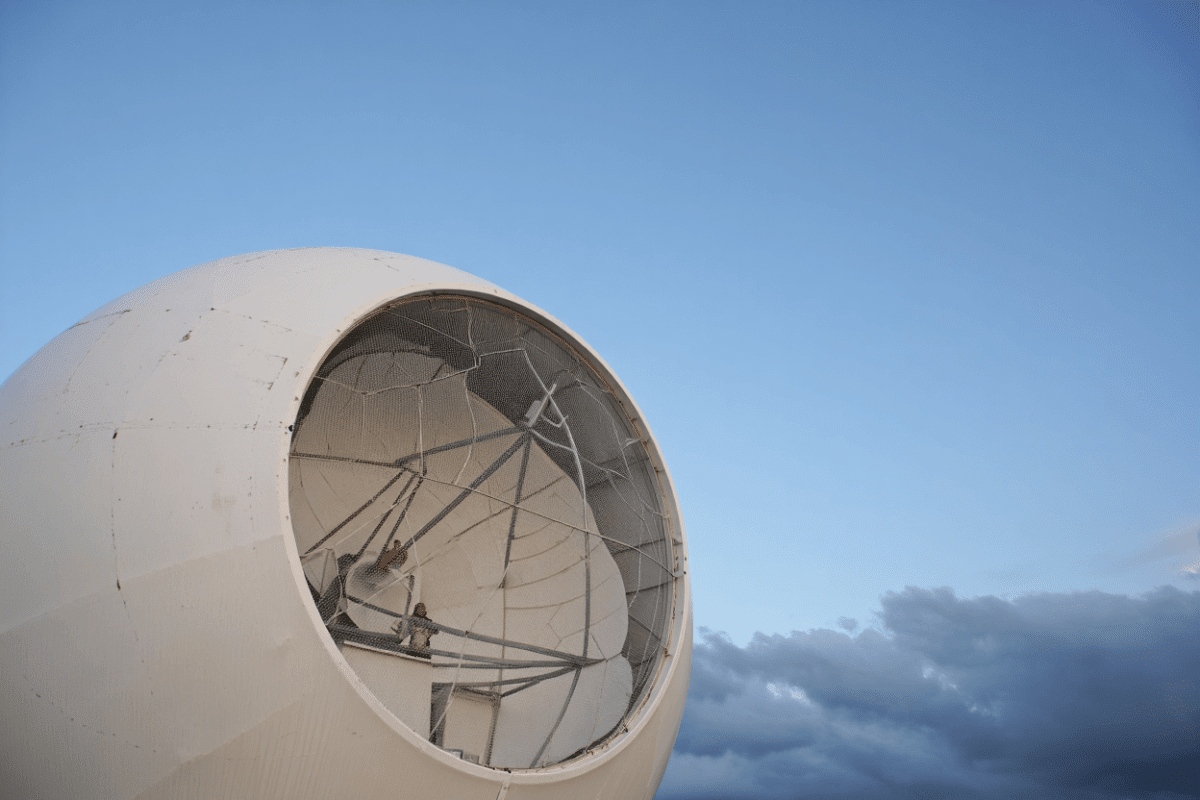
Klystron 9, Spectrum Bay News 9’s doppler radar system located in Pinellas Park, Florida, has been tracking Tampa Bay weather since 2001, providing hyperlocal forecasts and storm tracking for the region. The radar operates with 1 million watts of power and sends out 500 to 2,000 pulses per second, depending on its operational mode.
The system was launched on January 5, 2009, replacing the older Doppler 9000 and marking a significant technological upgrade for the station’s weather operations. The transition from the previous system’s Magnetron tube to a Klystron tube nearly tripled the radar’s power output, enabling more detailed storm analysis across the Tampa Bay area.
A key innovation of Klystron 9 is its dual-polarization capability, which allows the radar to conduct both vertical and horizontal scans of storm systems. When Klystron 9 debuted in 2009, it was one of the first five television radars in the United States to use dual-polarization technology. This dual-scan approach provides meteorologists with a much better understanding of precipitation type and can detect debris lofted in tornadoes or strong hurricanes, according to Spectrum Bay News 9’s meteorological team.
Doppler radar technology fundamentally improved weather forecasting by detecting the motion of precipitation and wind patterns within storms. According to the National Science Foundation, Doppler radar captures high-resolution data on precipitation and storm dynamics, improving the accuracy of severe weather warnings and forecasts. This capability allows meteorologists to identify rotation in thunderstorm clouds and measure wind strength and direction—critical information for tornado warnings and severe storm alerts.
In 2020, Klystron 9 underwent a major upgrade, with nearly all components replaced except the tower itself. The upgrade included a new Klystron tube, transmitter, receiver, and a larger antenna. A new radome—a dome structure that protects the radar’s working elements—was also constructed using a design first employed by the U.S. Navy. This improved radome design helps shed rain more efficiently, reducing the signal loss that occurs when heavy precipitation falls on the radar’s surface.
The radar’s detection range extends to 300 miles, though it will overshoot most storm cells at 200 miles except for tall severe thunderstorms. Data collected by the radar is sent to a computer facility in Huntsville, Alabama, where unwanted non-meteorological returns—such as birds, insects, and buildings—are filtered out through a machine-learning program. The cleaned data is returned to Spectrum Bay News 9’s weather center with only a 30-second delay, providing viewers with clear, real-time radar imagery on air and online.
Sources
- Spectrum Bay News 9 — Klystron 9 specifications, dual-polarization capabilities, and 2020 upgrade details
- National Science Foundation — Doppler radar’s role in improving severe weather warning accuracy
- NOAA — Doppler radar capabilities for detecting precipitation, rotation, and wind patterns
- Wikipedia — Klystron 9 launch date and technology overview