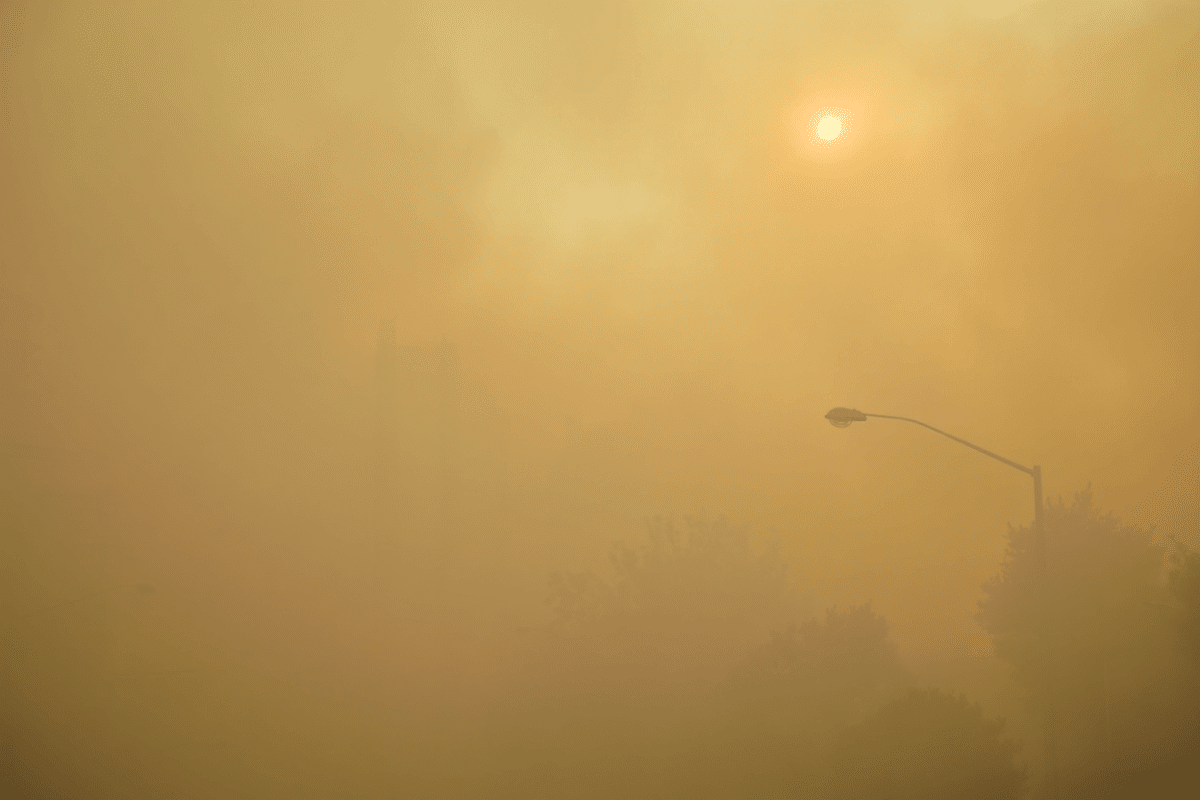
Connecticut’s air quality turned hazy on Wednesday as smoke from over 800 wildfires burning across Ontario and Quebec drifted into the state, triggering air quality alerts across the Northeast and limiting outdoor visibility and air conditions for sensitive groups.
An extensive plume of thick wildfire smoke has turned skies a milky, yellow-brown hue across New England, according to WBUR. The smoke, steered by jet stream winds acting as a massive funnel, traveled directly from Canada into the region, creating hazardous conditions that stretched from New York and Philadelphia down to the Great Lakes.
The air quality index in Boston spiked to around 130 on Wednesday morning, landing firmly in the “unhealthy for sensitive groups” category, according to WBUR. Connecticut’s Department of Energy and Environmental Protection issued an Air Quality Action Day, with the state’s official forecast showing “unhealthy for sensitive groups” conditions statewide on Wednesday.
Fine particles, known as PM2.5, form the core health concern. According to the EPA, these particles are respiratory irritants that can cause persistent coughing, phlegm, wheezing, and difficulty breathing. Research from Yale School of Public Health notes that fine particles can penetrate the respiratory tract and bloodstream, triggering oxidative stress and inflammation that can impair lung function and increase hospitalization risks for cardiorespiratory diseases.
A second wave of thick smoke is projected to push back into New England on Thursday afternoon, according to WBUR. The forecast predicts a deep corridor of very high smoke concentrations spreading across central and southern New England, with ground-level smoke increasing again Thursday afternoon and evening.
Connecticut has faced similar smoke events before. In 2023, Canadian wildfire smoke gave Connecticut’s skies an orange tint and pushed air quality to unhealthy levels across the state, according to the Connecticut Department of Energy and Environmental Protection. That event demonstrated how transnational wildfire smoke can repeatedly impact the region’s air quality.
Sources
- WBUR — air quality alert details, AQI readings, forecast timeline, smoke source location
- ABC News — wildfire count and scale
- CT.GOV (Connecticut Department of Energy and Environmental Protection) — state air quality forecast and 2023 precedent
- EPA (U.S. Environmental Protection Agency) — health effects of fine particles and PM2.5
- Yale School of Public Health — fine particle health impacts and mechanism