
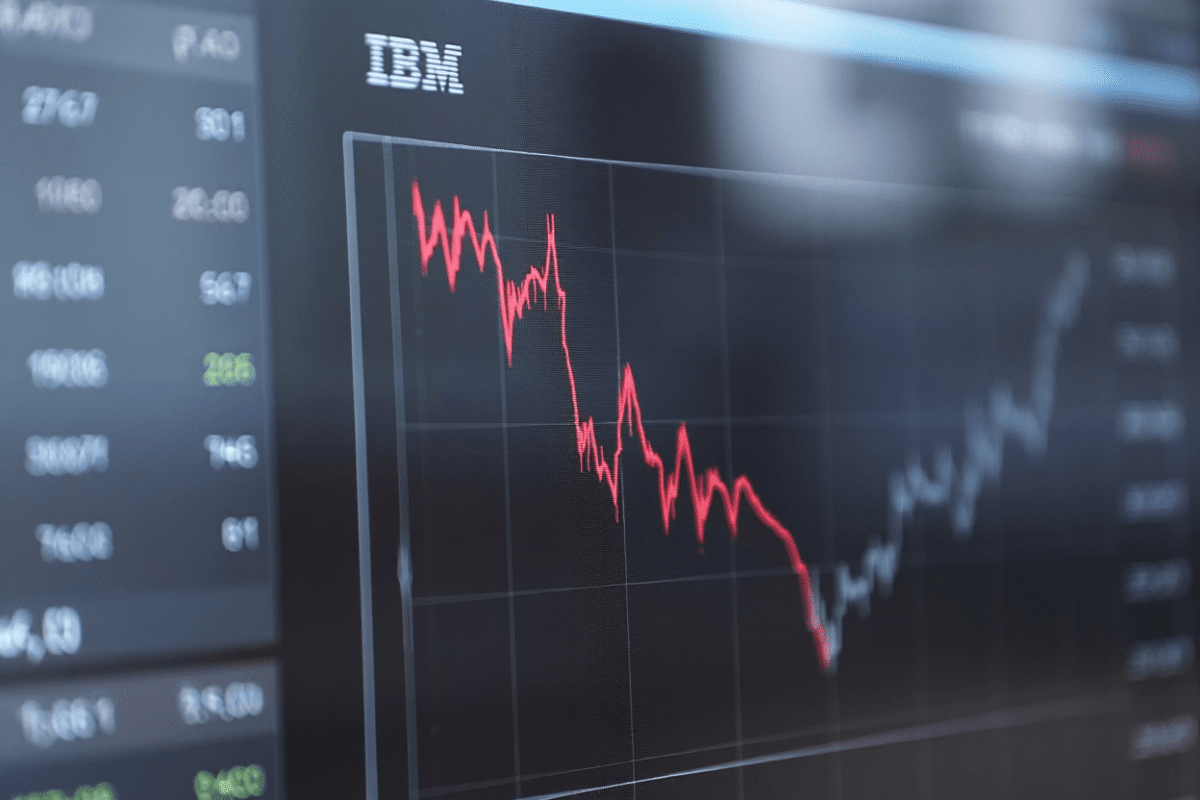
IBM stock plunged 25% on July 14, 2026, marking the tech giant’s worst trading day since the 1987 Black Monday crash, after the company issued a profit warning citing a sudden shift in customer spending toward AI servers and infrastructure.
The company reported preliminary second-quarter revenue of $17.2 billion, up just 1% year-over-year but well below analyst expectations of $17.8 billion. Infrastructure revenue fell 7% in the quarter, while software revenue rose 5%, according to the Financial Times.
CEO Arvind Krishna acknowledged the company’s failure to anticipate the magnitude of the shift, stating in a letter to investors that IBM “faltered” and did not adapt quickly enough. “We did not adapt and move quickly enough, and numerous large deals failed to close on the timelines we expected, driving the majority of our shortfall,” Krishna said, according to the Financial Times.
Customers redirected capital spending away from IBM’s software and mainframe products toward computing hardware such as servers, storage, and memory chips as they rushed to secure supply-constrained AI infrastructure ahead of expected price increases. Krishna told investors that customers had also been “distracted” by “rapidly evolving, industry-wide cyber security concerns.”
The stock’s decline erased approximately $68 billion in market value in a single session, according to LinkedIn. The closing price of $217.05 represented IBM’s steepest single-day loss since at least 1972, surpassing the 23.7% drop the stock suffered on Black Monday, October 19, 1987, according to CNN and the Wall Street Journal.
The earnings miss reflects a broader challenge facing IBM as it attempts to transition from a company known for mainframes and hardware into a software-focused business. Despite spending tens of billions on acquisitions including Red Hat, HashiCorp, and Confluent to strengthen its software portfolio, IBM is now contending with an AI investment cycle that is funneling corporate budgets toward computing infrastructure rather than software.
The warning signals the durability challenges facing established software businesses in an era of intense AI infrastructure spending. When comparable disruptions hit the tech sector in the past, recoveries have varied widely. The broader market’s ability to absorb such shocks has improved significantly since 1987, when circuit breakers and trading halts were not yet in place to prevent panic selling.
Sources
- Financial Times — IBM’s profit warning, customer shift to AI infrastructure, CEO Krishna’s statement that the company “faltered”
- CNBC — Q2 revenue of $17.2 billion, adjusted earnings of $2.93 per share (vs. analyst forecast of $3.01), stock decline of 25%
- Bloomberg — IBM shares plummeted as much as 26%, on track for biggest one-day drop since at least 1968
- Reuters — Q2 revenue forecast of $17.2 billion vs. analyst estimate of $17.86 billion, infrastructure revenue decline of 7%
- CNN — IBM’s worst day in premarket trading compared to Black Monday 1987 (23.7% fall)
- Yahoo Finance — Infrastructure revenue fell 7%, software revenue rose 5%, earnings per share fell 2% to $2.27
- LinkedIn — IBM’s worst single-day drop in decades, erasing ~$68 billion in market value
- Wall Street Journal — IBM stock headed for worst day since Black Monday 1987










