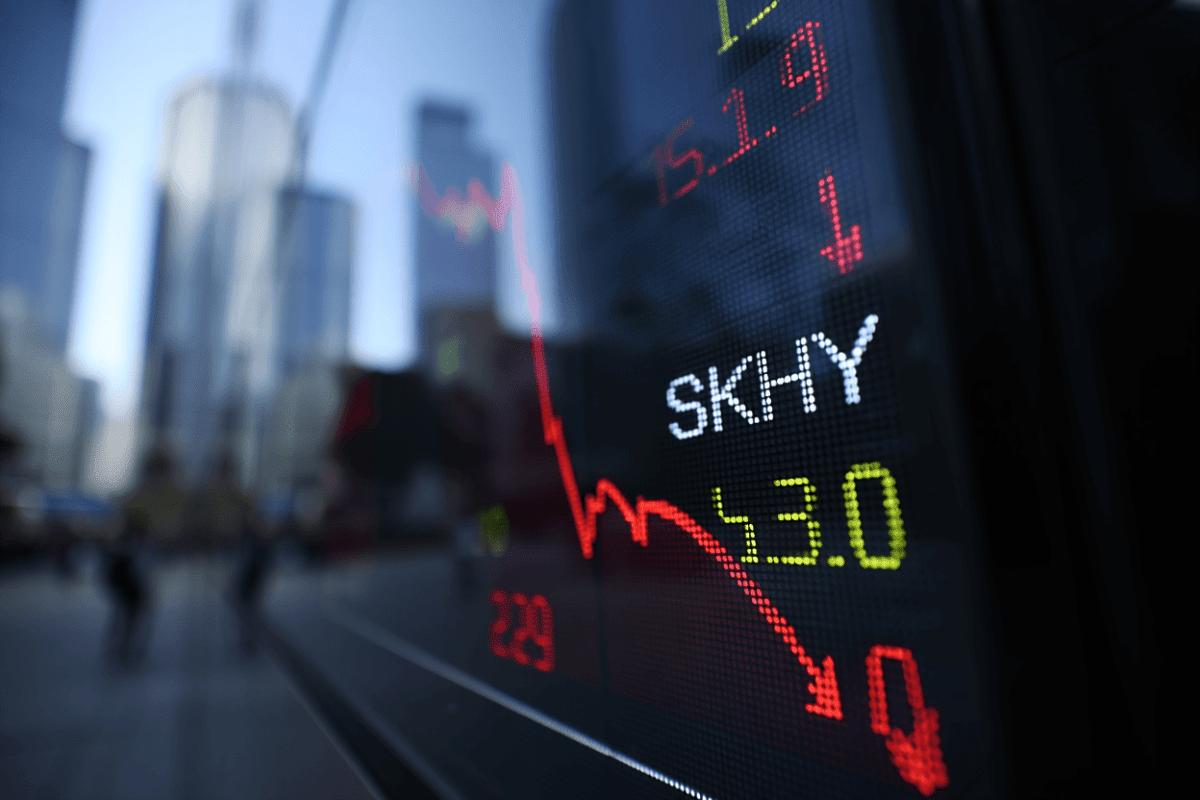
SK Hynix stock plunged 15% in Seoul on Monday, marking its biggest one-day decline on record, as investors booked profits following the South Korean chipmaker’s blockbuster Nasdaq debut just days earlier.
The memory-chip giant raised $26.5 billion last week, selling American Depositary Receipts at $149 each. The ADRs opened 14% above the offer price on July 10 and closed their first trading day up 12.8% at $168.01, signaling strong U.S. investor appetite for the AI-focused semiconductor maker.
But the Seoul rally reversed sharply on Monday. SK Hynix’s shares, which had more than tripled in 2026 before the listing, fell 15.4% to close at 1,845,000 won. The decline dragged down South Korea’s broader market; the Kospi index plunged 9%, triggering a 20-minute trading halt, according to Reuters.
Ryu Young-ho, a senior analyst at NH Investment & Securities, told Reuters that investors were profit-taking after the conclusion of the U.S. listing. But sentiment also suffered from caution regarding SK Hynix’s second-quarter earnings. “Investors had expected shipments of SK Hynix’s HBM4 chips to increase from the second quarter, but that the increase does not appear to have materialised at scale,” Ryu said, according to Reuters.
Ryu also noted that investors moderated earnings expectations because SK Hynix, with its greater exposure to the HBM market than rival Samsung Electronics, was set to benefit less from a recent rise in prices for conventional DRAM chips. SK Hynix led the market for high-bandwidth memory chips with a 58% revenue share in the first quarter, according to Counterpoint Research data cited by Reuters.
Lorraine Tan, a director at Morningstar, told Reuters that while “the current memory upcycle is tracking substantially stronger than expected,” the base case “continues to assume normalisation in cycle dynamics, limiting upside at current levels.” She values the company at $160 per ADR. Tan also highlighted concerns about AI monetisation uncertainty and pressure on profitability for key players like OpenAI, raising questions about the sustainability of current spending levels.
The divergence between U.S. and Seoul prices widened after the rout. SK Hynix’s U.S. ADRs, which represent one-tenth of a share and closed at $168 on Friday, were left trading at about a 37% premium to its South Korean share price by Monday’s close, according to Reuters. James Ooi, a market strategist at Tiger Brokers in Singapore, noted that companies with both U.S. and home-market listings often trade at a premium in the U.S. due to broader investor access and deeper liquidity, though arbitrage is limited by hurdles in converting Korean shares to ADRs.
Volatility in SK Hynix shares has surged throughout 2026 as the stock became a target of global investors betting on sustained profits from a shortage of high-bandwidth memory chips used in AI data centres. In Hong Kong, a single-stock leveraged ETF tracking SK Hynix lost more than a third of its value on Monday, its biggest one-day decline since listing in October, according to Reuters.
Sources
- Reuters — SK Hynix’s 15% Seoul decline, Kospi plunge, analyst commentary from Ryu Young-ho, Morningstar’s Lorraine Tan valuation and earnings concerns, trading premium data, and Hong Kong ETF losses
- CNBC — SK Hynix Nasdaq debut details: 13% first-day gain, $168.01 closing price, $26.5 billion raise
- Bloomberg — SK Hynix shares dropped in Seoul after Nasdaq debut, earnings optimism concerns
- Nikkei Asia — SK Hynix share price closed down 15.4% at 1,845,000 won
- Counterpoint Research — SK Hynix 58% HBM revenue share in Q1 2026