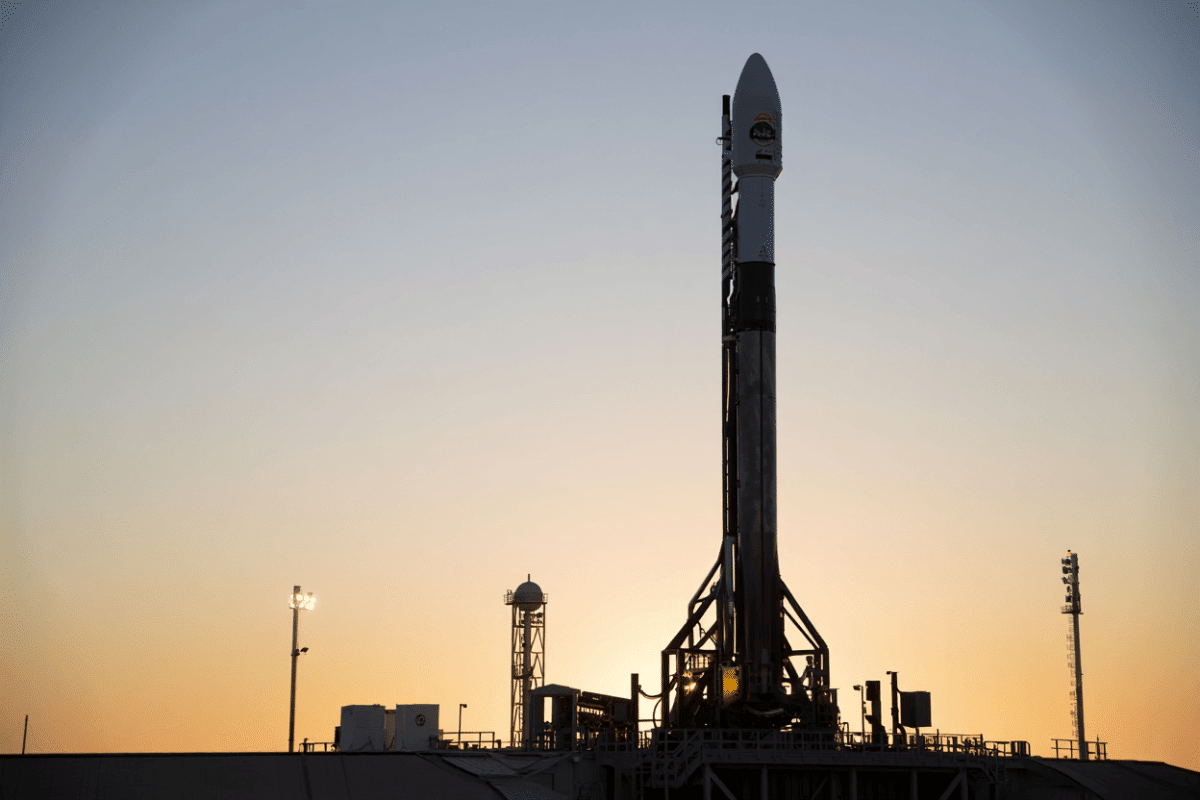
SpaceX’s Falcon 9 is set to launch 29 Starlink satellites from Cape Canaveral on July 5, 2026, carrying the company’s expanding broadband internet constellation to low Earth orbit alongside an unusual cargo of semiconductor manufacturing test equipment.
The Starlink 10-50 mission is scheduled to lift off at 6:46 a.m. EDT (3:46 a.m. PDT) from Space Launch Complex 40 at Cape Canaveral Space Force Station, according to Spaceflight Now. The Space Force predicted an 85 percent chance of favorable weather for launch.
Beyond the 29 Starlink v2 Mini satellites, the Falcon 9 first-stage booster will carry two prototype semiconductor manufacturing pods for Washington, D.C.-based startup Besxar Space Industries on an eight-minute, 19-second sub-orbital flight, according to Spaceflight Now. The pods, called ‘Clipper Class’ Fabships, are about the size of a microwave oven and will test space-based substrate and precursor material manufacturing for semiconductors.
Besxar Space Industries CEO Ashley Pilipiszyn said in a previous statement that “we’re reaching the limits of what can be built on Earth. AI data centers are straining against power and cooling limits, silicon is nearing its physical edge, and fabrication plants can’t achieve the vacuum or yields that next-generation materials demand.” The company booked 12 Falcon 9 flights in October 2025 to test its manufacturing process in the vacuum of space.
Starlink is the world’s first and largest satellite mega-constellation, using low Earth orbit to deliver broadband internet capable of supporting streaming, online gaming, and video calls, according to Starlink’s technology page. As of June 2026, the network consisted of approximately 10,413 satellites in low Earth orbit, with about 10,397 operational, according to Space.com.
This launch marks SpaceX’s 62nd Starlink delivery mission of 2026, demonstrating the company’s accelerated deployment schedule for expanding global internet coverage. The Falcon 9 rocket is the world’s first orbital-class reusable rocket, allowing SpaceX to reflew the most expensive parts of the vehicle and reduce the cost of space access. Deployment of the Starlink satellites is scheduled to occur one hour, three minutes, and 31 seconds after launch, according to Spaceflight Now.
Sources
- Spaceflight Now — Starlink 10-50 mission details, launch time, weather forecast, and Besxar Space Industries payload information
- Starlink (official) — Description of Starlink as a low Earth orbit satellite constellation for broadband internet
- Space.com — Starlink constellation size as of June 2026 (10,413 satellites, 10,397 operational)
- SpaceX (official) — Falcon 9 reusability and cost reduction information