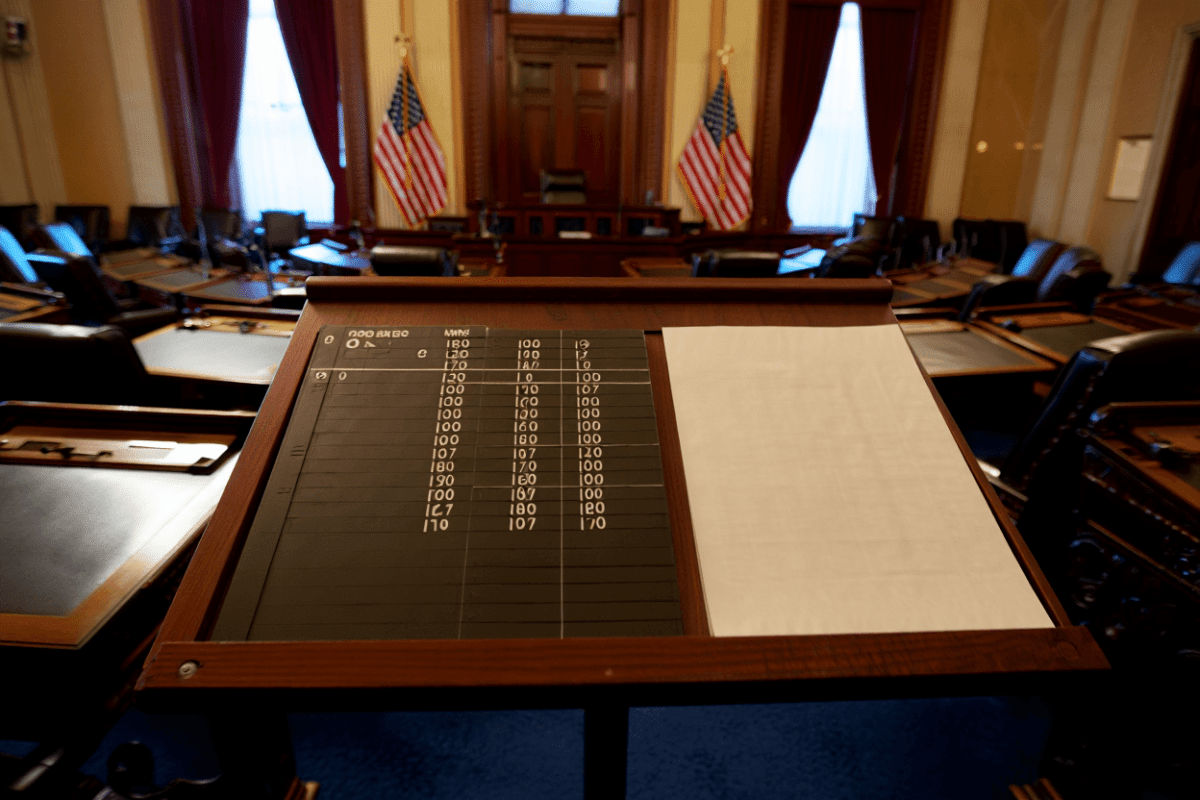
The Senate approved a war powers resolution on Iran on Tuesday, voting 50-48 to adopt a House-passed measure that marks the first time Congress has unified behind a directive to limit Trump’s military authority in the conflict. Four Republicans—Susan Collins of Maine, Lisa Murkowski of Alaska, Bill Cassidy of Louisiana, and Rand Paul of Kentucky—joined all but one Democrat to deliver the rebuke, while Pennsylvania Democrat John Fetterman cast the sole Democratic vote against it.
The resolution directs President Trump to remove U.S. armed forces from hostilities against Iran unless Congress declares war or explicitly authorizes military force. Because it is a concurrent resolution, it does not require the president’s signature and carries no binding legal force, making it largely symbolic despite its historic passage through both chambers.
Tuesday’s vote was the tenth time the Senate has attempted to rein in Trump on Iran since the conflict began in late February 2026. The House passed the same measure on June 3 by a vote of 215-208, with four Republicans breaking ranks to join Democrats. The Senate’s passage marks a turning point after months of failed attempts to build sufficient bipartisan support.
The measure’s success was enabled in part by two absent Republicans: Mitch McConnell of Kentucky, who was hospitalized last week, and Dave McCormick of Pennsylvania. Neither senator had supported previous war powers resolutions, according to reporting from The Guardian, suggesting their absence tipped the balance in favor of passage.
Support for the Iran war has eroded significantly among the American public. A Reuters/Ipsos poll released Tuesday found that only 23 percent of Americans believed the United States was stronger because of the conflict with Iran, and nearly two-thirds thought any truce with Tehran was unlikely to last, according to The Guardian. The resolution’s passage reflects growing GOP discomfort with a conflict that has become unpopular ahead of the November midterm elections, when Republicans will be defending their control of Congress.
Senate Minority Leader Chuck Schumer, a New York Democrat, urged Republicans to act before the vote. “Republicans can complain about Trump’s war, his secrecy and his disastrous deal with Iran all they want behind closed doors,” he said. “But the only way to ensure this war ends once and for all is for Republicans to act.” Greg Meeks, the top Democrat on the House Foreign Affairs Committee and sponsor of the resolution, said in a statement he would “explore all legal avenues to ensure the executive complies with the will of Congress.”
The resolution comes after Trump dispatched Vice President JD Vance to Switzerland to negotiate a settlement that would resolve the conflict the U.S. began alongside Israel in February. Trump and his Republican allies have questioned the constitutionality of the 1973 War Powers Act under which the resolution was passed. The War Powers Act requires presidents to notify Congress within 48 hours of committing armed forces to military action and generally prohibits armed forces from remaining in hostilities for more than 60 days without congressional authorization.
Sources
- CNN — Senate vote count (50-48), Republican votes, concurrent resolution status, tenth Senate vote count
- The Guardian — Republican senators voting yes, Fetterman vote, first time both chambers passed measure, public polling data, McConnell and McCormick absences, Schumer and Meeks statements
- CBS News — Senate vote details, Republican and Democratic votes, concurrent resolution explanation, House passage vote (215-208), Senate vote history
- NPR — House passage vote count and Republican support